My Saxon lyre played by the wind in Manzanita Bay.
Tag: washington
Over the bleak whale-road

A bewildered Grebe in a punk hair-do ducks under the lightly rippled, gray surface of Eagle Harbor as we steam past the green buoy marking the channel. Old Hand heels sharply to port in a sudden gust as the honk of the Bainbridge/Seattle ferry echos over the rolling hills of Eagledale.
It’s Spring, season of departures; when we succumb to the age-old lure of quest, and deeds of heroism, tragedy or folly are undertaken. They are the stuff of legend, of epic voyages recounted around the galley table by dreamy minstrels or aged salts over a pint. Something in us is forever departing along the imaginal meridians vaguely descried in youth, over the bleak whale-roads of yore.
There’s Agamemnon’s dramatic farewell and foul sacrifice for a fair breeze toward windy Troy. Oaths hurled into the spray are drowned by the weazy bellows of a fake northerly gale. A sword held against a blood-red sky by a masked tragedienne brings down the threadbare curtain. It is the ritual re- enactment of the primal leave-taking, when carved gods brooded from the bowsprit, holding vigilant watch while we set out toward the golden isle of dreams.
I too, have sat hungry around those ancestral fires, a villan, hero or common swab, subject to the changeable turns of an unswerving fate.
I haul the main halyards as the mainsail flaps in the freshening breeze. Old Hand hesitates, like a portly dowager lifting her skirts before a pier-head jump, and falls off on a starboard tack toward the red buoy that marks the southern extent of Tyee Shoal.
We hear melodious calls to haul away in the pump shanty’s that float over the troubled waters of time- a theme that has lifted the spirit of land-lubber and salt throughout the ages.
In Watteau’s painterly celebration of leave-taking, Voyage to Citheria, we see jaded gentry waltzing down a winding path to a moored lighter bound toward the Arcadian isle.

Courses drawn on a yellowed, dog-eared chart mark the departures and arrivals that make up the saga of Old Hand. She recedes forever like a fog-bound light, into the theatical haze of memory.
What am I departing from? I set out before dawn, with only my own noisy mind as mate. The Captain, asleep below, will soon ascend the companionway stairs, glare at the rising swell, shout imperious commands like Gregory Peck, and set the unsteady keel of this narrative on a true course toward an imaginary landfall. He is the guiding spirit of this voyage, a horn-fisted old coot named Saturnius McWhirr.
Chop wood,carry on


Its been very lovely in Port Madison this Spring. I’ve been regrouping after putting up the art show, taking stock and redirecting energy toward simpler things like chopping wood. We are talking serious wood chopping.
The building is a workshop built by Ed Monk. I’ve been privileged to Moor Old Hand at this historic site, built by one of the Northwest’s finest boat designers. I feel his presence in the stoutly built out- buildings and docks, and gladdened by the thought that, he too, hauled gear and materials up and down the steep path to the water. His can-do spirit inspires my humble efforts, and I take extra care in the stacking of split maple and cedar. This stacking is itself, an art.
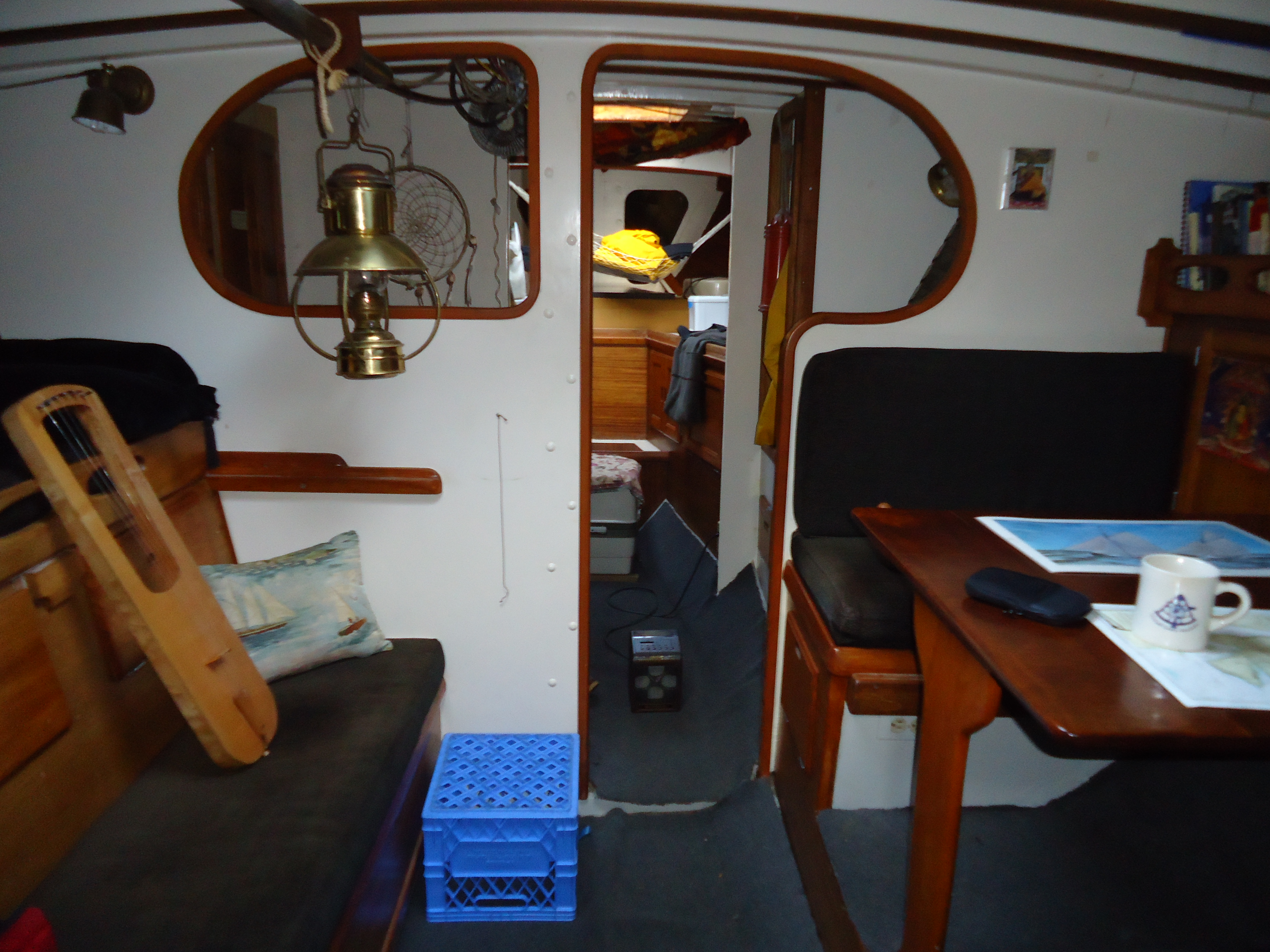
At first, I was unimpressed by Monk’s designs. But as I worked on his boat-houses I came to see his ubiquitous, wooden power cruisers in a new light.
I find rusty, bent shipwright tools near Monk’s shop, and use an old, weathered workbench he made. After the long preparation for the exhibit, this physical connection with common objects that surrounded his life has inspired in me an appreciation for the simple aesthetic of usefulness.
My boat, Old Hand is not a Monk, but was built of such stuff. Her portly hull design is a scaled-down version of the hefty Norwegian lifeboats designed by Colin Archer. After 10 years of owning her I’ve greater appreciation for her ponderous lines and stout workmanship . So I am readying for another season of sailing. I look at tide tables and plot course South toward Old Hand’s first port of call: Gig Harbor.
So stay tuned for posts chronicling these adventures on the Salish Sea told in art, music and videos.
Artwork in progress-a look back

Here’s an installation photo from my show. It’s good to get it done. Now I can move on to other things. Like gardening, chopping wood, and writing blog posts again.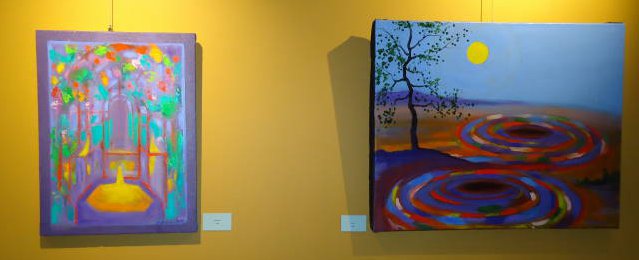
Putting up a show is always a double-edged thing. There’s the excitement and sense of accomplishment, but it’s also something of a let down in the end. It’s a summation, of sorts, a statement of where I’ve arrived at this point in time, life and career. It’s strange to think I did my first oil painting 50 years ago. I thought of showing this painting too, but couldn’t hang it without a little more work on it. Would this be cheating?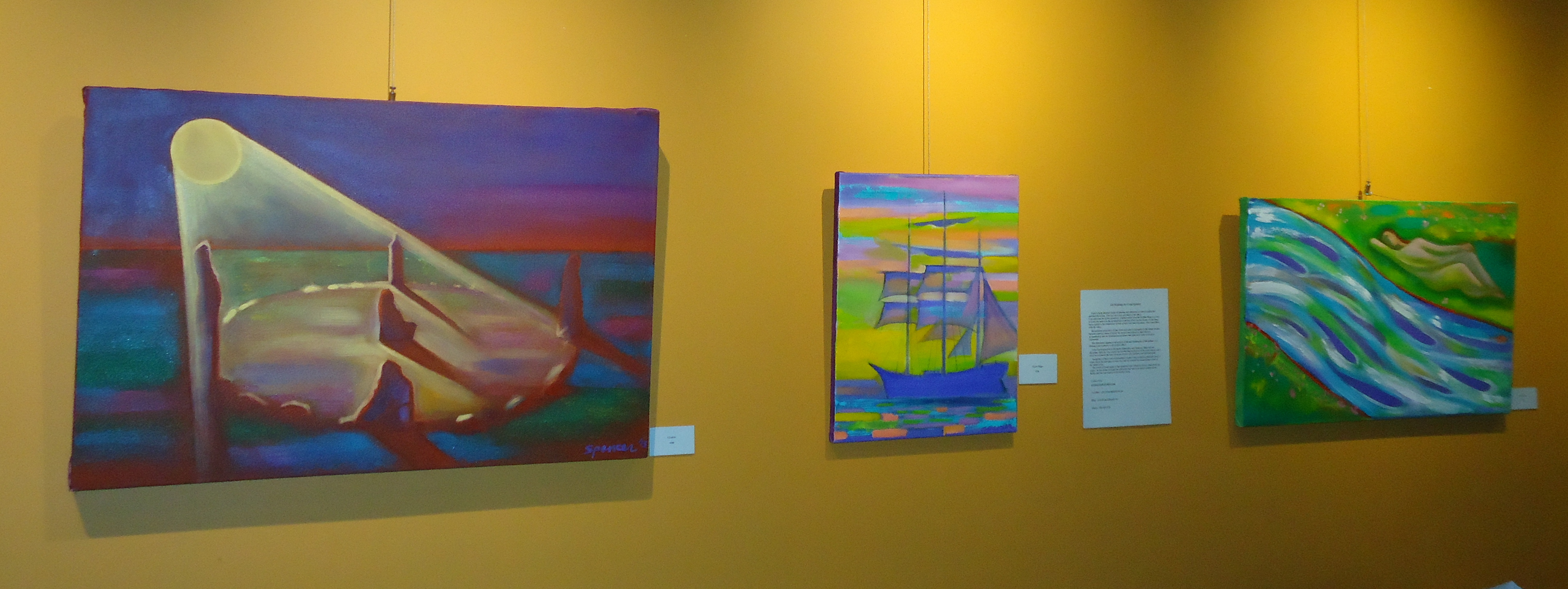
Last touch up for April art exhibit
Here are some paintings I’ve been finishing for my art exhibit this month. I’ve been too busy getting them ready to find time for a blog post.
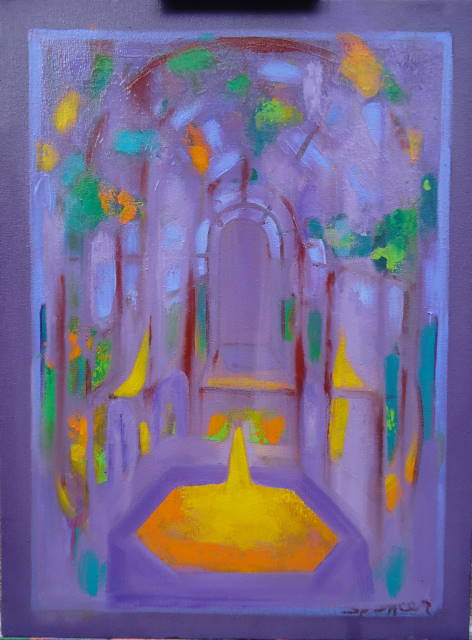
The Sufi Shrine has been a real challange, but I believe I pulled it out at the last minute.

The Sleeping Poet (not sure of title) has a long history as well. It was inspired by a medieval poem called the Pearl-a pious allegory where the poet falls into a dream by a beautiful river bank. I’m not usually into allegory-especially pious ones-but something about this story has grabbed me ever since reading it (and memorizing some) 20 years ago.

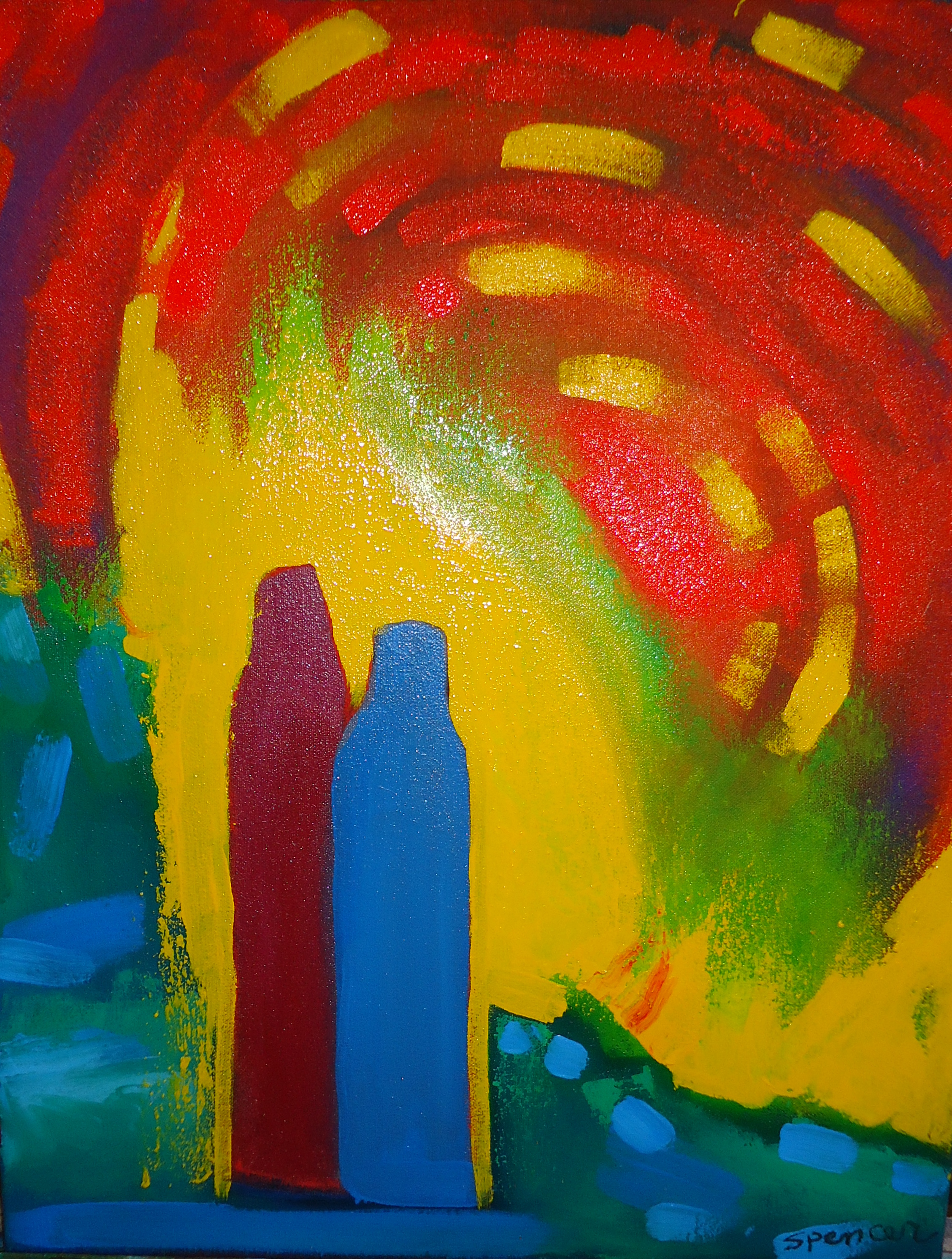
The Square Rigger is my latest, unfinished painting. It evokes an earlier time of Port Madison history. She emerges from the sunset mists like a ghostly presence.
Here is my version of Dante’s Inferno. I’ve been listening to a recording of the Divine Comedy while getting ready for this show.
An Artwork in Progress-A Cinderella Tale
 My boots are heavy with the soil of Thatcher Farm. This is the foundation from which I begin this homage to a hallowed place, and invoke the Genius Loci of the old harbor community I’ve come to call home. Among last year’s pumpkin vines I sift the refuse of common household
  objects. To ground this narrative I reach across time and make contact with the elders through the humble detritus of everyday life. I touch cup fragments once held in living hands around the faded embers of the ancestral hearth.

There is also the secret record. It’s a spiritual history that, some say, dates back to the Rosicrucians, who preserved the remnants of Solomon’s wisdom. But we must forego linear chronology to enter the transhistorical and poetic record of events that transpire in the soul.
Just down the road is Kane Cemetery.
Many of the headstones of Port Madison’s founders are inscribed with Masonic symbols. This secret society played a major role in much of Port Madison’s early cultural and artistic history. The Kane No. 8 Masonic Lodge Hall was situated on a dock in the town center. It was said that Edwin Booth performed there. I can’t verify this, but a world where the great actor brought his melodious interpretation of the Melancholy Dane to sleepy Port Madison is a world I prefer to live in. He did perform in Oregon territory.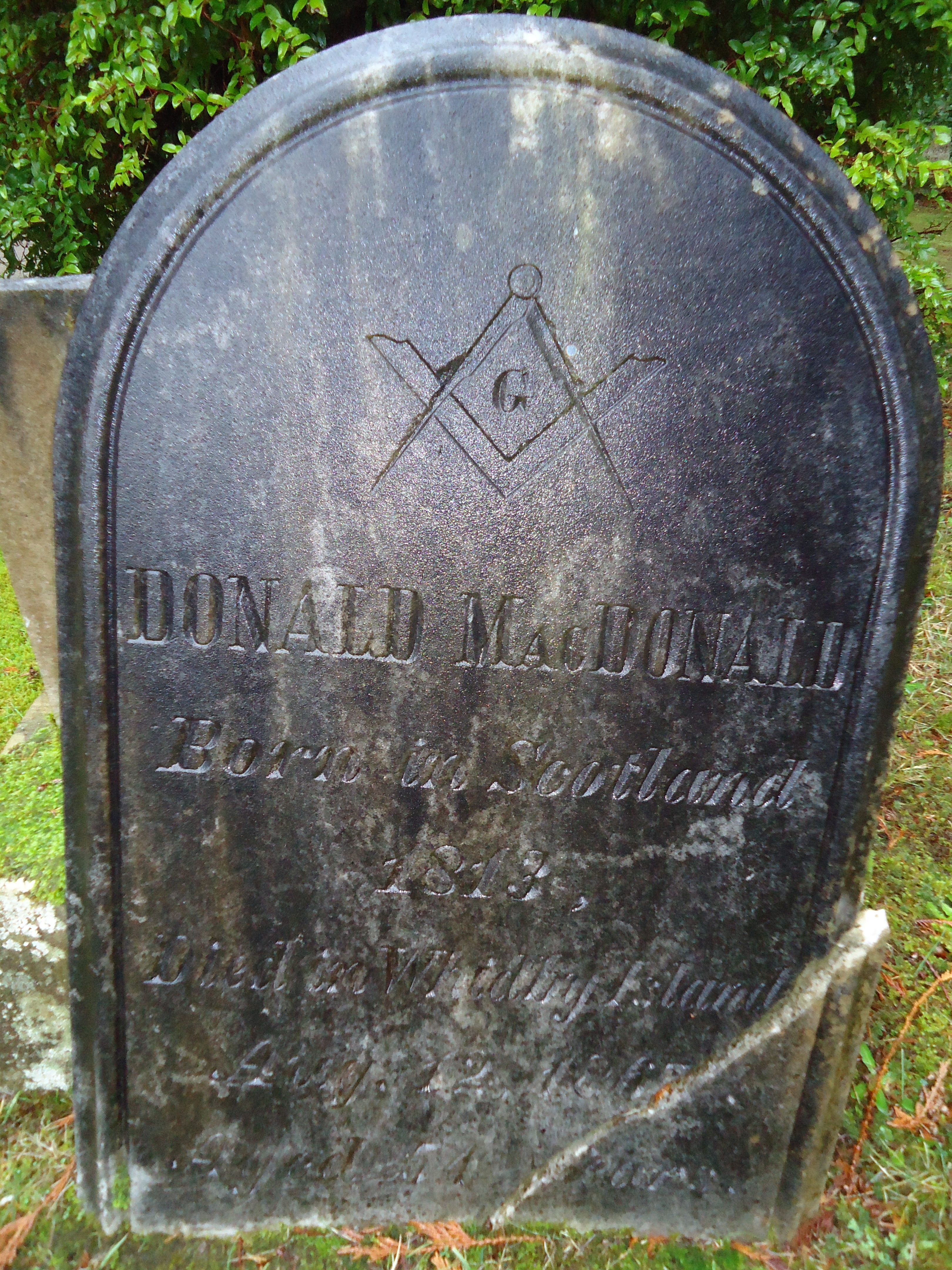

I read of a production of Cinderella staged by the MacDonald sisters in the Hall. I find the choice of this particular tale for the entertainment and edification of the community significant. It was, for a time in the mid 19th Century, the myth which inspired the rough and tumble loggers and mill hands toward loftier goals than decimating forests, whoring and drinking. A wild west mill town staged a pageant honoring the Anima. “The Anima of man,” writes Jung, “has a strongly historical character. As a personification of the unconscious she goes back into prehistory…she provides the individual with those elements that he ought to know about his prehistory.”
The curtain rises on a poor maid covered in ashes. She fans the faded embers of a secret tradition based on humility and good works, preserving in the vestal flame an esoteric knowledge of salvation.
Jacob Boheme says : “The inner light is the natural ascent of the spirit within us which at last illuminates and transfigures those who tend it.” She ascends by degrees (symbolized by her changes of clothes) to her royal estate and abides among the envoys of supernal light. Swedenborg, in his Concordance, says that shoes correspond with the lowest natural things and that beautiful shoes symbolize the delight of making oneself useful. This has long been the Freemason’s credo. She teaches us that we are exalted through selfless servitude. Her lost shoe forms a link between her role as humble servant and her radiant heavenly counterpart. This ascension provides a model for the spiritual adept. Perhaps these mysterious changes of raiment are reflected in the robes of office and pageantry of Masonic Rites.
Lost in these speculations, I return to till the soil. Maybe I’ll find more spiritual artifacts or the way to elevate this arcane history by tilling the rich soil of good works.
An artwork in progress-Port Madison Reverie

Reflections of brilliant red kayaks fall vertically into the mud off Reah’s dock . The gray water stretches toward steep soundings off Jefferson Head and a fitful northerly brightens the harbor entrance with catspaws . An ancient tug nudges a barge off Meig’s old mill site, while the sqwak of a blue heron echoes from tall cedars veiled in ghostly fog. The fog creates vast space by removing nearby objects beyond this present time to maroon me with only my dark thoughts. A little mystery by way of atmospheric perspective.

Strange to think how the population of this quiet port dwarfed Seattle in the mid 19th Century, when Meig’s mill belched acrid smoke into the northwest gloom and the west shore shipyard built lumber schooners for the coast trade. Then, the steam side wheeler’s whistle sounded along these shores. Venerable tugs like the Politkovsky, brought passengers, mail and logs to the hearty inhabitants of a thriving boomtown built with the lumber milled for distant ports. The long history of this now peaceful anchorage holds some dirty secrets- like when Meigs suddenly fired all Chinese workers or used trickery to monopolize the mosquito fleet, the main form of transport on Bainbridge Island.
I’ve taken a break from painting to work at Thatcher Farm. My art work has long tended toward abstraction (the term is used loosely since my work is figurative) and I needed connection with our ancestral earth to ground my mercurial mind. Speaking of Mercury, it seems significant that Thatcher farm was the main switchboard for Island communications for much of the 20th Century.
So now I’m sending out a communique into an ever expanding cyber network where few have time for an old sailor’s questionable yarn. Among crockery shards I disinter rusty hinges for a gate that opens into another time. How many have turned this soil over the centuries, have pulled crabgrass, hacked blackberry vines into submission and bent hoe blades on this weathered rock? I till midden heaps of kitchen ware and toss rocks into a plastic bucket with a loud, dull thunk!.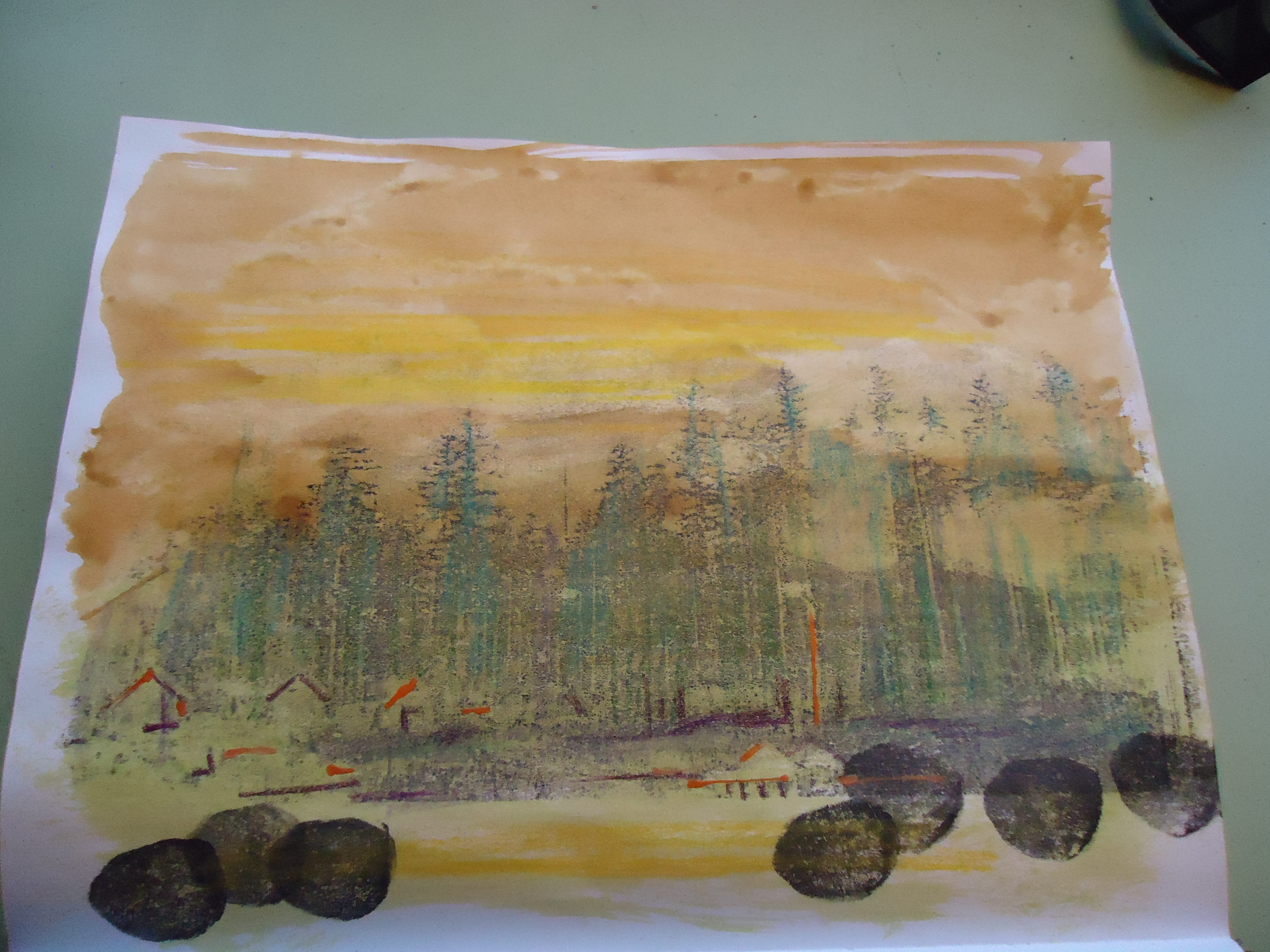
Under golden maples that sway over the harbor entrance, a cemetery holds the remains of Port Madison’s founders. Here I came upon a stone bearing this simple elegy:
…Gallieau, 1905-2005, Lost at Sea
What an epic sea romance is encapsulated in this terse inscription! Would that my own humble literary efforts were enlivened by such economy and expressiveness. I see Gallieau as a Conradian swab on a lumber schooner bound for Frisco after the big quake, or an ancient mariner going down for the last time off Foulweather Bluff in a squall. May he rest in peace.
 A View from the Wheelhouse