Posted in Euphrates Voyage, Saturnius McWhirr stories

Mesopotamia Voyage 3–Osman

“What is the greatest virtue a steam man may have to best fulfill his role?“ The Professor was already going strong before my foot touched the last wrung of the companionway ladder into the engine room.

“I don’t know.”

“A steam man’s greatest virtue is reason and moderation”

“I’m no wiz at math, but that sounds like two virtues to me.”

Budge, unhearing, went on:

“The three essential elements of the steam man’s art is fire, water and air. Only the most equitable balance between them ensures safe operation; and therefore an auspicious outcome to our common endeavor. And what is our common endeavor?”

“To not be blown to smitherines?”

“Yes, for one. And our number one priority.” He went to his blackboard and drew a pyramid.

“The harmonious disposition of the three elements, fire, water and air, is essential for a well-ordered steam engine. These three elements form an equilateral triangle with air at the apex. The dynamic between them produces the miraculous, fourth element, steam.” At the last word, he hit the blackboard so hard the chalk broke. “What would you say is an analogous model in other aspects of life?”

“You have me there Mister Budge.”

“A corresponding relationship exists in the three parts of the human soul: the calculating nature, the spirited nature, and the grasping nature—appetite. Just as the equitable disposition of air, Fire and Water creates the conditions to fuel our ship, so the harmonious accord of the three parts of soul; each doing their part in the appropriate measure and time, ensures the success of our collective enterprise. But it’s essential that all parts be ruled over by the faculty of reason. Disequilibrium among the parts—or elements—would spell disaster.” Here he erased the triangle with a dramatic flourish.

“Mister Spencer, report topside. We are approaching the station. Prepare to take on a passenger.”

I went into the wheelhouse as we neared the wharf. McWhirr said: “He’s a big shot named Osman Hamdi Bey, director of the Imperial Ottoman Museum. Word is, he’s been a royal pain in the arse in getting authorization for the Dig at Nippur—a real stickler for rules. His reputation for obstinacy is well known to the trustees back in Pennsylvania. There’s rumors about an article he wrote to help his buddy and patron, Midhat Pasha, whitewash the Bulgarian Massacre. He probably wants to check us out to make sure we don’t steal the loot.”

I could hear the revulsion in McWhirr’s voice. There’s nothing he abhors more than man’s inhumanity to man. The massacre was a horrible war crime and had liberals in England all worked up; calling for revocation of British support for the Ottoman Empire. But Osman’s spectacular finds in Syria—and securing them for the Ottoman Imperial Museum—had made him famous. It had also made him anathema to the covetous British Museum officials who were incensed that the treasures should be held in the “barbarous” hands of the Turks. So who is to say what was really behind the outrage at Osman’s alleged role as apologist for brutal treatment of the April Revolutionaries by the Ottoman army?

The landing was covered by an absurdly large pile of luggage attended by two Arab porters. Then a tall, lanky guy in a fez walked slowly up the gangplank with the dignified gate of man of affairs. For all his reputation, he wasn’t much to look at. But he was a real professor, not some bargain, boiler room philosopher like our engineer, Thaddeus Budge.

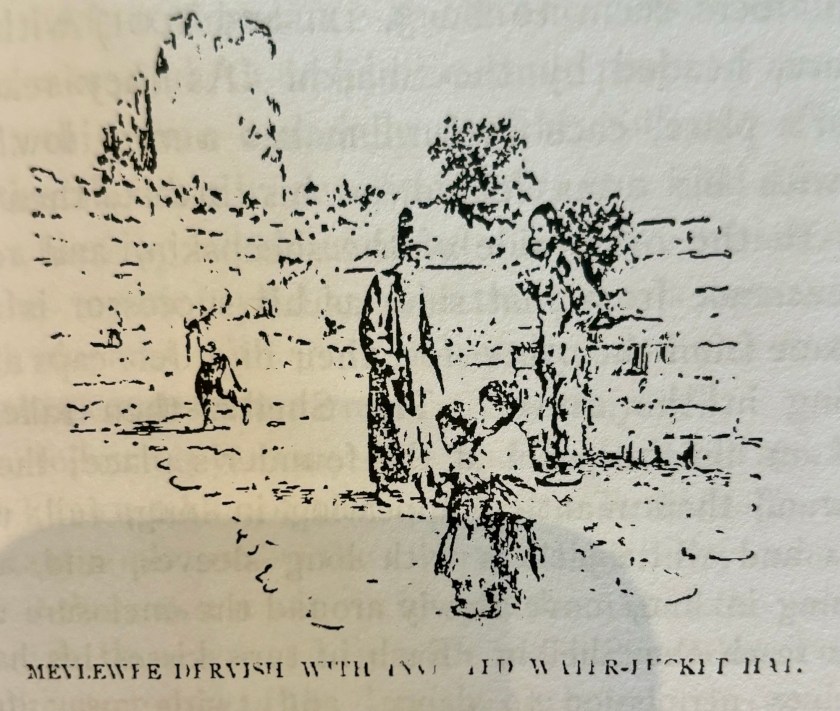
Osman’s effects were loaded by the porters who, as it turned out, were personal assistants accompanying him aboard for the trip to Nippur. They quickly spread their mats under a striped tarpaulin on the foredeck and set to making coffee over a charcoal stove.

“Welcome aboard, Mister Bey.”

“Thank you, but your kind greeting is redundant. Bey actually means “mister.” Nonetheless, it’s a pleasure to finally meet Saturnius McWhirr. I was pleased to hear that the most august, Pennsylvania Museum board has hired you to ensure the safe transport of our precious antiquities.”

“Your fame precedes you as well, sir. But where, if I may be so bold to ask, are we to stow all your gear? Or should we just chuck it all overboard now in the interests of expediency?”

Osman’s eyes glared from behind his prince Nez glasses. Thus began the strange, unlikely relationship of the two most remarkable men I’ve ever known.

Posted in Art, Bird poop augury, opera, poetry, politics

Is bird augury really fake news?

Drumph is building a tremendous crypt above the 18th green at his Bedminster Golf course with financing from Russian oligarchs. He calls a meeting where the Saudis express interest in exclusive burial plots. The tremendous Drumph Tomb is shown–bottom left–to the assembly. But Tiresias enters to proclaim disquieting omens regarding the end of the ancient Drumph line.

Posted in Bird poop augury

Bird poop augury–11/25/17

20160919_113957In their attempts to descry portents in the flight of birds, ancient augurs oriented themselves toward the north. Flights from the right hand (East) were viewed as affirmation of the query, from the left, negation. Significantly, during the Roman Empire, this orientation was reversed. The cardinal point upon which political, ethical, and moral standards were based was suddenly reversed by Imperial decree.
Perhaps a similar reversal can help explain the spiritual affliction of Trump; as well as his seeming inability to properly honor fallen soldiers.

It might seem odd that we might learn from aviary divination something about double-speak and toxic spew of the Trump era, but ancient lore often discloses timeless truths which defy the logic on which we base our most cherished assumptions about reality today.

In Sophocles play, Antigone, Creon pits his tyrannical rule over that of non-political institutions, family ties, and the will of the gods. By refusing to bury the corpse of Polynices–who dared challenge his rule–he even tries to subordinate the gods of the underworld to his authority.
Though he claims to promote the common good–that of the city over family ties–Creon flouts divine decree, the dictates of custom and common decency. As a result, the city is plunged into a dark malaise so vividly evoked by Tiresias:

The public altars and sacred hearths are fouled,
one and all, by birds and dogs with carrion
torn from the corpse, the doomstruck son of Oedipus!
And so the gods are deaf to our prayers, they spurn
The offerings in our hands, the flame of holy flesh.
No birds cry out an omen clear and true…

The real weight of meaning is driven home to Creon by what the omens do not say, and he finally acknowledges his greatest sin–denial of sacred burial rites for a son of his predecessor, Oedipus–only after bringing ruin to his home, family, and reign.

Posted in Musings, Uncategorized

Tales of the Tot Lot 2

So the land swap was stopped when the City Attorney admonished the Council it was their obligation to compel Parks to abide by the terms of the transfer and honor the restrictions.  The Council then voted unanimously to record a conservation easement which would preserve the Tot Lot in perpetuity.

But then, Val Tollefson moved to delay the recording of the Conservation Easement while an access road was worked out between Laughlin, Parks, and the adjacent, Madison Cottages community. It seems the Madison Cottages folk decide it best to accommodate the access road because if the Wyatt Cottages proposal is not granted, a more intrusive and aesthetically disagreeable development might replace the good work of Cutler/Anderson Architects.

Point well taken, but too smacking of defeatist accommodation for me. And since the good folk of Madison Cottages represent a mere fraction of Park’s-going public, why should they have such disproportionate influence?

We await the announcement of the Wyatt Cottages proposal to the Design Review Board with a mixture of dread and anticipation. Will the concerned parties present accurate information this time around regarding the Declarations of Covenants, Restrictions and Reciprocal Easements–remember those?

This is but a sketch of a convoluted tale of intrigue. There remain such details as the erroneous reports by the County Assessor, a land value increase of nearly 80% the very year the property was transferred to Parks, the “disappearance” of the studio from the assessor’s building report 2 years before it was demolished, the miraculous appearance of a ghostly pole-frame building, mysterious address changes, and specious readings of legal terms.

It seems we are afflicted with a double denial of many troubling aspects of the concurrent Wyatt Cottages and Suzuki developments. On the one hand, the Madison Cottages community–as well as the Friends of Suzuki– sweep the shady history of land transfers to Parks under the rug. On the other, we have the present Council embarrassed by their part in obscuring Parks and the previous Council’s questionable deeds. Add to this HRB’s reluctance to jeprodise Council support by allowing public scrutiny of these sketchy practices, and the tight-lipped, good old boys in the Building Department, and you have a first class cover-up.

All sides of this debate can be said to lack transparency.  We need a fresh and honest perspective on the issues that shape the island’s future. We need tranlate our high ideals of inclusiveness and economic equality into practical solutions while preserving the precious remnants of our natural environment.

Posted in Old Hand's Indonesian Voyage

Old Hand’s Indonesian voyage–part 6

 “To the Toer wharf,”  said McWhirr. 

 With indomitable energy, Rubio peddled his bicak and sang Unchained Melody for all he was worth.  For reason I’ve yet to fathom, Indonesians consider the Righteous Brothers to be the apex of musical accomplishment.  We soon arrived at the dock to see a steamship being loaded by scrawny Malays carrying heavy sacks of rice.  She was an absurdly stout vessel of Victorian pedigree, whose small wheelhouse perched on her coach roof like a petite hat on a frumpy, lady dowager.  On the ornate paddle boxes were emblazoned the words: The East India Company.  The thick cloud issuing from her smokestack showed she was building up a head of steam for immanent departure.

As we ascended the ladder to the wheelhouse, I saw that the balustrade of the gallery which extended from the house to the rails was ornamented by a carved frieze of twined figures writhing in chained attitudes of torment.  We were about to knock on the weathered, oak door when, through the blinds, came a low voice intoning:

“It is thou, O river, who judges man’s judgment… O river of sanctuaries. ..O river of light…”

 
McWhirr opened the door. a beefy guy in shorts, stockings and pith helmet bent over a chart table reading from a weathered scroll.  Without turning he said: “What say ye,? Does the ocean refuse the river’s tribute?”
  He fell silent and gazed out the wheelhouse windows.  The dawn light shone violet, as though the dirty chaos of the waterfront had been suddenly transfigured by the celestial Light of Glory.
This was our engineer, Thaddeus Budge, and a wackier coot I’ve never known.  But Hans had assured us that he would keep the old Polly steaming past mud banks and typhoons; the first we were to strike in short order, the latter, we were to find, swept through the middle reaches of the Ciliwung with all the frenzied vehemence of doomsday.
 
“Full ahead, Mister Budge,” McWhirr called into the speaking horn by the wheel.
 
With a creaking shudder, the paddle wheels began to churn the water into brown froth, and we bore away from the wharf into the gently flowing waters of the River.
  We chugged past endless shacks and mountains of rusty, flattened cars.  It was as though alluvial deposits had washed up all the planned obsolescence of millennia; and the foundering hulk of Pantijasila– those lofty 5 principles of the new Indonesia–had fetched up on a reeking bank of industrial wast and these half-naked laundresses whopping sarongs in the stagnant waters of the canal were singing an eerie monody for some dimly descried apocalypse.
 
The only charts we had were from the 20th century.  I searched for sailing directions to the upper reaches of the Ciliwung in vain and ransacked the tattered tomes that lined the mahogany shelves of the wheelhouse for any clue that might disclose the real purpose of the voyage we were fated to undertake.  
 
“That Bekert guy gives me the creeps.”  McWhirr’s said.  “I didn’t believe for a minute all that bull about his interest in antiquities.  He might just be sending us on a fool’s errand in this tin pot steamer.” 
  McWhirr unrolled a dog-eared chart that look like it was printed during Leopold’s reign, pointed to a particularly sepentine section of the river, and said:
“There’s death at every bend of this blasted river.  There are treacherous sandbanks and bandits that will cut your throat for a song. Here is the passage of Bulak Bindah.  Winds can funnel between those rocks like the fiends of hell.”
“Aye, on top of that, the very guards appointed by the museum trustees who sponsor these excavations deal in the illicit trade of artifacts. Their collusion with Javanese authorities can land innocent shippers like us in jail. 
“Crooked trade in antiquities is nearly as old as civilization itself. These sites had already been plundered in ancient times by looters who sold to dealers in Bangkok.  Now the plunder is conducted on an industrial scale by the East India Company. The stones of sacred Temples are looted to build the brutal towers of Tomorrowland and the stolen images of the Holy Immortals now entice consumers, like sheep, into endless malls of mediocrity.  This must stopped.”
 
Like some portly, winded spinstress, the Polly steamed past camps of water buffalo herders, laptop recyclers, and armed horsemen whose dark eyes followed her wake with unconcealed contempt.