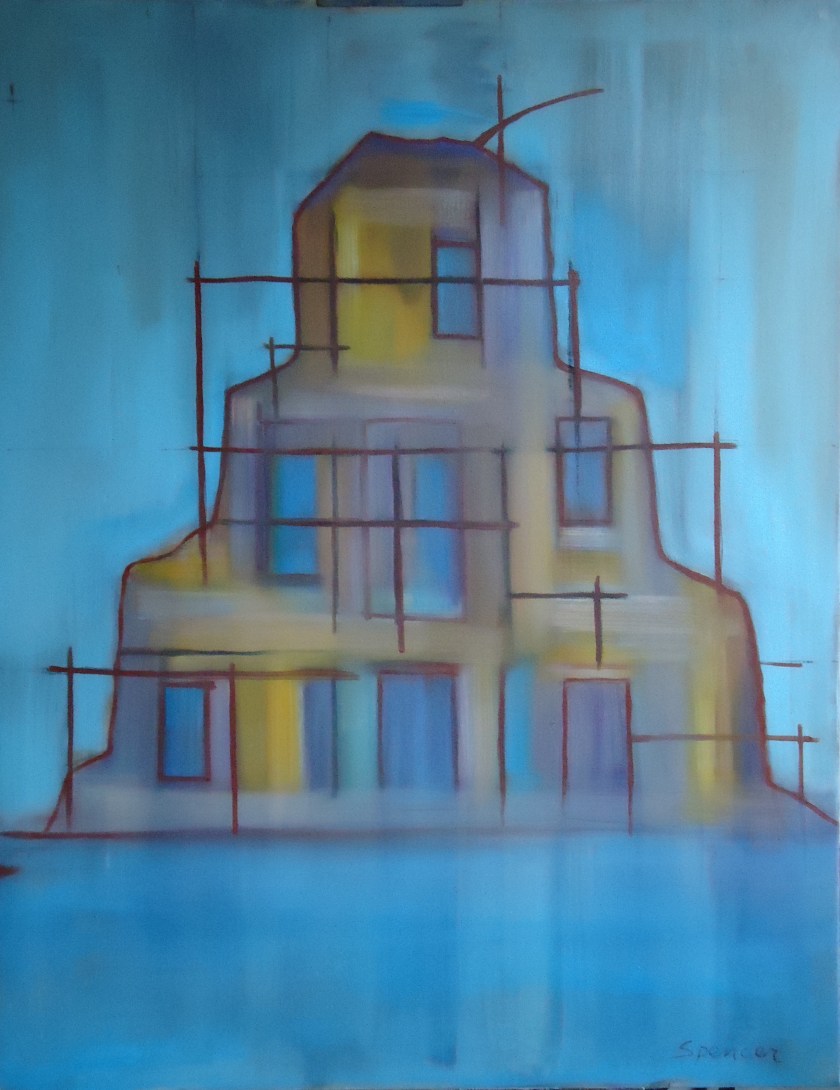

Strange. For all my efforts to loosen up, I seem to be heading in a more classical direction. When solid form threatens to vanish in an atmospheric haze, I recall Blake’s admonition to delineate everything a solid line. William Turner advised enclosing all shapes with a glowing red line that can move easily from cool shadow into warm, brilliant light. Gauguin used this technique to unify his compositions and bind his luxuriant forms to the picture plane.
Here, I use it to construct Blake’s towering edifice of Golganooza, whose:
…stones are pity, and the bricks, well wrought affections Enamell’d with love and kindness & the tiles engraven gold, Labour of merciful hands..
This Golganooza is built with primary colors on a scaffold of charcoal lines set along the Golden Mean proportion. The challenge is to integrate illusory depth with the shapes on the flat surface into a dynamic, interwoven whole. This is what makes it so complicated.
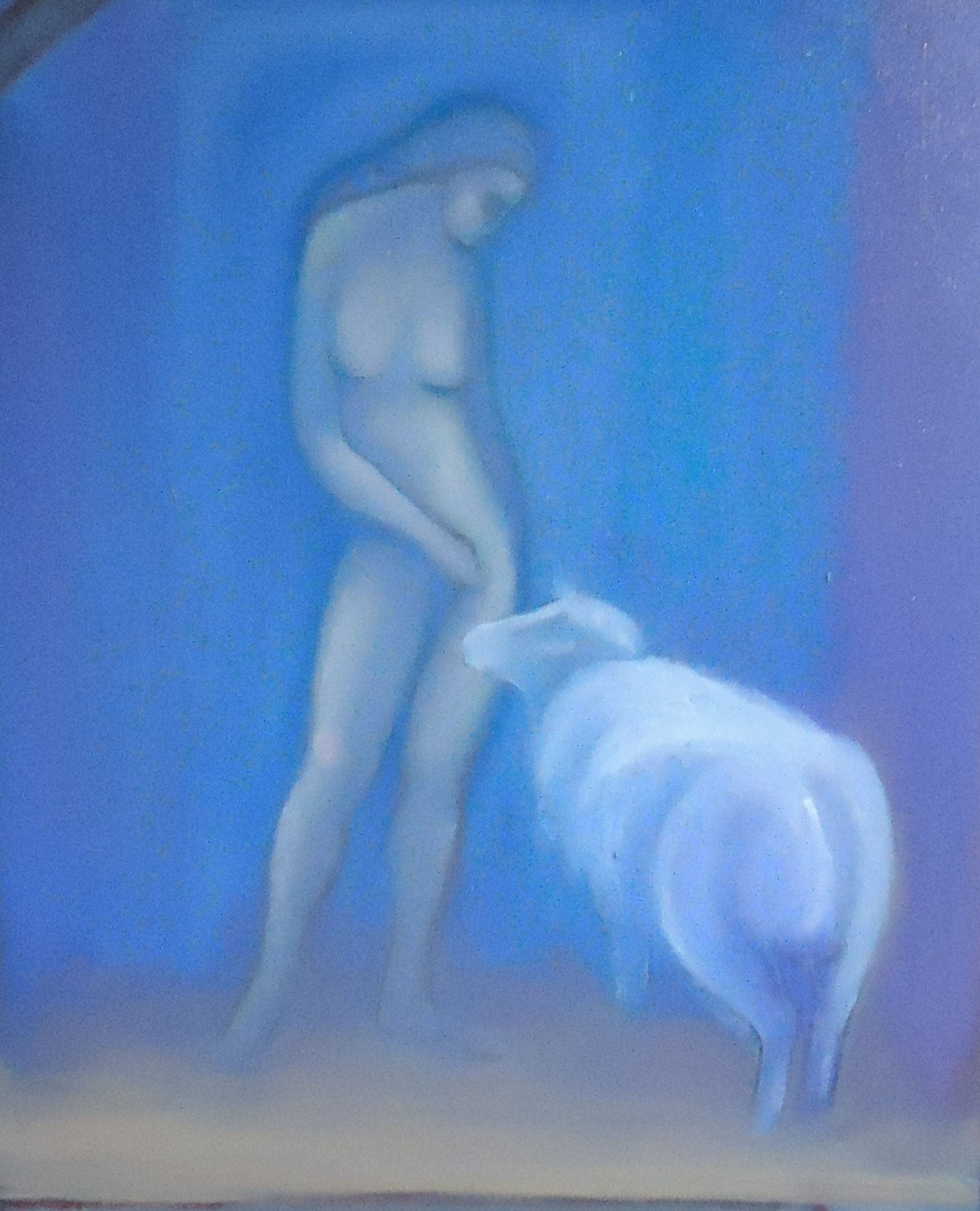
Painting doesn’t proceed only with big, creative leaps by the likes of a Picasso or Pollack. There is also a slow evolutionary process at work, and painting, like any other discipline, moves toward ever higher levels of complexity.
The dichotomy between abstraction and realism is a false one. It’s all abstract in a sense. What is bad is intellectual, materialist abstraction devoid of feeling and humanity–removed from art’s most exalted purpose:
To open Eternal Worlds, to open the immortal Eyes of Man inwards into the Worlds of Thought: into Eternity ever expanding in the Bosom of God: the Human Imagination!
-William Blake

 A View from the Wheelhouse
I love the detail from Jerusalem, very beautiful. The Lamb’s bride?
Thank you Sue. Yes, one of the sheep that live near my studio wandered into the painting.
Seems right at home there.
I came across an interesting book today… available on Google books too.
A Blake Dictionary: The Ideas and Symbols of William Blake
By S. Foster Damon
I’ve been wanting to order that book. Thanks
🙂
The doors of perception eh ?
Reblogged this on MARSocial Author Business Enhancement Romance Post.