Posted in Euphrates Voyage

At Nebuchadnezzar’s Quay

The Samamaris was making frightful leeway as we rounded the bend towards our moorings at Nebuchadnezzar’s quay. But it lightened somewhat on our approach and Captain McWhirr eased her up as if it were a Sunday family cruise. The storm, fierce as it had been, died down as quickly as it had risen.

“Make off the bowline to the second bollard Mister Spencer.”

“Easy now professor.”

After making fast and shutting down the boiler, we jumped ashore for a look around. It was an ancient mound—or tell—that slowly sloped down into the depths of the river to form the quay. The lower strata was made of baked mud bricks coated with bitumen, some of which were stamped with the seal of Nebuchadnezzar himself. To the Northwest, the mound rose high against the hot afternoon sun. An Arab Shepard stood gazing down at this apparition of a stern-wheel steamer with a wheelhouse that sat on her deck like a little hat on a frumpy British dowager.

Soon, a short guy in a white suit and pith helmet walked up and made an obsequious bow.

“I am Joesph Cairo of the customs office. Would you be the Captain of the steamer Samaramis?”

“I would.”

“The customs office has impounded your vessel due to a minor technical matter regarding…”

“Bakshish?” interrupted McWhirr.

“I wouldn’t put it so indelicately. But there are certain processing costs incurred by the Museum trustees sponsoring this worthy effort to preserve our priceless treasures for the future edification and enrichment of both of our great nations.“

“For the enrichment of somebody anyway.”

Cairo smiled placidly: “I heard you were a man of few but laconic words, Captain McWhirr. Shall we go to my office? It’s just up the promenade.”

McWhirr is well accustomed to Cairo’s ilk. Recent digs and spectacular finds have brought out sleazy shysters to exploit the ignorance of scholars and archeologists. Especially vulnerable to such scams are the rapture tourists, who seek affirmation of scripture by marking the river’s depths, which— as is prophesied in the Book of Revelations—will dry up as a sign of the end times. The chandler in Bagdad enjoys a brisk trade selling sounding gear to these New Age fundamentalists. But these days, all that’s needed is a pool cue, so they may have a point after all. An inch drop will have them speaking in tongues, talking to lizards and enthralled by the thought of total annihilation of a third of humankind. But we were concerned with more prosaic matters regarding the water’s depth. A blow like we had earlier could drive our shallow draft vessel sideways onto the bank, prey to bandits who roam this desert with impunity.

But events that were to unfold cast a new light on the prophesied end-times, and gave us—if not eternal salvation—a hard-won appreciation for the convoluted twists of fate.

We walked up the towpath—or “promenade” as Cairo so generously called it—and came to the customs house. It was no more than a shack of mud brick and bundles of reeds. A guy in a green visor and sleeve garters sat next to a fake banana plant contemplating a calendar. This month’s model was Theda Bara tricked out as the Goddess of the Underworld. Those dark eyes followed me around the shack; eyes that can go from abject terror to ecstatic elation without so much as a smoke break between takes. We paid the gentlemen who were, after all, only playing their parts in the perpetual exchange of vice and virtue; where everything evens out in the end—more or less.

Later, as I lay on the pilot house bunk listening to the eerie keening of jackels far into the night, I could hear the professor intone:

“He set sail; the father set sail,

Enkei the God of Wisdom set sail for the underworld

……the waters of the sea devoured the bow of his boat like wolves.

The waters of the sea struck the stern like lions.”

I flowed downriver. The bleak boatman had abandoned his tiller, leaving me adrift. But I escaped shipwreck and the scene suddenly changed. I gazed into the blue eyes of the glittering goddess. We embraced and kissed. It was a sweet soul kiss that I could still taste when I woke to McWhirr’s hail.

“All hands on deck!”

McWhirr runs a tight ship, even if it is a mode of propulsion he thinks unseemly for a man of working sail.

O. Handy Bey—Director of the Imperial Ottoman Museum, 1888 CE
Posted in Uncategorized

Mesopotamia Voyage

“What do you do when you see a gauge rise?”

Professor Budge asked sharply.

“I’d open a valve” I stammered.

“All at once?”

His intensely earnest tone unnerved me. McWhirr had told me how the engineer’s—we called him the Professor—long, solitary hours below decks had gone to his head. Apparently, he was also an amateur linguist and had recently developed a keen interest in ancient Mesopotamian texts. Beyond the maze of pipes, gauges and boilers behind him, a blackboard was mounted on the steel bulkhead on which was written in chalk:

Climb the walls of Uruk, walk its length.

Survey the foundation, study the brickwork.

There—is it not made with oven baked bricks?

Did the Seven Sages not lay its foundations?

The professor went on: “Of course the amount of change in the glass will depend on where the pipe connects to the bottom of the boiler, because there the water column is cooler and gives only a partial…”

“Stations men! We’re in for a dusting!” McWhirr called through the speaking horn.

I rushed up the ladder to see McWhirr squinting through the wheelhouse windows at the dark, lowering clouds. Our boat began to pitch violently in a chop that had suddenly transformed the placid surface of the river into a seething snarl of whitecaps. I’d heard of storms on the Euphrates but, being a strictly blue-water sailor, thought them merely overblown yarns told by salts in the far-flung grog-shops of the globe. But here it was, a veritable hurricane, as if the whole river was pounding against our bows like the fabled flood that crushes walls of stone.

“Steady Mister Budge, it’s only a capful of wind,”

Wrestling the wheel, McWhirr yelled: “Nebuchadnezzar’s Quay is only around the bend. If we can get there before fetching up on a mudbank we’ll be golden. And Mister Spencer, pay heed to the professor. He may have a few bolts loose, but he knows his stuff!”

We’d been commissioned by the University of Pennsylvania Museum to ship antiquities found by the Punnett excavations upriver at Nippur. Captain McWhirr had taken the opportunity to make a few lira by hauling priceless artifacts down a pirate infested river on the paddle-wheel steamer, the Samaramis.

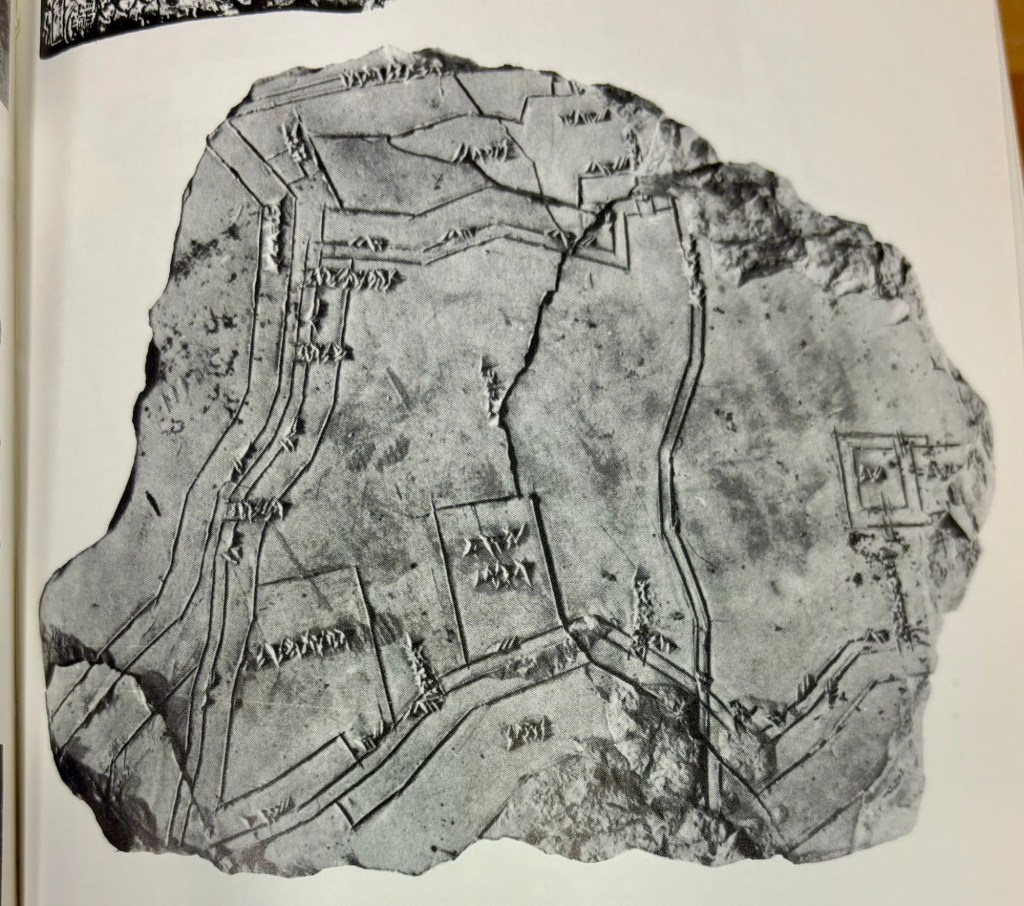
Map of Nippur

Posted in Art, Bird poop augury, opera, poetry, politics

Is bird augury really fake news?

Drumph is building a tremendous crypt above the 18th green at his Bedminster Golf course with financing from Russian oligarchs. He calls a meeting where the Saudis express interest in exclusive burial plots. The tremendous Drumph Tomb is shown–bottom left–to the assembly. But Tiresias enters to proclaim disquieting omens regarding the end of the ancient Drumph line.

Posted in Art, Musings, Uncategorized

The Alchemy of Bird Poop

The real mystery does not behave mysteriously, but speaks a secret language.

                                                                       –Carl Gustav Jung20160919_101939.jpg

Bird poop is the Prima Materia of the opus, the alpha and omega of the great work of the philosophers.  Transmuted and transfigured by the alchemical fire in the sealed retort of the adepts, the excretions of our winged brethren reveal the grand pageant of creation on the microcosmic scale.  I shall endeavor to elucidate the arcana of avian excrement and thereby elevate my humble office of brush bearer to that of high art; to seek amid the white glyphs that adorn the docks a sign that might illuminate secrets of a hidden world.20160504_183526


Bird poop is the mother of all elements, without beginning, existent from all eternity and mixed with the handful of primal earth Adam brought forth from Eden.  It is found always and everywhere.  It contains the Divine presence in the obdurate whiteness of its adamantine– and often goopy–reality.  It is both the beginning and end of the great work, the primal ooze from which the aspirant takes flight into the rarefied spheres of heavenly gnossis.

This post is the first in a series logging my daily circumambulation, bearing the broom of my high office.  The broom is the emblem of adepts, the standard of those who seek the philosopher’s stone among the crustacean beasties that reign over the intertidal zone.

Posted in Poulsbo, Seal log

The Selkies of Dogfish Bay

Last June I had the good fortune to land a job at at the Dogfish Bay Marina.  Aside from sweeping the docks, parking lot and the endless chores, I found myself cast in the role of a sort of ambassador between the human and the pinniped populations.  I experienced the trauma of a seal pup, abandoned by it’s mother, slowly die from starvation.

20160317_213128
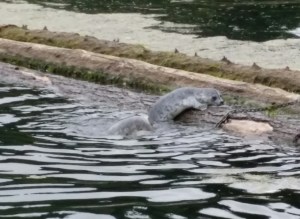
Mother helping her pup onto haulout logs.


Seals must get a firm scent at birth in order to establish contact.  Immediately after birth, the mother clasps her newborn by the nape of the neck in order to get the scent.  If this process is interrupted, the mother fails to establish the link which allows her to “recognize” her pup.  Through the interference of a well-meaning child, this process was interrupted, and the mother let her offspring starve.  After the poor pup’s demise, she haunted the dock near where her pup had hauled out on the low swim-step of a speedboat; her eyes streaming with tears.


For ages, seals have emanated an aura of magic. In the Celtic stories of the Selkies, a hunter, on a quest for worldly riches, is summoned into the depths by a shape-shifting, seal messenger of Lachlann’s undersea Kingdom.  After a lengthy stay, the hero returns to terra firma transformed by his experience–a wiser, more compassionate being.  His cruel, rapacious heart is softened by his ordeal and he emerges a changed man; one who has seen the depths of profound reality below the selfish preoccupations with material gain. Such a visitation by the Selkie heralds an epiphany– an awareness of our deep relatedness with all creation.

20160317_133337
Komokwa–Chief of the undersea Kingdom and master and protector of seals


Among Northwest tribes, seal people played a role as emissary of their guardian King, Komokwa, in the winter Tseteka–shaman–dances where supernatural beings came from the spirit world to initiate the young into the dancing societies.  A seal conducted the novice into the submarine world where, after a period of fasting and prayer, he returned to the tribe in a canoe laden with a wealth of copper, to found a new lineage which was then honored in the dancing houses.20160317_201531

By day, the lumbering hulks of seals lounge on the docks.  One night, I saw a flash of green phosphorescence as the seals sped below the surface of Dogfish Bay.  These mercurial denizens of the deep bridge the yawning divide between the conscious and unconscious energies, and guide the seeker into timeless mysteries where shadowy beings lie below the reflective surface of the sea.  Their uncanny visitations shake up our smug assumptions of human supremacy and herald a new awareness based in feeling, compassion, and illumined by the transfiguring light of dreams.

This is my first post telling of my experience as pinniped ambassador, documenting scientific observation, and evoking the mythology of seals.  I hope my blog is informative as well as therapeutic.  After the traumatic death of Bobby last Summer, I wish to be better prepared to deal with all the many, tragi-comic aspects of the birthing season.

Posted in Uncategorized

Old Reah’s Bulkhead

After a day spent prepping decks and bowsprit for paint, I sip a local sauvignon blanc in the wheelhouse and view the harbor scene. Old Don Reah is building another rock wall on his steep bank, setting boulders to shore the hillside against rising seas. While I admire his fortitude, I’d think he would take a break after nearly 90 years labor on life’s rock pile.reah

Old Hand lies becalmed while flotsam and weed drift slowly past the bow. I submit to the pull and creak of time and hear the low moan of the hawsers pulling against the weathered dock. Sometimes the almost human sounds start me from revery.   It’s seems as if they  were made by the phantom pioneers who lie buried in Kane Cemetary near the harbor entrance.

The thought of old age, sickness and death recalls me to particulars—the cerulean sky opens between massed cumulonimbus over Port Madison where  fledgling osprey arc in widening circles ever farther from their nests. Each year there’s a whole new crop of them, crying loud in their voracious flight in search of fleeting fingerling.

I am reading the biography of Thomas Wolfe. I love the extravagant, melodic rants of this failed playwright who, battling editors, critics and the philistine aesthetes of the the 20’s, went on to write one the great novels of the 20th Century: Look Homeward Angel. It is sad he died before he could haul his semi-fictional cast of Gants, Joyner’s or Webbers across the continent to the seaside town of Port Townsend as he planed. He caught pneumonia while crossing the very same Strait of Juan de Fuca Old Hand will navigate early next month.

But mostly, Thomas Wolfe’s work inspires me to write–to dare imagine that, after 63 years traipsing this wide, sad earth, I may actually have something to say.

Some, it seems, are born to write, to perpetrate effusive, yet judiciously restrained prose upon the citizenry of this steamship earth– writing which plumbs the deepest mysteries and gets at the heart of unshakable truth. But I have no pretensions to profundity and aspire only to create sea stories which might weather the deluge of time and stand as true as Reah’s solid bulkhead.

Posted in Old Hand's northern voyage, Uncategorized

Voyage on the Salish Sea

The 30 mile passage from Port Madison to Port Townsend is marked by the doleful names of voyages that came to grief on the Salish Sea. It is the saga of sunken tin-pot steamers who plied the vertiginous depths of Admiralty Inlet and now lie some fathoms deep among the fouled chain of time and memory.  The place names along the first leg of Old Hand’s forth-coming voyage to the San Juan Islands bear testament to historic, tortured founderings: Point no Point, Skunk Bay and Foulweather Bluff.

Perhaps the names are meant as caution to jaded yatchies who, besotted by the mirror calm of the convergence zone and assured by their virtual, abstract trajectories, sail blithely on over the sun-dappled main while toasting a lowering Margarita sky.  What are these names but vague appellations foor that stubborn tyranny of tide and rock that mark this bewitchingly placid and, by turns, malevolent stretch of sea?  And what are all our errant eastings, leewardings and embarkations but the the soul’s recurrent flight into the dream time–the Homeric drive by which all voyages are undertaken–and part of the eternal, unquenchable drive toward the further, mythic shore.

My plan is to sail with the new September moon toward a not-too-adventurous landfall in the San Juan Islands and there to blithely hang amid the encantadas of the north; to seek, to groove, to go where no green lubber has gone before, that my soul might find solace, inspiration and release.

Who knows? Maybe even that old Miphisto of the sea, that horn-fisted coot with the line-squall scowl might loom again in the night, his gaunt profile etched against the thundering flash of doomsday.  For none but Saturnius McWhirr can skipper Old Hand proper. None but he can set the serpentine track of this labored narrative on a course that is steady and true.