Hove to off Indianola listening to beautiful singing and drumming from members of the Suquamish Tribe.
Tag: port madison
Sailing the Bardo of Rebirth with McWhirr
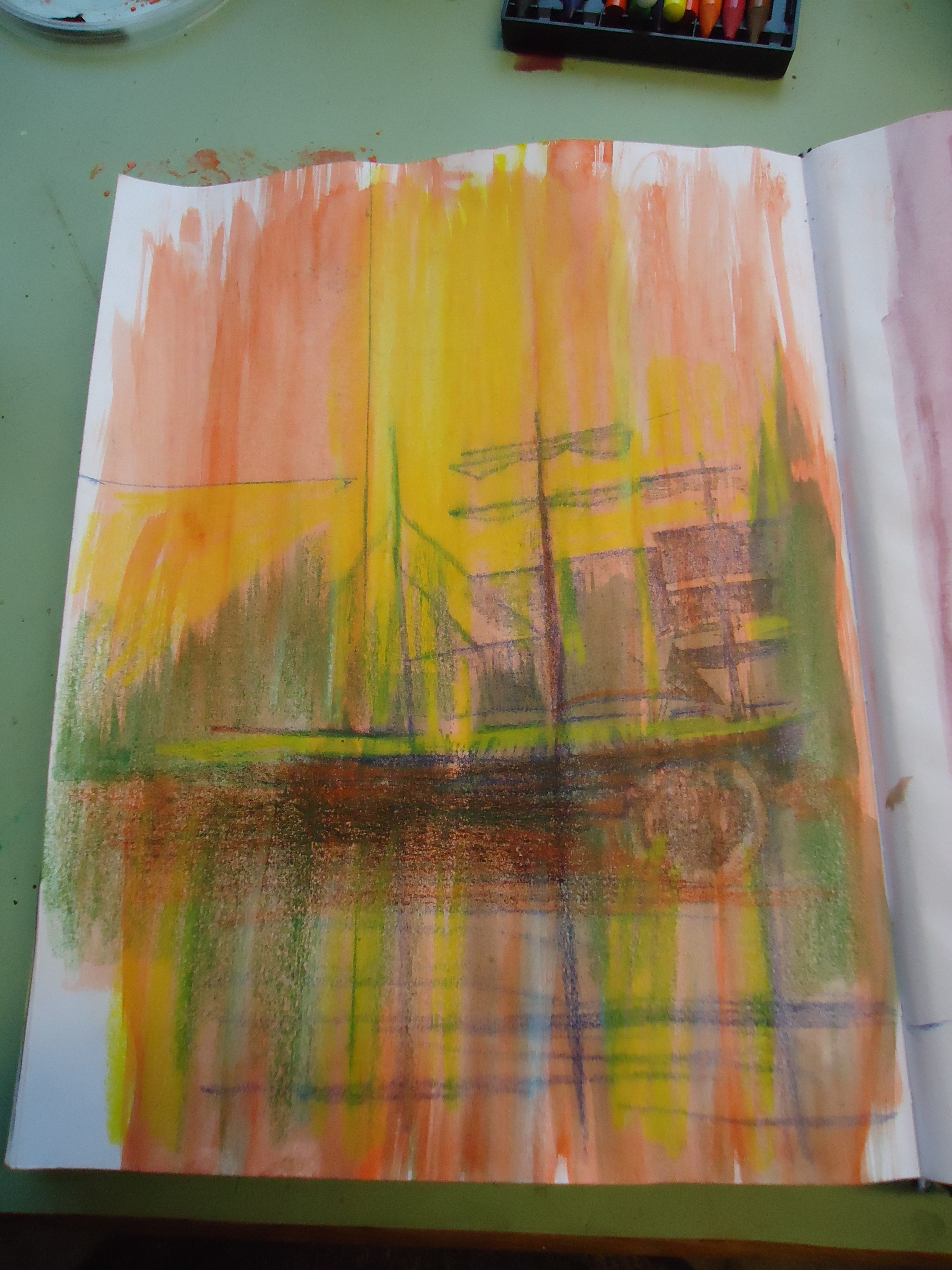 Cats paws darkened the blue reach of Puget Sound beyond Skiff Point to the north. I went below to shut down Phyllis, my Norwegian diesel engine (named after my mother,) trusting the breeze would hold and keep us off the shallow bank south of Fay Bainbridge park. There’s nothing so peaceful as that moment when the wind lifts and the engine is shut off. Old Hand sails better without human interference close-hauled, so I sit back and listen to the sound of water moving along her hull as she gathers speed along Bainbridge Island’s east shore.
It was lovely. We had attained a state of harmonious accord between man and boat in the mandala of winds, and that single point we occupied at that particular moment in time and space was golden perfection. I try to seize such moments on the fly and, by retelling them, prolong existence itself and sail with the generous breeze into eternity.
“Look sharp, Mister Spencer.”
The resonant voice was hoarse, as if graveled by long watches in the north Atlantic-as if it emerged from the very depths of the bilges.
“Ready about.”
“Ready about.”
McWhirr paused then called:
“Helm’s alee!”
I let go the jib sheet as the bow came across the wind and hauled in for a port tack toward deeper water northeast.
“Nicely done, lad. Ye’ll be a sailor before long.”
McWhirr is a pain in the neck sometimes. He’s a relic of working sail and can be as dark as Ahab in rehab on a bad hair day.
But such a breeze can soften a heart encrusted by long watches over icy seas. McWhirr stood stark against the red sky like a weathered piling on a rocky cape. Light flickered through the dark shrouds behind him as if projected on a movie screen.
“What do you make of the Ancient Mariner’s yarn, lad?”
– through soul’s stations he sails…sweetly, sweetly blew the breeze…sigh of compassion that pervades all creation… repents his cruel slaughter of the innocent bird and sees divinity in all beings… it raised my hair, it fanned my cheek…essential reality…wisdom and compassion combined…
“It’s a strange tale.”
McWhirr brooded as if some heavy recollection had made him grow, if it were possible, even more saturnine.
“Aye, we all carry the albatross’ weight around our necks.”
-tangled lines lost in fouled line-lockers…it mingled strangely with my fears…endless dream pilgrimages through foreign city streets looking for misplaced baggage… He loved the bird who loved the man… all those times too slow on the uptake, clueless or proud... who shot him with his bow..neglect of kin…Mom’s eyes…executors of karmic law…archons of the muddy sphere in which my life is, more or less, firmly moored …Oh, my neck.
“What about that part where he must repeat his tale endlessly to strangers?”
“I don’t know. It sounds like a writer I know. But I won’t mention any names.”
The Rhyme of the Ancient Mariner
I shot this video yesterday while cruising slowly down Bainbridge Island’s east shore toward Point Monroe and Port Madison beyond. Although my speed was a mere 2 knots, it was one of those days where all came together in a perfect moment. The only sign of wind I saw wind was along my course-
…on me, alone, it blew.
A summons to set out
At ebb tide the water swirls toward a North forever receding beyond the gray headland. Shadows of cedars stretch along the foreshore where tanned humans tourists roast mammals on spits; their gaudy shirts billowing like the capes of fishwives on a storm-wracked shore. Otters writhe on the grassy bank.
I hear the north wind as a summons to set out. From the wheelhouse, my eye is led toward the harbor entrance where it opens into Port Madison Bay. Knowing such an expanse of open sea lies just around the bend gives me a sense of spaciousness and freedom. The immensity is continuous with the confined space of the harbor.
I suppose it also has to do with the long history of this historic mill town and shipyard where lumber schooners were built on the west shore in the late 1800’s. The 1906 tug, Noreen, lies at Halvorson’s dock just off the mouth of Salmon Creek, her high pilot house tilted back haughtily as if in defiance of the steep waves of the inland sea.

I’ve been working on two versions of the Vickers memorial, trying to get that feeling of expansiveness the sculpture seems to generate. I wonder how much this has to do with the harmonious distribution of masses and voids, and how much is due to her angelic status-what she represents.
There is too much emphasis on the precious object in art-on its monetary value, as if that were the sole end of art. The art scene is a big Antiques Roadshow. This fixation doesn’t see beyond the material product to the more ineffable virtues of what art does, how it feels and whether it confers upon the environment a greater sense of spaciousness. For greater spaciousness is always a virtue, and good art amplifies that poetic space which is continuous with the spaciousness inside ourselves we find in moments of revery.
A Goose Story-Dispatch from the front lines
It’s a bright, sunny morning. The north wind freshens, sending diagonal ripples toward Old Hand’s stern as I gaze at reflected ovoid shapes meandering over the surface of Port Madison. The wavetops reflect the cobalt sky, while in the troughs, dark green falls into the depths.
Johnathan Raban, in his book, The Sea and it’s Meanings, says that the fantastic imagery of Northwest Coast Indian art is greatly inspired by this sight- their stylized abstractions emerged from long hours paddling through the Salish Sea Dreamtime. The ancient Northwest Coast artist first saw Thunderbird, Raven and Bear while in becalmed revery, gazing at the sea’s mirror. The bounded yet fluid shapes that contain and release their ovoid imagery are interwoven, like sinuous kelp, with the sea itself. The mythic Hamatsa (cannibal dancer) of the Kwakiutal was descried on that insubstantial realm between surface and depth where images flicker and vanish. This is the intermediate realm between wakefulness and dream. Some of the masks came originally from the deep, while others descended, exact prototypes of masks we see today, from the sky.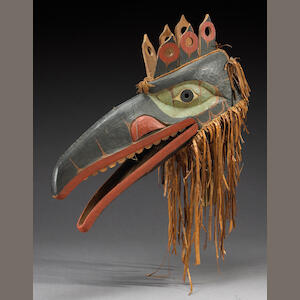
Things are quiet in Port Madison. I spend a lot of time watching the Canadian Geese. The other day I witnessed a flock on Reah’s bulkhead repel an alien siege from another group who also desired the choice spot. Perhaps a rabble-rouser was after a female that was serenely perched on one leg under the cherry tree. The invading bunch first tried to look casual as they eased up the old boat ramp. But the locals charged down on them, their beaks lowered aggressively. This was, of course, accompanied by a god-awful din. Always something. They should have a reality TV show.
Then there’s the goats. They would eat my studio if I let them. When I show up they give me this interrogative look, as if I had the answer for their goatish angst. Maybe I am projecting- anthropomorphizing. Try pronouncing that, goats.
Today is clean the goat-shed day, a task to rival Hercules’ distasteful trial.
But I shouldn’t complain. I am ever grateful for the blessed gift of this lovely place, thankful I have found a home in this peaceful harbor.
Here’s a goose video I shot of a diving lesson, a big step in the life of any chick. Sorry for the quality. You can see the little guy on the big rock below the woodpile. The parents on the right call to him with encouraging honks.
Takes me back to my own first leap into the sea. But that is for my next McWhirr story.
Our Lady of the Kedge

There are infinite possibilities in art. When faced with an empty canvas an artist can be stymied by so many alternatives. It requires a narrowing of focus to hone in on intention, that particular thing you are called upon to express.
One needs set the right environment, speak prayers of supplication to the muse, and open to what nature has to reveal in the exuberant flow of her endless manifestations.
The challenge is to maintain balance, and walk the fine line between conscious intent and receptivity to what arises spontaneously when paint hits canvas and colors bleed in confounding ways.
I take a break from the mental gyrations of painting to work in the garden.
Thatcher Farm is big, with more rows of fertile earth than I can plant. I take an 8 by 16′ bed and divide it according to the square foot gardening technique. I lay it out with sticks and line, and plant seeds so many per square depending on the plant’s requirement for space. I impose an ordered framework, prepare the ground and trust that Mother Gaia can take it from there.
It’s like the layout for my next painting. But here the grid is based on the mystic proportion, the Golden Mean.
It is a major precept of spiritual and artistic disciplines to work like nature. The ancients discovered that the Golden mean is the proportion that comes closest to the original unity from which the diversity of life forms arose. It is this unity to which, in spiritual practice, we aspire to return. The proportion is expressed in plants, shells and seasonal cycles.
I lay out a grid of charcoal lines and, with color studies, narrow the colors to a triad of blue/green, red/violet and yellow/orange.

The sculpture on the Vickers memorial abides by the golden proportion, and its mystic rule sets the measure for creative expansion into the space around her. She is a portion of that spaciousness which is the ultimate nature of reality and she bestows it generously upon the graves of Port Madison’s founders lying at her stone feet. Like a beacon, she radiates light far over the bay.
I recall what my Eastern European sculpture teacher told me: sculpture is, ultimately, about light and space. He talked about how Michelangelo distorted David’s head so it would catch light and project it upward. Maybe it had to do with chakra’s. But I did learn from him that the ultimate end of the sculptor’s work is emptiness.
It is the quality of spaciousness and light she projects that is the theme of my painting, and her expansive energy inspires a harmonious distribution of color and form on the canvas. For, in the end, it comes down to this: to call upon the muse of art (and gardening) to favor us with her bounty and use the brute material of the tangible world to evoke the intangible spirit.
The McWhirr stories-An Afterword?
Cormorants are huddled like a conclave of robed mystics brooding over lost fish. The wind blows from all directions in Port Madison.
I write windy dialogue that transpires between two contrary characters. I suppose the I of the story refers to myself, but even this first-person identity gets pretty tenuous at times. I am obtuse foil to McWhirr’s exacting command, and he is confounded by my poetic flights. This tension, this ever tipping dynamic, propels the leaky vessel of my prose.
In the voyage of this yarn to it’s “conclusion”, fact and fiction are interwoven to create a tapestry of associative episodes in order to express some ineffable truth about man’s impulse toward adventure.
But to what degree can I actually claim these adventures mine? Where was the line crossed between inspiration and plagiarism? All my powers of expression are called upon to render a fictional account of vaguely recalled events in the transient world of sensations and ideas.

I’ve come close to foundering in a fog of fantasy, relevant only to myself or to those souls fortunate enough (or unlucky enough) to be conversant with sailing lore, and experienced in the sea’s fickle ways.
Where has McWhirr gone? While his vanishing act seems a natural outcome of the narrative flow, it has left me without bearings-without a meaningful waypoint. He’s left me becalmed at slack water, transfixed by sunlight on the Strait of Juan de Fuca, with only an obscure missive from Virgil’s heroic verse: From me learn courage and patience, from others the meaning of fortune. Then again, maybe this is all the bearing I need.
Though the dream of finding a copy of the Aeneid happened some 20 years ago, it’s true import remains enigmatic. But I feel it has to do with carrying on a lineage, the bearing of the household gods to establish a new homeland or mode of awareness. It’s also about a mutual need, a pact made with the dead to honor them. My dad’s ghost comes and goes in the story, and recalls me to some forgotten bond. He says I should heed McWhirr.
The View from the Wheelhouse is a fluid one, and successful navigation depends on an ability to tolerate a constantly shifting perspective. The conclusion of this tale is as elusive as a Micronesian landfall.
So I trust this isn’t the last we’ve heard from McWhirr. The wily old coot’s vanishing act may be prologue to his reinstatement on a more believable level of fictional existence.
Wars are started by mistaking the thing in itself for the metaphor, and the inability to see through the symbol, as through a veil, to the symbolized. Scientists have recently discovered that the north wind doesn’t really have a beard and puffy cheeks. We’ve evolved beyond such nonsense. But this knowledge is of little use to the sailor driven on a rocky lee shore by a fierce northerly gale. For myself and everyone, I pray to the household gods.
Monument for a Liverpool engineer

I return to Kane Cemetery often to draw the Vickers memorial. A stone figure stands on a high pedestal with a great stone fisherman’s anchor steadied in her left hand, under the patchwork of golden light at the tree-lined harbor entrance. It’s a monument the citizens of Port Madison raised to honor a poor engineer on the Russian built, steam side paddle-wheeler tug, the Politkofsky.
I like to think Vicker’s went easily. That he never felt the shaft handle that fell on his head, delivering the humble British immigrant into the hallowed halls of Puget Sound maritime history. The good citizens raised a charitable fund to have this sculpture shipped from Italy. Here it stands, a century later, a moving gesture of honor for the bygone age of steam paddle wheel tugs and the men in them. I am heartened by knowing how loggers and mill hands paused from clear-cutting Bainbridge Island’s forests to pool their hard-won dollars to honor a humble seaman with a fond tribute.
It is such monuments that mark high civilizations. I hope that we are still capable of such moving, selfless gestures of magnanimity. For, often, it seems our culture has nothing to leave posterity but endless strip malls, business and theme parks and miles of consumer-friendly, soul-denying landscapes.
I’ve tried many times to capture the essence of this angelic figure in paint or charcoal, and her spirit has ever eluded me. She seems to rise by the power of her fisherman’s anchor, as if that very symbol of hope and faith had lifted her into the empyrean vaults by its dumb weight; and the toil of a Liverpool engineer is rewarded, finally,with the grace of an angel’s smile.
The Voyage of Old Hand-the Descent
Ye Realms, yet unreveal’d to human sight,
Ye Gods, who rule the Regions of the Night,
Ye gliding ghosts, permit me to relate
The mystic wonders of your silent state.
The Aeneid, book 6, John Dryden, trans.

The Sierra Echo buoy flashes a mile off the starboard beam as I sheet in for a close, starboard reach. Through the rain-pelted wheelhouse windows, I see lightening streak diagonally into the black face of Foulweather Bluff like the bronze spears of invading armies.
“Steady lad, tis a mere capful of wind.” Says McWhirr.
“It’s a big head of storm to fill such a cap, Captain.”
We are just able to lay the Foulweather buoy. The bell rings dolefully as it’s black profile sways wildly off the starboard beam.
I remember that blackness from long before, far away…
You gods of souls who dwell in endless night,

grant that I may tell wonders of regions void of light.
Abreojos was a small Baja fishing village of plywood shacks. Hollow waves broke over a razor-sharp reef, and the afternoon offshore winds blew rainbow rooster tails over the backs of pitching surf. The name meant open eyes; and the longer I stayed in the palm-roofed fish hut, waiting for the big swell, the more my eyes opened to it’s stark beauty. The name was also warning to keep a steady watch, and the iron keel of a wrecked schooner high on the point was testament to the fierce chubasco winds that hammered that arid shore.

The moonlight bleached the low, rounded dunes and cast angular shadows of lobster pots half buried in the sand. I descended the vague path to the graveyard south of the village. Gaudy tombs of fisher-men stood in the pallid light. Enclosed in the florid, stucco niche’s were relics of their earthly lives: an action figure, cheap guitar, and the blessed baseball glove.
My shadow rose up the moonlit dunes as I slowly approached the cemetery gate. Night breezes swirled with vaporous shades who mended starry nets and sang the Mexican Birthday song:
O Lady Guadalupe, O Lady Guadalupe…
It was your image come in dreams, dear father, that set my course toward your dark shore. In a dream garage sale I found a clue that led to your habitation. Three times I have tried to clasp your hand. Three times my vain words have left me reaching for empty air. Like you, I gasp to articulate an ancestral rage, and long to transmute the leaden ore of miss-shapen phrases into avowals of love from the hearts golden core.
“Fall off a few points west. There’s a deep-draft bearing down from north-east.”
McWhirr’s profile is etched by lightening against the bulkhead.
“A few points west it is, sir.
On we plunge into darkness, Old Hand’s bow lifts high and then falls with a jolt into the black troughs of the seas. The wind screams in the rigging as a fan of spray flies off the storm jib in an arc of phosphorescent light. Seas advance, white-capped, like a phalanx of militant headstones called up from Gabriel’s northern gate to defend the ramparts of Dis.

Saturnius McWhirr

“ Have ye clapped eyes on McWhirr, mate?”
The weazy drawl came from a wall-eyed galloot who followed me. The starboard list in his walk, the hollow stare and grog-blossoms that festooned his weathered mug showed him to be a waister on a leaky bum-boat.
“He has a scowl like a North Sea line squall that would strike fear into the black heart of Beelzebub himself.”
He sent a brown spew of tobacco juice onto the dock as if he spat out the last vestige of the accursed name.
“They say, long ago, the crew of the old Uranus found him off Cape Horn-a mere babe afloat in a Quaker cradle.”
This was laying it on a bit thick.
I’d signed articles the day before-and, here I am, traipsing innocently down the wharf toward my next berth and this guy starts yammerin’ like some hop-head bit-player in a mid-20th Century movie.
He pointed a boney finger at the dismal sky as his voice rose.
“They say he’s Zoroastrian ‘er some such heretical blasphemy that, as sure as I’m standin’ here, will lead the impious reprobates into eternal hellfire!”
This was prelude to my first encounter with Saturnius McWhirr…
Point no Point lies off the port beam at sundown. By the time we make Foulweather Bluff darkness has fallen, and the Kinney Point light is veiled behind a scrim of fog.
His gaunt profile lit green by the radar, McWhirr says:
“What’s all this about Aeneas? The Roman?”
“Trojan, sir.”
“And what has he to do with this voyage?”
“I don’t know sir.”
“Then I suggest you focus on navigating the here and now, son.”
It’s McWhirr’s watch. Sometimes he gets on my nerves. Zero imagination. Mention free association to him and he grabs a cutlass. He thinks it’s a Commie group…
 A View from the Wheelhouse