Posted in Paintings in Progress

Raven Visitation

raven windowraven window

I’ve gotten to work on my November art show, beginning with an image inspired by an encounter with raven.

In waking life, while walking in the forest I heard the a rush of a raven’s wings beating the air overhead.

Later, the same sound woke me from sleep. The clear call pierced my dream and I suddenly woke  in my bedroom with nary a raven in sight and the doors firmly shut against intruders.

A visitation, a call? The light-bringer moved between worlds with a sign for me to to transpose into the language of art.

So this is where the work comes in.   It is a Art Deco stained glass window motif I thought appropriate Raven’s boundary-crossing spirit.  It is a spirit that, as James  Fielden puts it in his beautiful post,  A Lapse of Time, “pushes against the edges of mystery.”

Posted in Books I love

Books I love-Journey to Ixtlan by Carlos Castaneda

You must give up your personal history.

This terse comment by Carlos Castaneda’s teacher Don Juan, in Journey to Ixtlan, contains the key to this spiritual travelogue in which he renounces his anthropological career to enter the sorcerer’s path.

The drawings done of Castaneda, partially erased by himself, speak more eloquently than revelations of his mendacity or alleged misogyny.

For the sorcerer, reality, or the world we know is only a description.

For novelists (it is absurd to argue which category this work belongs) the world is the reality in which they are immersed at the moment of creation.

My feelings were clear bodily sensations; they did not need words.

Yet he describes, at great length, terrifying encounters in  the intermediate realm. When Castaneda is shaken by these experiences, Don Juan commands him:

Write! Write or you’ll die!

It is an imperative Castaneda takes to heart.   Abandonment of personal history might contradict Don Juan’s statement about writing as survival but, rather than a bid for immortality, Castaneda’s account may be the final act of self erasure.  It resulted, ultimately, in irrelevance.  As he progressed to the rank of Nagual (teacher of sorcery), the fiction stylist was displaced by his persona-his double.  As he was subsumed into the anemic New-Age genre, he became infatuated by his own image (or its absence) and got mired in convoluted explications of sorcery.   Most fatal, he lost his sense of humor.

Unfortunately this seems to be the lot of many successful artists who find endless justification for their surrender to the allurements of the marketplace.

But Journey to Ixtlan is Castaneda in his prime. Take the hilarious scene where Don Juan and his sidekick Don Genaro-as antidote to Castaneda’s attachment to his worldly vehicle-make his car disappear:

“Where’s my car?”

Don Genaro began turning over small rocks and looking underneath them…

“Don Genaro is a very thorough man,” Don Juan said with a serious expression. “He’s as thorough and meticulous as you are. You said yourself that you never leave a stone unturned. He’s doing the same.”

Genaro, puffing and sweating, tries to lift a boulder.

 We could not budge the rock. Don Juan suggested we go to the house and find a thick piece of wood to use as a lever…

Resigned to this insanity, Castaneda lends a hand; with a tremendous effort, they lift the boulder.

 …Don Genaro examined the dirt underneath the rock with the most maddening patience and thoroughness.

“No. It isn’t here,” he announced.

Other passages are suffused with a beauty as stark and dramatic as the desert landscape through which they travel. In the chapter, Becoming a Hunter, the sophisticated anthropologist, Castaneda, admits to the reader his feelings of superiority over an Indian.  Reading his mind, Don Juan says:

“We are not equals.  I am a hunter and a warrior and you are a pimp.”

Don Juan then meets Castaneda’s angry protest at these harsh words with a masterful act of “not doing.”

…when it was pitch black around us he seemed to have merged into the blackness of the stones. His state of motionlessness was so total it was if he did not exist any longer.

It was midnight before I realized that he could and would stay motionless there in that wilderness, in those rocks, perhaps forever if he had to. His world of precise acts and feelings and decisions was indeed superior.

I quietly touched his arm and tears flooded me.

Castaneda has been maligned for having done his field-work exclusively in the UCLA library.  But, for me, this only makes his work more impressive.  No other writer so cannily expressed the manic spirit of the psychedelic era. I am forever astounded by the man who could transmute the dusty anthropological tomes of the UCLA library into supreme works of imagination.

Posted in Paintings in Progress

Our Lady of the Kedge

vickers painting may 23 2013

There are infinite possibilities in art. When faced with an empty canvas an artist can be stymied by so many alternatives. It requires a narrowing of focus to hone in on intention, that particular thing you are called upon to express.

One needs set the right environment, speak prayers of supplication to the muse, and open to what nature has to reveal in the exuberant flow of her endless manifestations.

The challenge is to maintain balance, and walk the fine line between conscious intent and receptivity to what arises spontaneously when paint hits canvas and colors bleed in confounding ways.

I take a break from the mental gyrations of painting to work in the garden.DSC02047

Thatcher Farm is big, with more rows of fertile earth than I can plant. I take an 8 by 16′ bed and divide it according to the square foot gardening technique. I lay it out with sticks and line, and plant seeds so many per square depending on the plant’s requirement for space. I impose an ordered framework, prepare the ground and trust that Mother Gaia can take it from there.

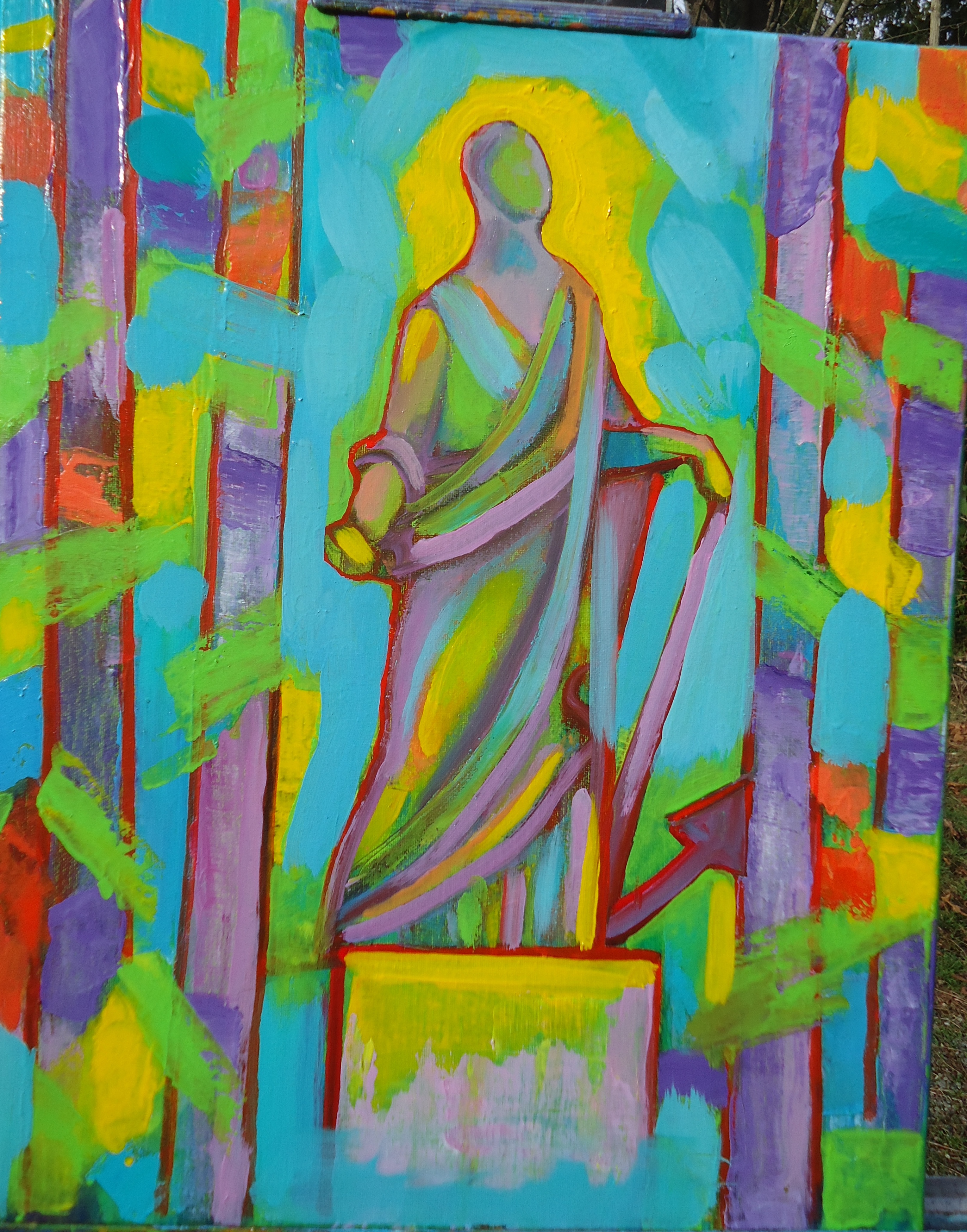
It’s like the layout for my next painting. But here the grid is based on the mystic proportion, the Golden Mean.

It is a major precept of spiritual and artistic disciplines to work like nature. The ancients discovered that the Golden mean is the proportion that comes closest to the original unity from which the diversity of life forms arose. It is this unity to which, in spiritual practice, we aspire to return. The proportion is expressed in plants, shells and seasonal cycles.

I lay out a grid of charcoal lines and, with color studies, narrow the colors to a triad of blue/green, red/violet and yellow/orange.

vickers painting 3

The sculpture on the Vickers memorial abides by the golden proportion, and its mystic rule sets the measure for creative expansion into the space around her. She is a portion of that spaciousness which is the ultimate nature of reality and she bestows it generously upon the graves of Port Madison’s founders lying at her stone feet.  Like a beacon, she radiates light far over the bay.

I recall what my Eastern European sculpture teacher told me: sculpture is, ultimately, about light and space. He talked about how Michelangelo distorted David’s head so it would catch light and project it upward. Maybe it had to do with chakra’s. But I did learn from him that the ultimate end of the sculptor’s work is emptiness.

It is the quality of spaciousness and light she projects that is the theme of my painting, and her expansive energy inspires a harmonious distribution of color and form on the canvas. For, in the end, it comes down to this: to call upon the muse of art (and gardening) to favor us with her bounty and use the brute material of the tangible world to evoke the intangible spirit.

Posted in Musings

Chop wood,carry on

Noreen
Classic tug, Noreen, built in 1906
DSC01975
Oh my back! Monk’s shop to left

Its been very lovely in Port Madison this Spring.  I’ve been regrouping after putting up the art show, taking stock and redirecting energy toward simpler things like chopping wood.  We are talking serious wood chopping.

The building is a workshop built by  Ed Monk.  I’ve been privileged to Moor Old Hand at this historic site, built by one of the Northwest’s finest boat designers.  I feel his presence in the stoutly built out- buildings and docks,  and gladdened by the thought that, he too, hauled gear and materials up and down the steep path to the water.  His can-do spirit inspires my humble efforts, and I take extra care in the stacking of split maple and cedar.  This stacking is itself, an art.

old hand interior January '12 007
Interior of Old Hand

At first, I was unimpressed by Monk’s designs.  But as I worked on his boat-houses I came to see his ubiquitous, wooden power cruisers in a new light.

I find rusty, bent shipwright tools near Monk’s shop, and use an old, weathered workbench he made.  After the long preparation for the exhibit, this physical connection with  common objects that surrounded his life has inspired in me an appreciation for the simple aesthetic of usefulness.

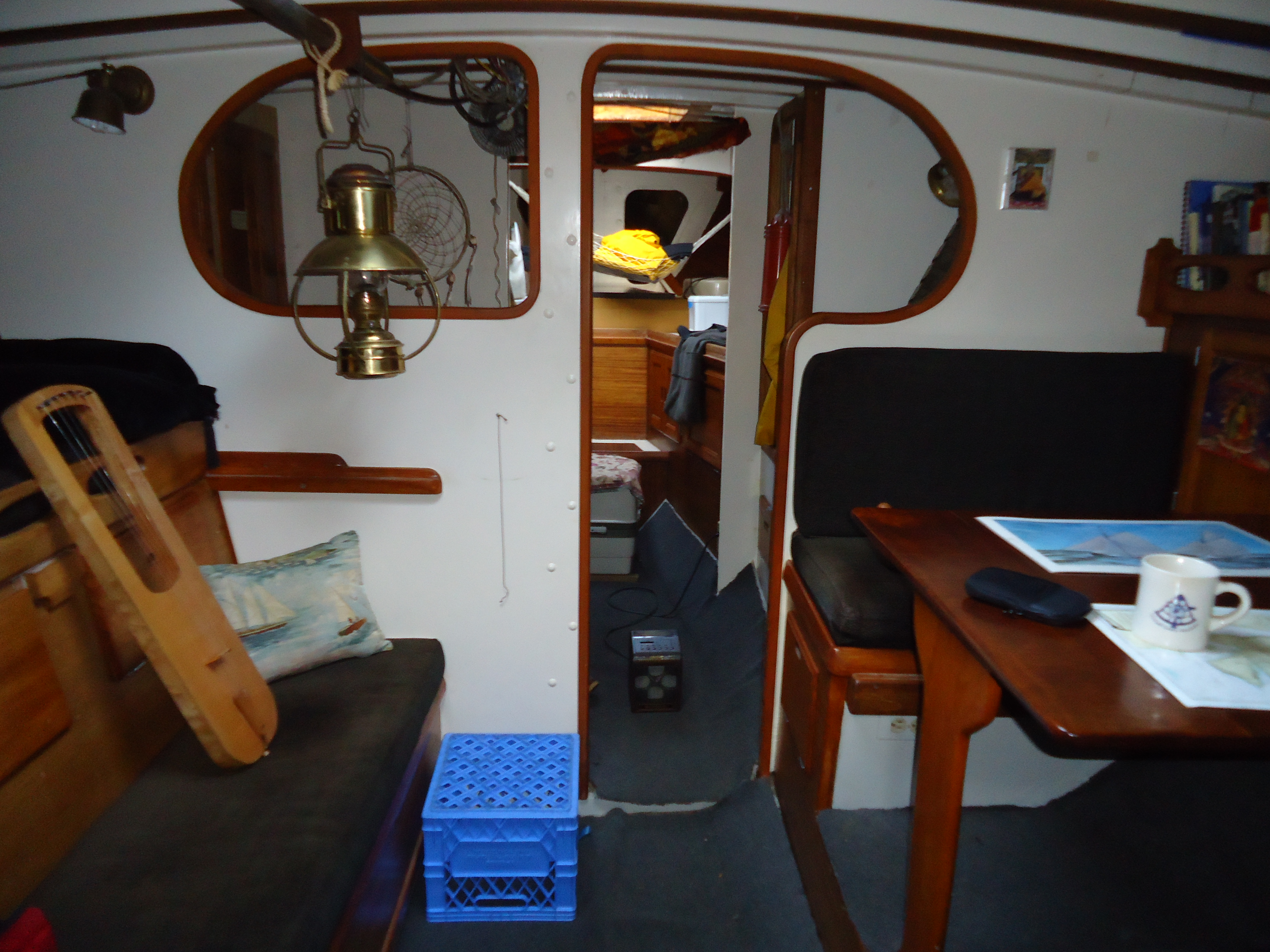
My boat, Old Hand is not a Monk, but was built of such stuff.  Her portly hull design is a scaled-down version of the hefty Norwegian lifeboats designed by Colin Archer.  After 10 years of owning her I’ve   greater appreciation for her ponderous lines and stout workmanshipShaw Island 2009 961.                                         So I am readying for another season of sailing.  I look at tide tables and plot course South toward Old Hand’s first port of call:  Gig Harbor.

So stay tuned for posts chronicling these adventures on the Salish Sea told in art, music and videos.

Posted in Musings

The Anchor-a cosmology

DSC01780 (1)

Here is a painting of the Vickers memorial in Kane cemetery.

anchor 2 An angelic stone figure holding an anchor stands on a pedestal gazing up into the golden light that filters through the maple trees.

jacobs ladder
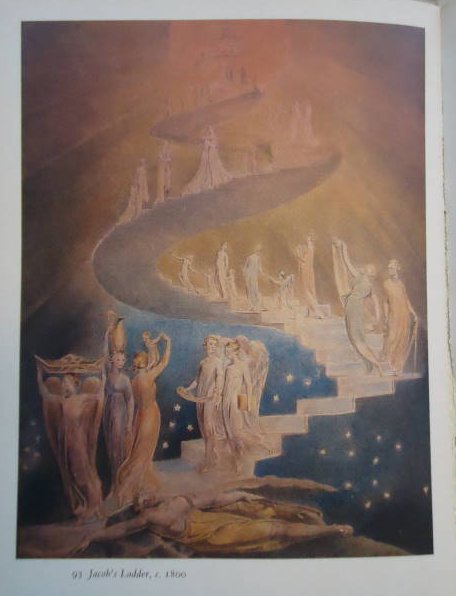
Jacob’s Ladder, by William Blake

The anchor has long been a symbol variously interpreted as faith, hope and soul.  But I think there is another level of interpretation.  The anchor and movement of chain as the tide rises and falls is  a cosmological image.  As the tides rises, the circle occupied by the vessel in its revolutions gets smaller until the chain is vertical, and remains, theoretically, in the center.  This movement describes a cone shape.


Single Gyre

The geocentric, medieval image of the universe, though out-dated by Copernican discoveries, has its origin in human experience and is set to the measure of man’s ratio. It is a true cosmology because it defines spiritual co-ordinates  and gives meaning to a world that, at certain points in history, tends toward a state of dissolution, of entropy. This image of the universe reflects a recurring pattern in civilization’s rise and fall,  yearly cycles, and, on the microscopic level, the alternation of breath.

In Dante’s Divine Comedy, the downward vortex where Satan resides at nethermost point of hell, cast down by gravity and the weight of sin, is mirrored  in the ascending spiral of Mount Purgatory.  In the medieval scheme of salvation, this point is the earthly paradise at the mountain’s summit.  Martha Heyneman in her fascinating book, The Breathing Cathedral, likens this spiral to the movement of thread on a spindle.  She sites Yeats’ vision of  gyres, where the  reciprocal upward and downward movement of these vortexes occur simultaneously.  This reciprocal movement is like the souls ascent through the heavenly spheres at death and the corresponding descent of Divine Intellect into the manifest world, of the timeless dimension into the field of time.

In traditional societies, the dead were honored for their humble service, and the relationship between the dead and living was one of mutual reciprocity. We are culturally enriched by such simple gestures of remembrance. The honor conferred upon the dead completes a pact with the living and the departed are helped in their ascent toward knowledge and liberation.