Posted in Old Hand's northern voyage

Septemptrionic Voyage

DSC02497

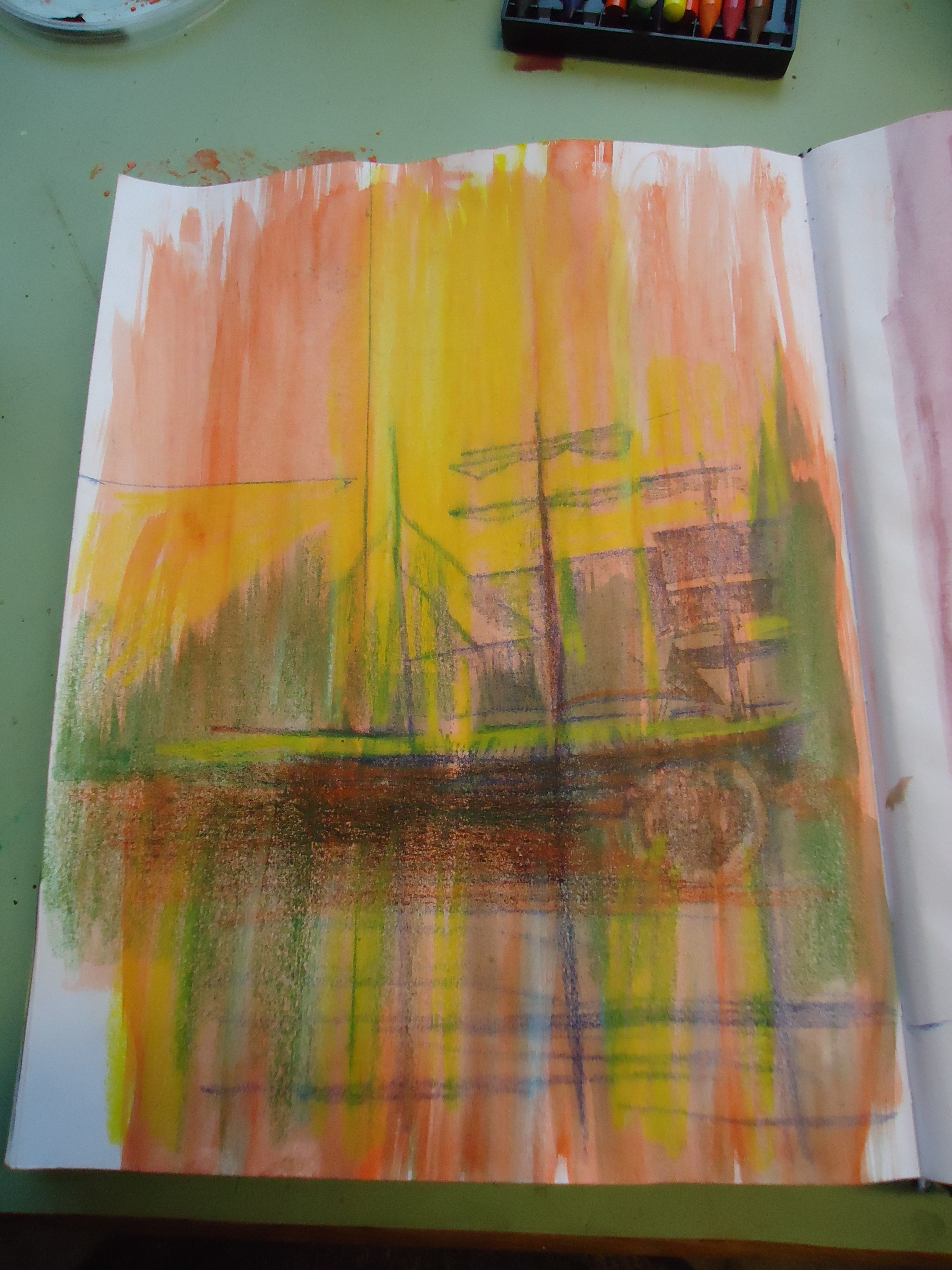
In the mid 70’s I had a studio in Eugene. Nearby was a pioneer cemetery where stood a tall, gray weathered tomb which housed an early patriarch of the Oregon Territory named Septembus Spencer.   While I won’t deny my memory may embellish the facts, this outlandish moniker has stayed with me all these years. Now I find that one of Willamette valley venerable line of Spencers had made his way further north to this stormy spit on Lopez Island’s east shore.

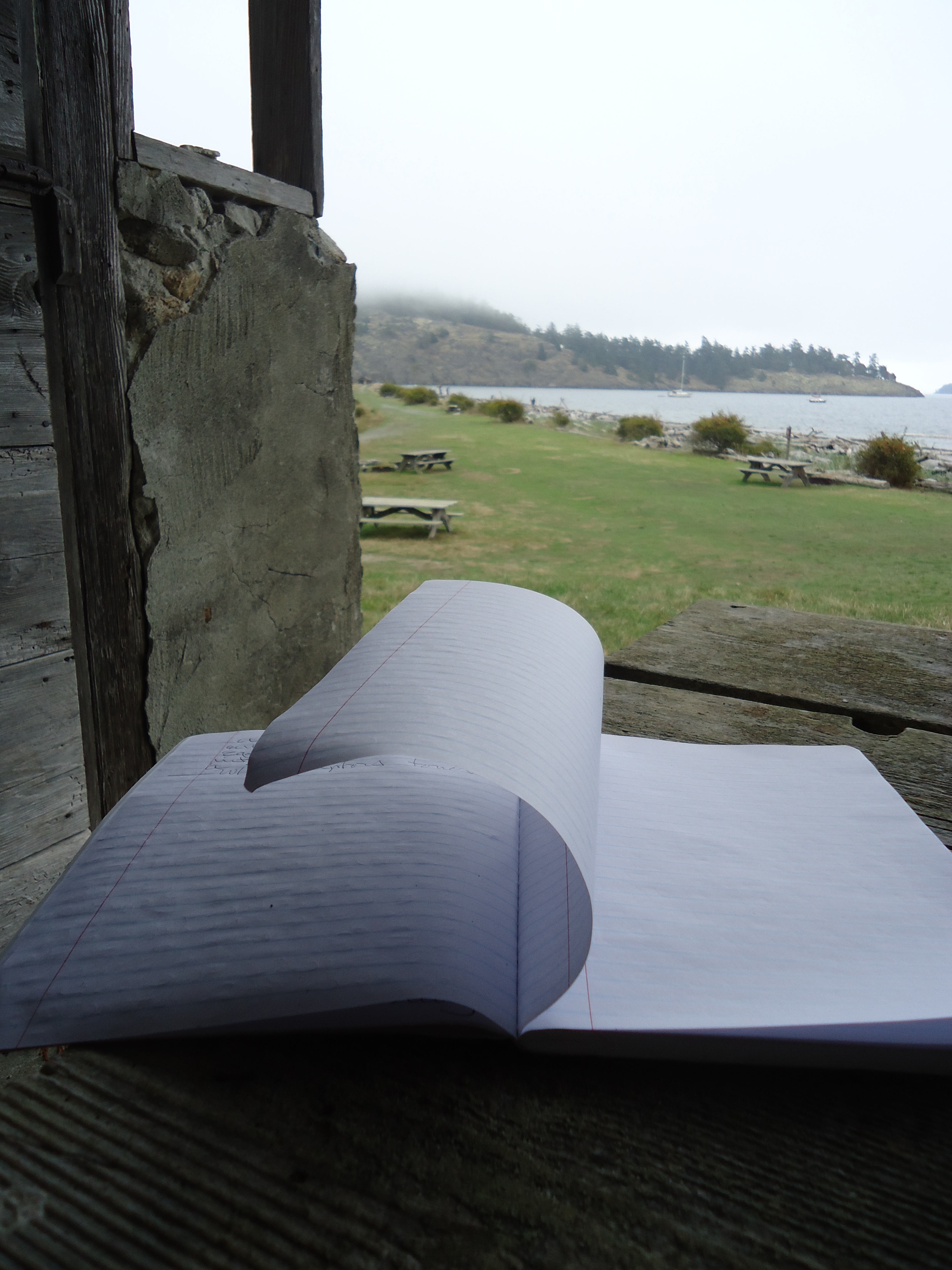
As though by a master sculptor’s hand, Equinoctial storms have carved cyphers into the rough stonework of the storehouse.  Apples still fall from the trees he planted on the grassy knoll.

Septembus comes from Septentrio, which is Latin for North.

On this gravel spit formed with perfect symmetry by alternating currents are seen middens of a tribal fish camp that had been used for over 3,000 years.

Though I bear no relation to the Eugene and Lopez Spencers, I find it strange to arrive at the most northern outpost of those Northwest settlers-that venerable line whose family tomb I saw in my earlier days. It is their most, so to speak, Septentrionic point.

I take heart in knowing that the same northern, wayfaring spirit calling us toward these enchanted Isles inspired the peregrinations of T. W. Spencer-that the same pole star he set his course by is the way point toward which Old Hand shapes her course.

DSC02499

I was taught by a Cowlitz elder that the cardinal directions are more than physical points on the compass, but spiritual states which must be embarked upon with full awareness of all their various qualities.

Black Elk once said the center of the world was Harney  (was this the same hawkish general who tried to incite war with England over a dead pig?) Peak in South Dakota.  Black Elk went on to add that the center is everywhere. It’s the same awareness that lead Jesus to sing to his round-dance on his crucifixion eve:

“The universe is inside the dancer.”

The tide flows into the lagoon at full flood like the rushing green flow of the Willamette River by which I sat staring so long that, when I rose, the solid banks seemed to move with the same fluid motion as the water.

The sacred land is everywhere-is already won. It is somewhere in Harney Channel (Harney again!) The Center is in the old Odd fellows Hall on Orcas Island where we hold our Dance of Universal Peace on this Sunday. The universe revolves around Old Hand’s keel as we voyage to the spiritual state of North; to honor the wisdom teachings of all faiths that ever points us toward the true polestar.
Posted in Paintings in Progress

All that is Golden- The Sun Standard

It’s hard to say why we are struck by certain images.

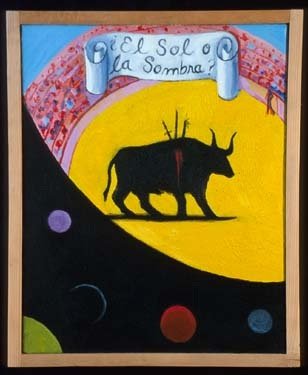
20 years ago I did a painting inspired by a dream of a bullfight. Bullfight ticket sellers ask their customers: “el sol o la sombra? Meaning: “do you want seats in the sun or the shade?”. As the sun passed, the shaded seats commanded a higher price. This fluid standard seemed a true valuation system because of it’s cosmic scope. It might be called the Sun standard.el sol o sombre

Gold and Sun are symbols that announce a new age ruled by the truest of values-that which emerge from the human heart.

In this Spanish interrogative I hear echoed the ancient Mithraic conflict between the Light of Glory and Ahrimanic Darkness. This is a drama which transcends religious history, learned judgments about dualism, and my own, personal revulsion at an act of cruelty.

The arena is a mandala-a microcosm.  The ritual killing it sanctifies has echoes throughout the cycles of history as an archetype-one that charges a brutal spectator sport with religious energy.  it is the reenactment of the primordial victory that ensures the perpetuation of the world.

In his book, Spiritual Body and Celestial Earth, Henry Corbin uses the striking  image of the progersso harmonium to describe the relationship between Shi’ite Islam and the earlier Mazdianism religion. The relation is not the  linear view of religious history by which  fundamentalists of all faiths are bound, but the fundamental tone, the timeless Truth to which all religions are ultimately traced.  It is ever present, running throughout time like a basso profundo under the higher registers of the octave.

To pass from one octave to another is not the same as to pass from one date in time to another, but is a progression to a height or pitch that is qualitatively different. All the elements are changed, yet the form of the melody is the same. Something in the nature of harmonic perception is needed to perceive a world of many dimensions.

So midway between the darkness of uncertainty and the light of inspiration, I revisit a related image, the altar. I set the stage with a yellow/orange ground. I want to hone my harmonic perception that I may realize my theme in a higher register, one that captures it’s elusive quality.day of dead altar

It now becomes  an altar for the Day of the Dead. On it I place my mother’s ashes, the tattered image of dad, and all loved ones who’ve left the arena of life. Here is the true value-the measure of all that is Golden.

Posted in Paintings in Progress

Raven Visitation 2

DSC02373raven window 2

Carrying on with the Raven Visitation. As Raven is the messenger who dwells between worlds, the stained glass window motif fits the theme. It frames the shifty threshold where spirit travels between waking and dream.

Stained-glass demands a faithfulness to process which brings you back, again and again, to the logical form of it’s making. It is fitting that the material for scribing of boundaries in stained-glass windows is Saturn’s element, lead.

It is also fitting that the base material of the painter is charcoal, end product of the calcification process in Alchemy. Composition is a fiery process where all superfluous passages are burnt away, leaving only the original inspiration, the point of it all. It is a reminder of the point of all this shifting between worlds, and the spirit I need to maintain through the fiery calcification process: that my heart’s work may benefit all beings. It is Raven’s wake-up call.

Posted in Paintings in Progress

Raven Visitation

raven windowraven window

I’ve gotten to work on my November art show, beginning with an image inspired by an encounter with raven.

In waking life, while walking in the forest I heard the a rush of a raven’s wings beating the air overhead.

Later, the same sound woke me from sleep. The clear call pierced my dream and I suddenly woke  in my bedroom with nary a raven in sight and the doors firmly shut against intruders.

A visitation, a call? The light-bringer moved between worlds with a sign for me to to transpose into the language of art.

So this is where the work comes in.   It is a Art Deco stained glass window motif I thought appropriate Raven’s boundary-crossing spirit.  It is a spirit that, as James  Fielden puts it in his beautiful post,  A Lapse of Time, “pushes against the edges of mystery.”

Posted in Books I love

Books I love-Journey to Ixtlan by Carlos Castaneda

You must give up your personal history.

This terse comment by Carlos Castaneda’s teacher Don Juan, in Journey to Ixtlan, contains the key to this spiritual travelogue in which he renounces his anthropological career to enter the sorcerer’s path.

The drawings done of Castaneda, partially erased by himself, speak more eloquently than revelations of his mendacity or alleged misogyny.

For the sorcerer, reality, or the world we know is only a description.

For novelists (it is absurd to argue which category this work belongs) the world is the reality in which they are immersed at the moment of creation.

My feelings were clear bodily sensations; they did not need words.

Yet he describes, at great length, terrifying encounters in  the intermediate realm. When Castaneda is shaken by these experiences, Don Juan commands him:

Write! Write or you’ll die!

It is an imperative Castaneda takes to heart.   Abandonment of personal history might contradict Don Juan’s statement about writing as survival but, rather than a bid for immortality, Castaneda’s account may be the final act of self erasure.  It resulted, ultimately, in irrelevance.  As he progressed to the rank of Nagual (teacher of sorcery), the fiction stylist was displaced by his persona-his double.  As he was subsumed into the anemic New-Age genre, he became infatuated by his own image (or its absence) and got mired in convoluted explications of sorcery.   Most fatal, he lost his sense of humor.

Unfortunately this seems to be the lot of many successful artists who find endless justification for their surrender to the allurements of the marketplace.

But Journey to Ixtlan is Castaneda in his prime. Take the hilarious scene where Don Juan and his sidekick Don Genaro-as antidote to Castaneda’s attachment to his worldly vehicle-make his car disappear:

“Where’s my car?”

Don Genaro began turning over small rocks and looking underneath them…

“Don Genaro is a very thorough man,” Don Juan said with a serious expression. “He’s as thorough and meticulous as you are. You said yourself that you never leave a stone unturned. He’s doing the same.”

Genaro, puffing and sweating, tries to lift a boulder.

 We could not budge the rock. Don Juan suggested we go to the house and find a thick piece of wood to use as a lever…

Resigned to this insanity, Castaneda lends a hand; with a tremendous effort, they lift the boulder.

 …Don Genaro examined the dirt underneath the rock with the most maddening patience and thoroughness.

“No. It isn’t here,” he announced.

Other passages are suffused with a beauty as stark and dramatic as the desert landscape through which they travel. In the chapter, Becoming a Hunter, the sophisticated anthropologist, Castaneda, admits to the reader his feelings of superiority over an Indian.  Reading his mind, Don Juan says:

“We are not equals.  I am a hunter and a warrior and you are a pimp.”

Don Juan then meets Castaneda’s angry protest at these harsh words with a masterful act of “not doing.”

…when it was pitch black around us he seemed to have merged into the blackness of the stones. His state of motionlessness was so total it was if he did not exist any longer.

It was midnight before I realized that he could and would stay motionless there in that wilderness, in those rocks, perhaps forever if he had to. His world of precise acts and feelings and decisions was indeed superior.

I quietly touched his arm and tears flooded me.

Castaneda has been maligned for having done his field-work exclusively in the UCLA library.  But, for me, this only makes his work more impressive.  No other writer so cannily expressed the manic spirit of the psychedelic era. I am forever astounded by the man who could transmute the dusty anthropological tomes of the UCLA library into supreme works of imagination.

Posted in Saturnius McWhirr stories

Sailing the Bardo of Rebirth with McWhirr

port madisson images 032Cats paws darkened the blue reach of Puget Sound beyond Skiff Point to the north. I went below to shut down Phyllis, my Norwegian diesel engine (named after my mother,) trusting the breeze would hold and keep us off the shallow bank south of Fay Bainbridge park. There’s nothing so peaceful as that moment when the wind lifts and the engine is shut off. Old Hand sails better without human interference close-hauled, so I sit back and listen to the sound of water moving along her hull as she gathers speed along Bainbridge Island’s east shore.

It was lovely. We had attained a state of harmonious accord between man and boat in the mandala of winds, and that single point we occupied at that particular moment in time and space was golden perfection. I try to seize such moments on the fly and, by retelling them, prolong existence itself and sail with the generous breeze into eternity.

“Look sharp, Mister Spencer.”

The resonant voice was hoarse, as if graveled by long watches in the north Atlantic-as if it emerged from the very depths of the bilges.

“Ready about.”

“Ready about.”

McWhirr paused then called:

“Helm’s alee!”

I let go the jib sheet as the bow came across the wind and hauled in for a port tack toward deeper water northeast.

“Nicely done, lad. Ye’ll be a sailor before long.”

McWhirr is a pain in the neck sometimes. He’s a relic of working sail and can be as dark as Ahab in rehab on a bad hair day.

But such a breeze can soften a heart encrusted by long watches over icy seas. McWhirr stood stark against the red sky like a weathered piling on a  rocky cape.  Light flickered through the dark shrouds  behind him as if projected on a movie screen.

“What do you make of the Ancient Mariner’s yarn, lad?”

– through soul’s stations he sails…sweetly, sweetly blew the breeze…sigh of compassion that pervades all creation… repents his cruel slaughter of the innocent bird and sees divinity in all beings… it raised my hair, it fanned my cheek…essential reality…wisdom and compassion combined…

“It’s a strange tale.”

McWhirr brooded as if some heavy recollection had made him grow, if it were possible, even more saturnine.

“Aye, we all carry the albatross’ weight around our necks.”

-tangled lines lost in fouled line-lockers…it mingled strangely with my fears…endless dream pilgrimages through foreign city streets looking for misplaced baggage… He loved the bird who loved the man… all those times too slow on the uptake, clueless or proud... who shot him with his bow..neglect of kin…Mom’s eyes…executors of karmic law…archons of the muddy sphere in which my life is, more or less, firmly moored …Oh, my neck.

“What about that part where he must repeat his tale endlessly to strangers?”

“I don’t know.   It sounds like a writer I know. But I won’t mention any names.”

Posted in videos

The Rhyme of the Ancient Mariner

I shot this video yesterday while cruising slowly down Bainbridge Island’s east shore toward Point Monroe and Port Madison beyond.  Although my speed was a mere 2 knots, it was one of those days where all came together in a perfect moment.  The only sign of wind I saw wind was along my course-

…on me, alone, it blew.

Posted in Saturnius McWhirr stories

The McWhirr stories-An Afterword?

Cormorants are huddled like a conclave of robed mystics brooding over lost fish. The wind blows from all directions in Port Madison.

I write windy dialogue that transpires between two contrary characters.  I suppose the I of the story refers to myself, but even this first-person identity gets pretty tenuous at times.  I am obtuse foil to McWhirr’s exacting command, and he is confounded by my poetic flights.  This tension, this ever tipping dynamic, propels the leaky vessel of my prose.

In the voyage of this yarn to it’s “conclusion”, fact and fiction are interwoven to create a tapestry of associative episodes in order to express some ineffable truth about man’s impulse toward adventure.

But to what degree can I actually claim these adventures mine? Where was the line crossed between inspiration and plagiarism? All my powers of expression are called upon to render a fictional account of  vaguely recalled events in the transient world of sensations and ideas.

craig at helm 014
Me sneezing

I’ve come close to foundering in a fog of  fantasy, relevant only to myself or to those souls fortunate enough (or unlucky enough) to be conversant with sailing lore, and experienced in the sea’s fickle ways.

Where has McWhirr gone? While his vanishing act seems a natural outcome of the narrative flow, it has left me without bearings-without a meaningful waypoint.  He’s left me becalmed at slack water, transfixed by sunlight on the Strait of Juan de Fuca, with only an obscure missive from Virgil’s heroic verse:  From me learn courage and patience, from others the meaning of fortune.  Then again, maybe this is all the bearing I need.

Though the dream of finding a copy of the Aeneid happened some 20 years ago, it’s true import remains enigmatic.  But I feel it has to do with carrying on a lineage, the bearing of the household gods to establish a new homeland or  mode of awareness.  It’s also about a mutual need, a pact made with the dead to honor them.  My dad’s ghost comes and goes in the story, and recalls me to some forgotten bond.  He says I should heed McWhirr.

The View from the Wheelhouse is a fluid one, and successful navigation depends on an ability to tolerate a constantly shifting perspective. The conclusion of this tale is as elusive as a Micronesian landfall.

So I trust this isn’t the last we’ve heard from McWhirr. The wily old coot’s vanishing act may be prologue to his reinstatement on a more believable level of fictional existence.

Wars are started by mistaking the thing in itself for the metaphor, and the inability to see through the symbol, as through a veil, to the symbolized. Scientists have recently discovered that the north wind doesn’t really have a beard and puffy cheeks. We’ve evolved beyond such nonsense.  But this knowledge is of little use to the sailor driven on a rocky lee shore by a fierce northerly gale.  For myself and everyone, I pray to the household gods.

Posted in Saturnius McWhirr stories

The Rapture of McWhirr

Stars vanished in the rosey dawn and the earthen red facade of the old seafront was reflected on the smooth water of Port Townsend Bay. I served up kippers and joe to Captain McWhirr as he plotted our course across the Strait of Juan de fuca, drawing arcs over a chart of the eastern Straits with an aged compass that might have demarcated the first measured globe.

“Best we are underweigh at 0800 hours.”

“More joseph sir?”

Smiling strangely serene, he said:

“Aye, That’ll do nicely, old son.”

We headed out across the flat surface of Admiralty Inlet with the last of the flood, keeping Partridge Point fine on the port bow.

“ Now lay our course 318 degrees toward the Romeo Alfa buoy. Call me at slack water.”

“318 degrees it is, sir.”

McWhirr went below, leaving the weight of command to me. The calm, blue surface of the straits reached far westward. The regular thump of the diesel engine set a rythym that wove songs of lost schooners into our widening wake, and drew us, with the swirling kelp, into deeper sound.

O our packet sails tomorrow…studio etc 016

We bore away northwest. An eagle soared in high cirrus where the great indraught of the sea swept past the headland into the inlets of soul.  Gulls were flattened across the blue vault of sky. The bell sounded and the sea heaved in steady writhing swells from the Pacific Ocean as the torpid heat drove all energy from the weary face of the world.

Shal-low-O- Shallow Brown…

A blip on the radar screen moved toward us through the seven concentric circles like a wrathful diety seeking tribute-like an archon who held Old Hand in irons, bound to earthly time, and from which we yet nursed a forlorn hope of deliverance.

And it fills me heart with sorrow…

The waypoint cross of the GPS fixed the moment on the still sea. All space was enclosed in the mystic compass rose, and our voyage was but another leg in man’s perpetual departure beyond the world’s edge; to where the the sunlight’s descent crosses the horizon’s sparkling band, and time intersects infinity.

Shal-low Shallow Brownstudio etc 011

I went below to find McWhirr gone. There was only a tattered copy of Virgil’s Aeneid. A passage highlighted in gold caught my eye:

From me learn patience and true courage, from others the meaning of fortune.

McWhirr has left for the far shore, cut his painter and retreated through the diaphanous veils that seperate worlds. In a realm between the offices of master and mate he floats supine, hands clasped over his white beard, in surrender to the ebbing stream where all noble hearts must finally hie. He was the true sovreign of the watery sphere which had long held me captive. He is the enlightened aspect of my inner Captain Bligh, Noah of my being, guiding me safely past malestroms where the faithless whirl forever amid skeletal hulks and drowned chain.

Here’s a beautiful rendition of Shallow Brown by Sting.