Posted in Euphrates Voyage

At Nebuchadnezzar’s Quay

The Samamaris was making frightful leeway as we rounded the bend towards our moorings at Nebuchadnezzar’s quay. But it lightened somewhat on our approach and Captain McWhirr eased her up as if it were a Sunday family cruise. The storm, fierce as it had been, died down as quickly as it had risen.

“Make off the bowline to the second bollard Mister Spencer.”

“Easy now professor.”

After making fast and shutting down the boiler, we jumped ashore for a look around. It was an ancient mound—or tell—that slowly sloped down into the depths of the river to form the quay. The lower strata was made of baked mud bricks coated with bitumen, some of which were stamped with the seal of Nebuchadnezzar himself. To the Northwest, the mound rose high against the hot afternoon sun. An Arab Shepard stood gazing down at this apparition of a stern-wheel steamer with a wheelhouse that sat on her deck like a little hat on a frumpy British dowager.

Soon, a short guy in a white suit and pith helmet walked up and made an obsequious bow.

“I am Joesph Cairo of the customs office. Would you be the Captain of the steamer Samaramis?”

“I would.”

“The customs office has impounded your vessel due to a minor technical matter regarding…”

“Bakshish?” interrupted McWhirr.

“I wouldn’t put it so indelicately. But there are certain processing costs incurred by the Museum trustees sponsoring this worthy effort to preserve our priceless treasures for the future edification and enrichment of both of our great nations.“

“For the enrichment of somebody anyway.”

Cairo smiled placidly: “I heard you were a man of few but laconic words, Captain McWhirr. Shall we go to my office? It’s just up the promenade.”

McWhirr is well accustomed to Cairo’s ilk. Recent digs and spectacular finds have brought out sleazy shysters to exploit the ignorance of scholars and archeologists. Especially vulnerable to such scams are the rapture tourists, who seek affirmation of scripture by marking the river’s depths, which— as is prophesied in the Book of Revelations—will dry up as a sign of the end times. The chandler in Bagdad enjoys a brisk trade selling sounding gear to these New Age fundamentalists. But these days, all that’s needed is a pool cue, so they may have a point after all. An inch drop will have them speaking in tongues, talking to lizards and enthralled by the thought of total annihilation of a third of humankind. But we were concerned with more prosaic matters regarding the water’s depth. A blow like we had earlier could drive our shallow draft vessel sideways onto the bank, prey to bandits who roam this desert with impunity.

But events that were to unfold cast a new light on the prophesied end-times, and gave us—if not eternal salvation—a hard-won appreciation for the convoluted twists of fate.

We walked up the towpath—or “promenade” as Cairo so generously called it—and came to the customs house. It was no more than a shack of mud brick and bundles of reeds. A guy in a green visor and sleeve garters sat next to a fake banana plant contemplating a calendar. This month’s model was Theda Bara tricked out as the Goddess of the Underworld. Those dark eyes followed me around the shack; eyes that can go from abject terror to ecstatic elation without so much as a smoke break between takes. We paid the gentlemen who were, after all, only playing their parts in the perpetual exchange of vice and virtue; where everything evens out in the end—more or less.

Later, as I lay on the pilot house bunk listening to the eerie keening of jackels far into the night, I could hear the professor intone:

“He set sail; the father set sail,

Enkei the God of Wisdom set sail for the underworld

……the waters of the sea devoured the bow of his boat like wolves.

The waters of the sea struck the stern like lions.”

I flowed downriver. The bleak boatman had abandoned his tiller, leaving me adrift. But I escaped shipwreck and the scene suddenly changed. I gazed into the blue eyes of the glittering goddess. We embraced and kissed. It was a sweet soul kiss that I could still taste when I woke to McWhirr’s hail.

“All hands on deck!”

McWhirr runs a tight ship, even if it is a mode of propulsion he thinks unseemly for a man of working sail.

O. Handy Bey—Director of the Imperial Ottoman Museum, 1888 CE
Posted in poetry, Seal log

Logboom Update

Number 25 of the season–whom I shall name William–was born around 0400 hours this morning. Marty, rising early for work, kindly kayaked around them in order to avoid disturbing the vital, bonding ritual between mom and newborn pup. Good on ya, mate.

The drama on the logboom is always entertaining. A yearling deposed William from the choice haulout spot for the latest pups, while Will’s mom growled and waved her flipper in righteous indignation at the clueless interloper. Harumph.

I named the latest two pups after William Blake and his brother, who appeared to the poet long after Robert’s passing; to guide him in the alchemical process of gravure. This relates to my last post about negative capability. Robert’s physical absence gave way to spiritual presence, which guided Blake into the mysteries of relief etching. This technique–which Blake was the first to use–requires a disolution of the copper plate in acidic hellfire in order to exalt the spiritual form as pure light.

Kathleen Raine writes of how the ancient Persephone myth appears in Blake’s poetry to symbolize the soul’s descent into the the material world. The Neo Platonists–whose philosophy Raine says informed Blake’s work–saw birth as death or banishment of the most vital and ineffable part of us.

O life of this our Spring! Why fades the lotus of the water? Why fade these children of the Spring, born but to smile and fall? Ah! Thel is like a watery bow, and like a parting cloud, like a reflection in the glass; like shadows in the water.

Posted in Old Hand's Indonesian Voyage, Saturnius McWhirr stories

Old Hand’s Indonesian Voyage–episode 1

The bewitching breezes that had vexed our northerly course along the bleak, rocky coast gave way to an absolute calm as we steamed into Sunda Kelepa Harbour and brought up under the ornate, lofty spires of Jakarta.  It was as though the anchorage were under the spell of some vengeful deity that held the stagnant seaport in irons– a fitful sleep of waking dream. I gazed up at Jakarta’s towers and heard, high on the ramparts, Rama’s  gong-struck plea to deliver a flute-weeping Sita from Ranga’s jangling curse.  A sword held against a blood-red sky by masked Barong tragediennes brought down the threadbare, red curtain in the ritual re- enactment of the primal leave-taking and arrival; when carved gods glared from the bowsprit, holding vigilant watch against marauders while we were moored off the savage isle of dreams.  I too, have sat hungry around those ancestral fires, a villan, hero or common swab, subject to the changeable turns of karmic law..

.“Skip lively, Mister Spencer.”

The resonant voice was hoarse, as if weathered by eternal watches on the Greenland ice, or worn ragged from hurling oaths into the teeth of a gale. I flaked out 5 fathoms of chain from the locker with hamfisted elegance.

“Nicely done, lad. Ye’ll be a sailor before long.”

McWhirr is a pain in the ass sometimes. He’s a relic of working sail and can be as dark as Ahab in rehab on a bad hair day.  He stood stark against the red sky like a weathered piling on a  rocky cape.  Light flickered through the dark shrouds, his shadow looming on the limp stays’l behind him, as if projected on a movie screen.  The  harrowing passage through the Sunda Strait had frayed my nerves and I groped clumsily the 3/8ths chain from the locker.

“All right, Mister Spencer.”

I let go the anchor. There sounded a low rumble as I paid out 3 fathoms of chain into the muddy bottom of Sunda Kelapa Harbour.

“Have you paid out enough scope, lad?”

“I cast the anchor in 6 fath…” I said.

“Avast, Ya greenhorn! You don’t “cast” anchors. This isn’t fly-fishing! My gorge rises at such lubberly misuse of sailing language.”

His wrath, like a line-squall, subsided as rapidly as it came.

“Did you know that to raise an anchor you must first let it go?”

“That’s true, sir.”

He always makes these pithy pronouncements like they were scripture.  And, for McWhirr the act of sailing is a religious rite. He hails from Zoroastrian, Quaker stock and, for him, a ship is a vessel to carry his weary spirit ascending through the seven concentric spheres of corporeality to the final landfall of essential being. He has seen the beatific vision reflected on the sea’s mirror and it draws him ever northward in search of the true face of divinity behind the mask of appearance.

Posted in Paintings in Progress

All that is Golden- The Sun Standard

It’s hard to say why we are struck by certain images.

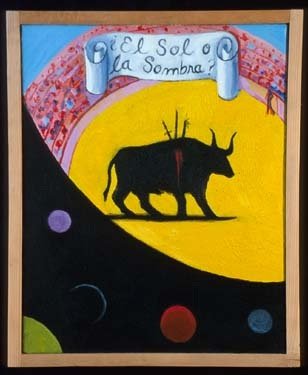
20 years ago I did a painting inspired by a dream of a bullfight. Bullfight ticket sellers ask their customers: “el sol o la sombra? Meaning: “do you want seats in the sun or the shade?”. As the sun passed, the shaded seats commanded a higher price. This fluid standard seemed a true valuation system because of it’s cosmic scope. It might be called the Sun standard.el sol o sombre

Gold and Sun are symbols that announce a new age ruled by the truest of values-that which emerge from the human heart.

In this Spanish interrogative I hear echoed the ancient Mithraic conflict between the Light of Glory and Ahrimanic Darkness. This is a drama which transcends religious history, learned judgments about dualism, and my own, personal revulsion at an act of cruelty.

The arena is a mandala-a microcosm.  The ritual killing it sanctifies has echoes throughout the cycles of history as an archetype-one that charges a brutal spectator sport with religious energy.  it is the reenactment of the primordial victory that ensures the perpetuation of the world.

In his book, Spiritual Body and Celestial Earth, Henry Corbin uses the striking  image of the progersso harmonium to describe the relationship between Shi’ite Islam and the earlier Mazdianism religion. The relation is not the  linear view of religious history by which  fundamentalists of all faiths are bound, but the fundamental tone, the timeless Truth to which all religions are ultimately traced.  It is ever present, running throughout time like a basso profundo under the higher registers of the octave.

To pass from one octave to another is not the same as to pass from one date in time to another, but is a progression to a height or pitch that is qualitatively different. All the elements are changed, yet the form of the melody is the same. Something in the nature of harmonic perception is needed to perceive a world of many dimensions.

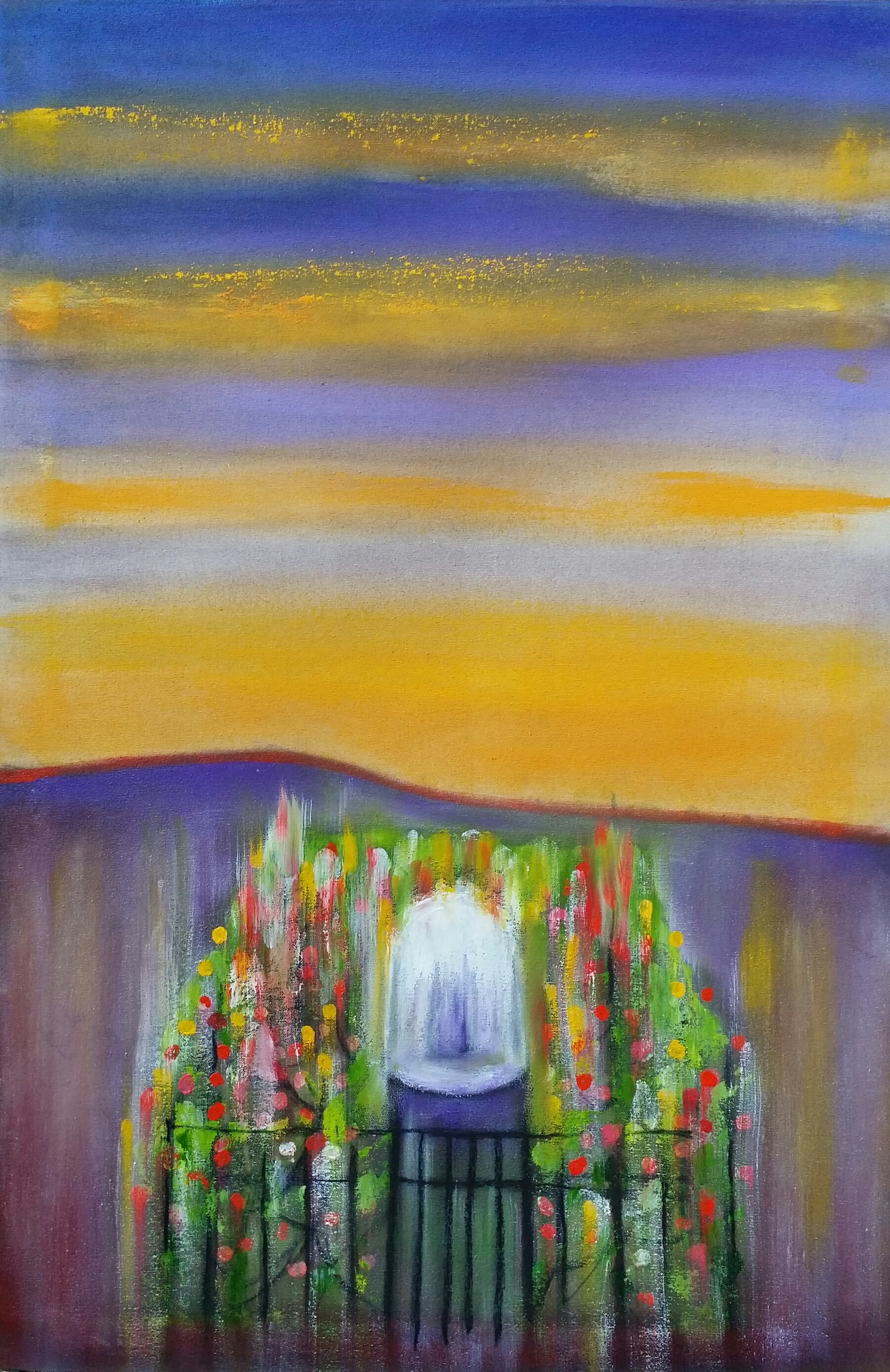
So midway between the darkness of uncertainty and the light of inspiration, I revisit a related image, the altar. I set the stage with a yellow/orange ground. I want to hone my harmonic perception that I may realize my theme in a higher register, one that captures it’s elusive quality.day of dead altar

It now becomes  an altar for the Day of the Dead. On it I place my mother’s ashes, the tattered image of dad, and all loved ones who’ve left the arena of life. Here is the true value-the measure of all that is Golden.

Posted in Paintings in Progress

Raven Window-The Albedo Phase

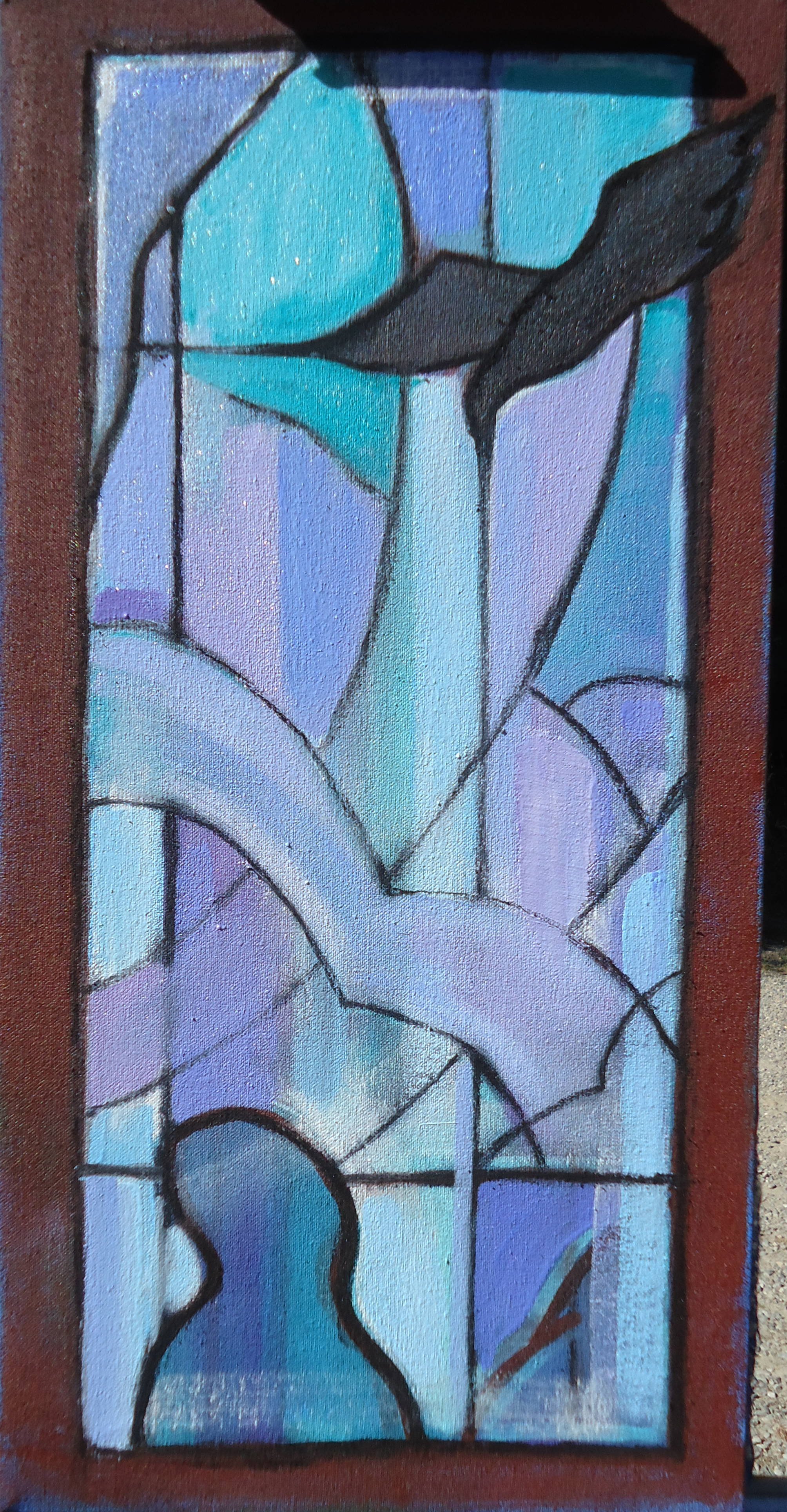
DSC02382raven window 3The canvas is theTemenos, where I had earlier faced the black work of the Nigredo- where the inessential was burnt away leaving the skeletal composition etched in blackest black..

Stained glass framed the scene for my latest confrontation with doubt and the obstinate reality of the Prima Materia.

Now is the phase to which corresponds the Alchemical process of the Albedo-the whitening.

The Hermetic philosopher, Artephius said it is:

“That which is uplifted by the air…pure, subtle, brilliant, clear as the dew, diaphanous as unflawed crystal.”

The diaphanous in between I invoke, where light reflects both ways.

Julius Evola, says in the Hermetic Tradition says the Albedo:

“ …reintegrates the personality with the non-corporeal state.”

It moves me outward from this dark interior of crowded thoughts, into something vast-where the spectral colors of the work’s final phase finds its completion in harmony.

It is Raven’s call.

Posted in Paintings in Progress

Raven Visitation 2

DSC02373raven window 2

Carrying on with the Raven Visitation. As Raven is the messenger who dwells between worlds, the stained glass window motif fits the theme. It frames the shifty threshold where spirit travels between waking and dream.

Stained-glass demands a faithfulness to process which brings you back, again and again, to the logical form of it’s making. It is fitting that the material for scribing of boundaries in stained-glass windows is Saturn’s element, lead.

It is also fitting that the base material of the painter is charcoal, end product of the calcification process in Alchemy. Composition is a fiery process where all superfluous passages are burnt away, leaving only the original inspiration, the point of it all. It is a reminder of the point of all this shifting between worlds, and the spirit I need to maintain through the fiery calcification process: that my heart’s work may benefit all beings. It is Raven’s wake-up call.