Posted in Musings

Surf City-The Slow Death of Huntington Beach

As a wide-eyed gremlin, I watched a surfer streak across a massive green wall and straight through the barnacle-encrusted, concrete pilings of Huntington Beach Pier. It was the 1964 Surfing Championship and all the big names were there. An unknown, Laguna Beach goofy-footer named Jim Craig took top honors for that awesome beast of a wave.

Even back then, there was civil unrest.  I recall passing a broken storefront window on my way home.

After I moved away, the rapaciousness of developers and city leaders in Huntington had transformed the funky beach town into a surfing theme park-a vast, out door shopping mall.

In 1986, during the OP Pro surfing contest, the crowd got unruly, burned trash cans, overturned and torched police cars. It appeared some vestige of the town’s wild spirit yet remained, despite all efforts to redirect it into acceptable channels-where the only expression of freedom encouraged is a choice between what brand of surf trunks to wear.

It is pointless to get moralistic about the stupid outbreak of violence this past week. But whatever our judgements, the riot was a response to social engineering-where power imposes constraints that are integrated with city planning and architecture itself. With the city’s long history of capitulation to  marketplace demands, citizens were disenfranchised and reduced to the role of passive consumers. But the spirit of rebellion won’t be stifled, though it fights targets as elusive as quicksilver (a telling brand name in this heady mix, and part of the corporate attempt to misappropriate surfing’s mercurial spirit.) Even the most chaotic and, on the surface, meaningless, events have a hidden logic, and the spontaneous explosion at this year’s surf contest was fueled by a long, bitter history of city mismanagement and greed.

Huntington Beach has long been a site of pilgrimage. People flock from the congested suburbs inland, to where the pier stretches into the sea as if it might extend man’s dominion ever further into pure emptiness itself. The theme of westward movement is encoded in our DNA and shapes our literature from Cather to Steinbeck, Kerouac and beyond. It is an Archetypal journey on which the soul travels from the world of endless toil and confinement to the promised land where we might, at last, find happiness in the spacious land of infinite surf, sun and fun, fun, fun.
Posted in Paintings in Progress

All that is Golden- The Sun Standard

It’s hard to say why we are struck by certain images.

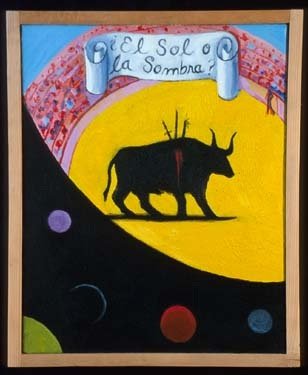
20 years ago I did a painting inspired by a dream of a bullfight. Bullfight ticket sellers ask their customers: “el sol o la sombra? Meaning: “do you want seats in the sun or the shade?”. As the sun passed, the shaded seats commanded a higher price. This fluid standard seemed a true valuation system because of it’s cosmic scope. It might be called the Sun standard.el sol o sombre

Gold and Sun are symbols that announce a new age ruled by the truest of values-that which emerge from the human heart.

In this Spanish interrogative I hear echoed the ancient Mithraic conflict between the Light of Glory and Ahrimanic Darkness. This is a drama which transcends religious history, learned judgments about dualism, and my own, personal revulsion at an act of cruelty.

The arena is a mandala-a microcosm.  The ritual killing it sanctifies has echoes throughout the cycles of history as an archetype-one that charges a brutal spectator sport with religious energy.  it is the reenactment of the primordial victory that ensures the perpetuation of the world.

In his book, Spiritual Body and Celestial Earth, Henry Corbin uses the striking  image of the progersso harmonium to describe the relationship between Shi’ite Islam and the earlier Mazdianism religion. The relation is not the  linear view of religious history by which  fundamentalists of all faiths are bound, but the fundamental tone, the timeless Truth to which all religions are ultimately traced.  It is ever present, running throughout time like a basso profundo under the higher registers of the octave.

To pass from one octave to another is not the same as to pass from one date in time to another, but is a progression to a height or pitch that is qualitatively different. All the elements are changed, yet the form of the melody is the same. Something in the nature of harmonic perception is needed to perceive a world of many dimensions.

So midway between the darkness of uncertainty and the light of inspiration, I revisit a related image, the altar. I set the stage with a yellow/orange ground. I want to hone my harmonic perception that I may realize my theme in a higher register, one that captures it’s elusive quality.day of dead altar

It now becomes  an altar for the Day of the Dead. On it I place my mother’s ashes, the tattered image of dad, and all loved ones who’ve left the arena of life. Here is the true value-the measure of all that is Golden.

Posted in Paintings in Progress

Raven Window-The Albedo Phase

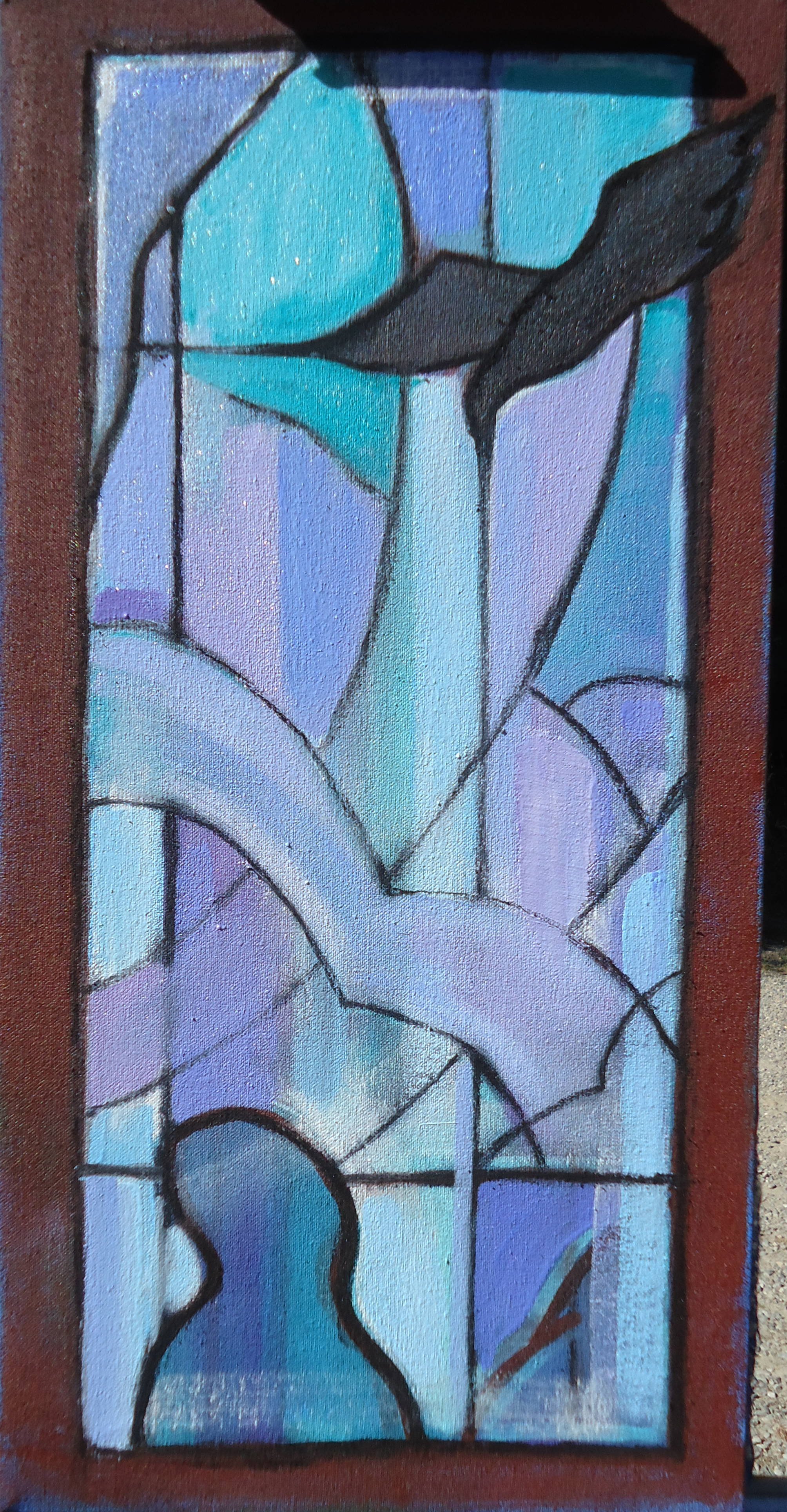
DSC02382raven window 3The canvas is theTemenos, where I had earlier faced the black work of the Nigredo- where the inessential was burnt away leaving the skeletal composition etched in blackest black..

Stained glass framed the scene for my latest confrontation with doubt and the obstinate reality of the Prima Materia.

Now is the phase to which corresponds the Alchemical process of the Albedo-the whitening.

The Hermetic philosopher, Artephius said it is:

“That which is uplifted by the air…pure, subtle, brilliant, clear as the dew, diaphanous as unflawed crystal.”

The diaphanous in between I invoke, where light reflects both ways.

Julius Evola, says in the Hermetic Tradition says the Albedo:

“ …reintegrates the personality with the non-corporeal state.”

It moves me outward from this dark interior of crowded thoughts, into something vast-where the spectral colors of the work’s final phase finds its completion in harmony.

It is Raven’s call.

Posted in Paintings in Progress

Raven Visitation 2

DSC02373raven window 2

Carrying on with the Raven Visitation. As Raven is the messenger who dwells between worlds, the stained glass window motif fits the theme. It frames the shifty threshold where spirit travels between waking and dream.

Stained-glass demands a faithfulness to process which brings you back, again and again, to the logical form of it’s making. It is fitting that the material for scribing of boundaries in stained-glass windows is Saturn’s element, lead.

It is also fitting that the base material of the painter is charcoal, end product of the calcification process in Alchemy. Composition is a fiery process where all superfluous passages are burnt away, leaving only the original inspiration, the point of it all. It is a reminder of the point of all this shifting between worlds, and the spirit I need to maintain through the fiery calcification process: that my heart’s work may benefit all beings. It is Raven’s wake-up call.

Posted in Paintings in Progress

Raven Visitation

raven windowraven window

I’ve gotten to work on my November art show, beginning with an image inspired by an encounter with raven.

In waking life, while walking in the forest I heard the a rush of a raven’s wings beating the air overhead.

Later, the same sound woke me from sleep. The clear call pierced my dream and I suddenly woke  in my bedroom with nary a raven in sight and the doors firmly shut against intruders.

A visitation, a call? The light-bringer moved between worlds with a sign for me to to transpose into the language of art.

So this is where the work comes in.   It is a Art Deco stained glass window motif I thought appropriate Raven’s boundary-crossing spirit.  It is a spirit that, as James  Fielden puts it in his beautiful post,  A Lapse of Time, “pushes against the edges of mystery.”

Posted in Books I love

Books I love-Journey to Ixtlan by Carlos Castaneda

You must give up your personal history.

This terse comment by Carlos Castaneda’s teacher Don Juan, in Journey to Ixtlan, contains the key to this spiritual travelogue in which he renounces his anthropological career to enter the sorcerer’s path.

The drawings done of Castaneda, partially erased by himself, speak more eloquently than revelations of his mendacity or alleged misogyny.

For the sorcerer, reality, or the world we know is only a description.

For novelists (it is absurd to argue which category this work belongs) the world is the reality in which they are immersed at the moment of creation.

My feelings were clear bodily sensations; they did not need words.

Yet he describes, at great length, terrifying encounters in  the intermediate realm. When Castaneda is shaken by these experiences, Don Juan commands him:

Write! Write or you’ll die!

It is an imperative Castaneda takes to heart.   Abandonment of personal history might contradict Don Juan’s statement about writing as survival but, rather than a bid for immortality, Castaneda’s account may be the final act of self erasure.  It resulted, ultimately, in irrelevance.  As he progressed to the rank of Nagual (teacher of sorcery), the fiction stylist was displaced by his persona-his double.  As he was subsumed into the anemic New-Age genre, he became infatuated by his own image (or its absence) and got mired in convoluted explications of sorcery.   Most fatal, he lost his sense of humor.

Unfortunately this seems to be the lot of many successful artists who find endless justification for their surrender to the allurements of the marketplace.

But Journey to Ixtlan is Castaneda in his prime. Take the hilarious scene where Don Juan and his sidekick Don Genaro-as antidote to Castaneda’s attachment to his worldly vehicle-make his car disappear:

“Where’s my car?”

Don Genaro began turning over small rocks and looking underneath them…

“Don Genaro is a very thorough man,” Don Juan said with a serious expression. “He’s as thorough and meticulous as you are. You said yourself that you never leave a stone unturned. He’s doing the same.”

Genaro, puffing and sweating, tries to lift a boulder.

 We could not budge the rock. Don Juan suggested we go to the house and find a thick piece of wood to use as a lever…

Resigned to this insanity, Castaneda lends a hand; with a tremendous effort, they lift the boulder.

 …Don Genaro examined the dirt underneath the rock with the most maddening patience and thoroughness.

“No. It isn’t here,” he announced.

Other passages are suffused with a beauty as stark and dramatic as the desert landscape through which they travel. In the chapter, Becoming a Hunter, the sophisticated anthropologist, Castaneda, admits to the reader his feelings of superiority over an Indian.  Reading his mind, Don Juan says:

“We are not equals.  I am a hunter and a warrior and you are a pimp.”

Don Juan then meets Castaneda’s angry protest at these harsh words with a masterful act of “not doing.”

…when it was pitch black around us he seemed to have merged into the blackness of the stones. His state of motionlessness was so total it was if he did not exist any longer.

It was midnight before I realized that he could and would stay motionless there in that wilderness, in those rocks, perhaps forever if he had to. His world of precise acts and feelings and decisions was indeed superior.

I quietly touched his arm and tears flooded me.

Castaneda has been maligned for having done his field-work exclusively in the UCLA library.  But, for me, this only makes his work more impressive.  No other writer so cannily expressed the manic spirit of the psychedelic era. I am forever astounded by the man who could transmute the dusty anthropological tomes of the UCLA library into supreme works of imagination.

Posted in guest blog posts

Old Hand’s Voyage to Ireland, Part 2

Here’s my 2nd installment as guest on Katie Sullivan’s fine blog.

Dogfish Bay's avatarThe D/A Dialogues

While A is away, the blog still gets to play. Please enjoy Part 2 of “Old Hand’s Voyage to Ireland,” from A View from the Wheelhouse. (Missed Part 1? Click here.)

The silence was broken by a cacophony of seabirds as the anchor fell with a rattle of chain into the green waters of Dingle Bay. I threw water jugs into the skiff, rowed to an ancient stone building at the head of a rickety wharf and, on rubbery legs,  walked up to the pub.

I pushed open a weathered, oak door. As my eyes adjusted to the darkness I saw men around tables in conversation.  A one-eyed galoot was yelling at a tweedy gent who bore an uncanny resemblance to Nigel Bruce.

“I tell ya, his foul betrayal will forever be a curse upon us all!”

Against the other wall, a lanky guy with glasses recited in…

View original post 463 more words

Posted in Uncategorized

Mute

Ever since I read this,  I can’t get this out of my head. I was thinking of commenting by painting a water color with limpid blue/violet brushstrokes and sinuous, washed out lines of charcoal.