Posted in Art, Musings, Uncategorized

The Alchemy of Bird Poop

The real mystery does not behave mysteriously, but speaks a secret language.

                                                                       –Carl Gustav Jung20160919_101939.jpg

Bird poop is the Prima Materia of the opus, the alpha and omega of the great work of the philosophers.  Transmuted and transfigured by the alchemical fire in the sealed retort of the adepts, the excretions of our winged brethren reveal the grand pageant of creation on the microcosmic scale.  I shall endeavor to elucidate the arcana of avian excrement and thereby elevate my humble office of brush bearer to that of high art; to seek amid the white glyphs that adorn the docks a sign that might illuminate secrets of a hidden world.20160504_183526


Bird poop is the mother of all elements, without beginning, existent from all eternity and mixed with the handful of primal earth Adam brought forth from Eden.  It is found always and everywhere.  It contains the Divine presence in the obdurate whiteness of its adamantine– and often goopy–reality.  It is both the beginning and end of the great work, the primal ooze from which the aspirant takes flight into the rarefied spheres of heavenly gnossis.

This post is the first in a series logging my daily circumambulation, bearing the broom of my high office.  The broom is the emblem of adepts, the standard of those who seek the philosopher’s stone among the crustacean beasties that reign over the intertidal zone.

Posted in Musings, Uncategorized

Tales of the Tot Lot 2

So the land swap was stopped when the City Attorney admonished the Council it was their obligation to compel Parks to abide by the terms of the transfer and honor the restrictions.  The Council then voted unanimously to record a conservation easement which would preserve the Tot Lot in perpetuity.

But then, Val Tollefson moved to delay the recording of the Conservation Easement while an access road was worked out between Laughlin, Parks, and the adjacent, Madison Cottages community. It seems the Madison Cottages folk decide it best to accommodate the access road because if the Wyatt Cottages proposal is not granted, a more intrusive and aesthetically disagreeable development might replace the good work of Cutler/Anderson Architects.

Point well taken, but too smacking of defeatist accommodation for me. And since the good folk of Madison Cottages represent a mere fraction of Park’s-going public, why should they have such disproportionate influence?

We await the announcement of the Wyatt Cottages proposal to the Design Review Board with a mixture of dread and anticipation. Will the concerned parties present accurate information this time around regarding the Declarations of Covenants, Restrictions and Reciprocal Easements–remember those?

This is but a sketch of a convoluted tale of intrigue. There remain such details as the erroneous reports by the County Assessor, a land value increase of nearly 80% the very year the property was transferred to Parks, the “disappearance” of the studio from the assessor’s building report 2 years before it was demolished, the miraculous appearance of a ghostly pole-frame building, mysterious address changes, and specious readings of legal terms.

It seems we are afflicted with a double denial of many troubling aspects of the concurrent Wyatt Cottages and Suzuki developments. On the one hand, the Madison Cottages community–as well as the Friends of Suzuki– sweep the shady history of land transfers to Parks under the rug. On the other, we have the present Council embarrassed by their part in obscuring Parks and the previous Council’s questionable deeds. Add to this HRB’s reluctance to jeprodise Council support by allowing public scrutiny of these sketchy practices, and the tight-lipped, good old boys in the Building Department, and you have a first class cover-up.

All sides of this debate can be said to lack transparency.  We need a fresh and honest perspective on the issues that shape the island’s future. We need tranlate our high ideals of inclusiveness and economic equality into practical solutions while preserving the precious remnants of our natural environment.

Posted in Art, Musings, Paintings in Progress

Tales of the Tot Lot part 1

The long history of the Tot Lot demands an uncommon level of attention and patience; I hope my good readers might bear with this convoluted tale about a tiny children’s playground in the heart of Whimsical Winslow.

The Tot Lot tale extends as far back as 1997, when Randy Varga sold the property to the City  with a “Declaration of Covenants, Restrictions and reciprocal Easements” which specified the property be preserved as a park.  He also called  for the preservation of a lovely art studio which I occupied rent-free as an artist-in-residence and caretaker–though my caretaking often fell short with all the demands of creating art.

 It was a time when our last elected Mayor held a prominent position on the Kitsap Regional Coordinating Council– though that detail is perhaps merely coincidental–after all, my significant other says I watch too many detective movies, and such things are only natural with all the demands of leadership and the equivocal nature of the greater good.

 Despite the prohibitions clearly spelled out in the Declarations, outcry of concerned citizens, several emails citing restrictions, heated Parks Board meetings, and a front page article in the Kitsap Sun, the studio was destroyed in 2011, just two years after it was transferred to the good, art-promoting BIMPRD–or whatever they’re called.

In February of last year, a land swap was proposed where the playground would be traded for a lot half its size on the corner of the island’s busiest intersections.  Well, you can imagine the outcry of local, island mothers over that scenario.

 Truth is, a big money developer had bought two properties adjacent the Tot Lot and wanted to realize a tidy profit by consolidation, and create a greater Wyatt Cottages.  Problem is, this is a greater good that mainly benefits said developer. .

So get this, the developer and Parks sign on as co-applicants to the Design Review Board for this swap which would grease the skids for this big money project on the homestead of Winslow’s founding father, Reilly Hoskinson, who settled it God knows when.  They fill out a legal form declaring there are no impediments to this swap, though–because of the brouhaha less than 5 years before–they obviously knew of the 1997 restrictions.

 So I give Val Tollefson a copy of the restrictions and the Council halts the swap, reminding Parks of their obligation to honor terms of the transfer.

To be continued…

Posted in Musings

Otter Weather

wheelhouseRain hammers the deck as the wind roars over the high bank of the south shore.  Like big, blue wings, the tarp on the derelict boat rafted alongside billows in the gusts and shoots spray high onto Old Hand’s wheelhouse windows.  Windward is a sorry sight–the once proud Herreshoff racing sloop now lies rotting through the long Northwest winter rains.  I used to pride myself on my tarpological creations, but now they are blown to blue tatters before the furious onslaught of the Pineapple Express.

A kingfisher chatters high over the rigging as the whole boathouse sways above Old Hand’s starboard rail.  At times like this, I wonder if I should have used 10″ lag bolts to anchor the posts onto the dock.  But it seems to be holding fine.

This is the weather the otter likes.  One slithers onto the float and lies momentarily atop my inverted Livingston dinghy before again vanishing into the green depths of Port Madison.  It’s good to see them otter croppedagain–my pals the otters–if I could only get them to use the cat box.  But they scoff at such refinements, and prefer to poop all over the lines I’d so artfully coiled on the dock.  Such is the life of those who toil at sea.

After all the work creating my art exhibit, I went through a depressed phase, exacerbated by a lingering cold.  This down time usually accompanies the completion of a project.  It’s just part of the process.  It’s only natural that we feel emptied out after such an expenditure of energy, and the empty feeling, far from being  bad, is just what I need.  Rather than feeling washed up, it’s better to make friends with the emptiness and spaciousness in order to be filled again with the creative spirit.

So now I roll and split great oak rounds near the old Ed Monk workshop, repair Old Hand’s diesel heater and go over current tables–making long, Springtime passages over the Salish Sea of my imagination.

Posted in Musings

Them Spambot Babes

The initial excitement of seeing that I’ve accumulated another 5 followers of my blog today is quickly dampened when I find their blogs mostly free of content. Some consist only of fashion photos.  Why they feel this subject is of interest to me is perplexing. My fashion sense has of late (and Lily might concur in this) suffered a tragic lapse into epic shabbiness and left my wardrobe in a woeful state of entropy. Perhaps news of my slovenly demeanor has reached beyond these shores, and even the fashionistas of foreign lands hope to rehabilitate my wretched wardrobe. I can only be touched by their concern for my well-being.

Others seem to advertise dentists and food processors from the exotic paradise of Jakarta. While I don’t doubt such devices may make my modest culinary efforts more palatable, I wonder if they really hope I may travel to that exotic Indonesian archipelago to purchase one directly-or that I may visit the eager dentist after cracking my teeth on the unground remnants of the latest labor-saving gizmo.

I am saddened to discover that their blogs seem unsullied by the corrupting influence of  humanity-that there appears no sign of actual human content at all.

Could these “followers” be the fabled spambots who infect the blogosphere with their vacuous sites in order to steal what meagre audience we real, earnest bloggers have?

Some seem tailored to my own interests. Others seem to feature computer generated poetry along with the earnest Gravatar of some attractive, female, aspiring writer seeking imaginary gain or some vaguely stated desire for my  attention. I ponder the possibilities of such relationships. But then again, Lily might object to my courting spambot babes, real or otherwise.

This state of affairs seems to pervade the blogging experience more and more. It leads me to wonder what the future of blogging may be like when computer generated sites completely take over the blogosphere and all  human error has been eliminated. They can then interact automatically with one another in binary code, multiplying endlessly, stealing each others automated audience without the need for such encumbrance as punctuation, grammar or spelling. All blogging could continue without making demands on our precious time and attention, free of obscure metaphor and existing in an unadulterated  state.  It would abide in the realm of Platonic ideas where everything is clear precise and soulless.

Posted in Musings, Old Hand's northern voyage

Maybe I’ll write about the Sea

studio etc 016

I rebed pad eyes by day and rewrite the wandering craft of my prose after dark.

Our plan is to leave September 5th on the new moon-the time propitious for undertaking our voyage north through Saratoga Passage, by way of the Swinomish Channel, to the funky wharf town of La Conner.  We then cross Rosario strait into the San Juan Islands.

I paint the deck a battleship gray that colored my 50’s childhood with visions of martial efficiency projected in the gaunt, strident scenes of the Great War.

I read Look Homeward Angel, marveling at the luscious prose. Who are these characters that populate Thomas Wolf’s stories? The stone carver, grave ornament maker, who had an Angelic vision as he chugged west to die among granite hills.

O lost!

The refrain Is heard throughout the story-as if our prodigal hero was born lost in this juicy world whose co-ordinates had been firmly laid with ancestral rites and arcane laws of property.

I’ll bring back McWhirr to tell of the Sea.  I miss the old guy during long spells of writer’s block-as if he were my inner navigator admonishing me to hold a steady course through the endless watches over the dim sea. It is his Saturnine compass that scribes the boundary of possible outcomes. Only his stentorian oaths can direct the wandering track of my narrative along a course that is true.

As the wind freshens, strange voices call my name. A woman’s voice beckons over the slimy, creaking sea, and vanishes when I turn to hear.   It’s as if she called softly from in the groaning, weathered piles that sway with the tides; when I least expect a visitation from the other world.

I hear faint drumming that-like a star that is seen only peripherally-falls silent when I listen.  Are they ghostly drummers chanting over the bright waters of Port Madison on a moonlit night. Grandfather said their voices still sound over the waters, calling from the other shore.  Haya, haya, haya-the song carries on the cool breeze.

How does my own story fit in here? How woven into the warp of necessary fiction?  Shadows ebb blue violet as blackness rakes the mudflats between two tides-between two lights. Raccoons paw the foreshore where starfish glow.   A heron is perched on Reah’s dockhouse like he owned the place.

I change writing pads so my crimped hand may expand in florid loops beyond the web of type-into fictional streams that draw me toward a vague landfall in some maritime dream of adventure.  I’ll write about the sea, about Old Hand’s tortuous passages into far reaches of the Skagit Channel. As ensign of our great endeavor, we shall festoon the masthead with laurel, and call upon the gods to bless our voyage. It is toward the faint sound of chanting drums that we set our course, toward an ever-receding song dimly heard from the north.

Posted in Musings

Surf City-The Slow Death of Huntington Beach

As a wide-eyed gremlin, I watched a surfer streak across a massive green wall and straight through the barnacle-encrusted, concrete pilings of Huntington Beach Pier. It was the 1964 Surfing Championship and all the big names were there. An unknown, Laguna Beach goofy-footer named Jim Craig took top honors for that awesome beast of a wave.

Even back then, there was civil unrest.  I recall passing a broken storefront window on my way home.

After I moved away, the rapaciousness of developers and city leaders in Huntington had transformed the funky beach town into a surfing theme park-a vast, out door shopping mall.

In 1986, during the OP Pro surfing contest, the crowd got unruly, burned trash cans, overturned and torched police cars. It appeared some vestige of the town’s wild spirit yet remained, despite all efforts to redirect it into acceptable channels-where the only expression of freedom encouraged is a choice between what brand of surf trunks to wear.

It is pointless to get moralistic about the stupid outbreak of violence this past week. But whatever our judgements, the riot was a response to social engineering-where power imposes constraints that are integrated with city planning and architecture itself. With the city’s long history of capitulation to  marketplace demands, citizens were disenfranchised and reduced to the role of passive consumers. But the spirit of rebellion won’t be stifled, though it fights targets as elusive as quicksilver (a telling brand name in this heady mix, and part of the corporate attempt to misappropriate surfing’s mercurial spirit.) Even the most chaotic and, on the surface, meaningless, events have a hidden logic, and the spontaneous explosion at this year’s surf contest was fueled by a long, bitter history of city mismanagement and greed.

Huntington Beach has long been a site of pilgrimage. People flock from the congested suburbs inland, to where the pier stretches into the sea as if it might extend man’s dominion ever further into pure emptiness itself. The theme of westward movement is encoded in our DNA and shapes our literature from Cather to Steinbeck, Kerouac and beyond. It is an Archetypal journey on which the soul travels from the world of endless toil and confinement to the promised land where we might, at last, find happiness in the spacious land of infinite surf, sun and fun, fun, fun.

Posted in Musings

Joseph Conrad’s Chthonic Folly

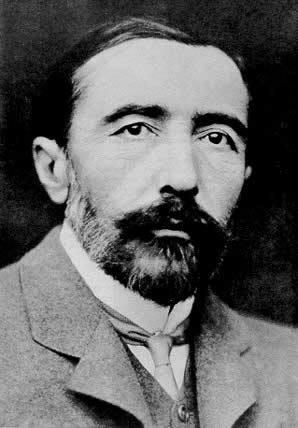
Joseph Conrad started writing relatively late in life.   He  drew heavily from a long career as master mariner in the era of European, eastern expansion.

In A Personal Record he tells of the first impulse to write. Sitting idle in his room at Bessborough Gardens he remembers his initial encounter with the man who inspired his first novel, Almayer’s Folly.

Conrad was 1st mate on a cargo steamer going up a Malaysian river to deliver supplies to a remote outpost. On board was a pony which the Dutch trader, Almayer, has ordered from Bali:

  The importation of that Bali pony might have been part of some deep scheme, of some diplomatic plan, of some hopeful intrigue. With Almayer, one could never tell. He governed his conduct by considerations removed from the obvious, by incredible assumptions, which rendered his logic impenetrable to any reasonable person.

The same might be said for the whole colonialist adventure. But this misguided effort is constantly undermined by inscrutable forces antithetical to the rigid mindset of the European.

Conrad describes the limp pony as he hoists it onto the dock in a sling:

 …his aggressive ears had collapsed, but as he went slowly swaying across the front of the bridge, I noticed an astute gleam in his dreamy, half-closed eye.

Upon releasing the sling, the pony immediately flattens Almayer and bolts for the dense forest- an outcome which Almayer meets with perplexing indifference.

 But Almayer, plunged in abstracted thought, did not seem to want the pony anymore.

He embodies the ambiguous,  often childish, desire for dominion over the remotest corners of the earth; a tragi-comic symbol of imperialist hyper-extension who, despite his convoluted plans, succumbs to uncontrollable forces and, ultimately, to dissipation.

Listen to Almayer’s halting, distracted monologue as he reveals to the narrator something of his frustrations:

“…the worst of this country is that one is not able to realize…” His voice sank into a languid mutter. “And when one has very large interests…” He finished faintly. “…up the river.”

Conrad was to later use such chthonic imagery and musical, fractured dialogue in his masterful indictment of imperialism: Heart of Darkness.

A Personal Record tells how the encounter with this “factual” character was instrumental in the birth of a long literary career; a career in which he brought to fictional art an unequaled degree of expressiveness. With the concision of the sea language in which he was so fluent-a language as pithy as poetic verse-Conrad condensed into the microcosmic image of Almayer all the absurdity and hubris of the expansionist age.

Conrad goes on to imagine meeting his alter ego in the Elysian fields and confessing:

  It is true, Almayer, that in the world below I have converted your name to my own uses. But that is very small larceny…Your name was common property of the winds…You were always complaining of being lost in the world, you should remember that if I had not believed enough in your existence to let you haunt my rooms in Bessborough Gardens you would have been much more lost.

Though a failure in his wind-born life, Almayer triumphs in the end through Conrad’s belief in the ability of his protagonist to express something deep and dark in the psyche of modern man. This ability is all the more poignant because of Almayer’s fictive power. It is a power that confers reality.

  …if I had not got to know Almayer pretty well it is almost certain there would never have been a line of mine in print.

Though I suspect Conrad’s Personal Record may not conform entirely to fact, his character attains a loftier status. He becomes a symbol of human folly that mere veracity cannot express.

Posted in Musings

Ovoids and Northwest Coast Indian Art

In my last post I cited Johnathan Raban’s observation in The sea and it’s meanings about the elongated oval motif seen in Northwest Coast Indian art. He said that the image was inspired by wave patterns on the water’s surface.  Though I wasn’t that impressed by Raban’s book, I think of this idea whenever I contemplate the play of light flitting over the water.

Then I began I began reading The Way of the Masks by Claude Levi-Strauss.

The stories of the masks are about preservation of a heritage, the appearance, healing or perpetuation of the ancestors through drama. Since the drama occurs in the timeless realm, its artistic retelling is continuous with the original creation, and the cyclic rehearsal of the masks’ origins is part of a long process establishing it’s status as an ancestor.

Levi-Strauss, using structural analysis of Salish stories, claims the masks (and accompanying stories, songs and dances) originated on the mainland and made their way to Vancouver Island. During migration, the chthonic, submarine origin stories of the mainland are counterpoised by a celestial derivation. As they made their long journey to the islands the stories underwent a structural and thematic inversion:

“Having placed the masks’ origin at the beginning instead of the end of the tale, and having the masks fall from the sky-in contrast with the mainland versions where they are pulled up from the bottom of the water-the island versions literally do not know how to finish the story. They need a conclusion…”

He goes on to say how these contrasting origin stories were resolved:

“…as the story unfolds between the mainland and the island, it always adopts intermediate courses. Instead of falling from the sky or surfacing from the bottom of a lake, the first mask suddenly appears on the roof of a house: halfway between up-above and down-below.”

Another such midpoint is the surface of the water.

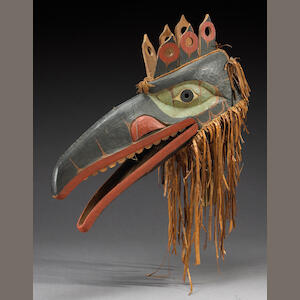
Many have remarked on the Northwest Coast artist’s capacity for improvisation within a limited set of design motifs. With this image of the oval, the  artist invites us to see above and below simultaneously. The ovoid shape and surrounding areas are interwoven with a fluid dynamism that unifies various elements and vantage points.  In addition to the simultaneous views of front and back, left and right, we see a fusion of above and below, uniting not only various views on the horizontal plane, but that along the vertical axis as well. The contrasting viewpoints are artistically realized on a higher plane-a broader prospect that transcends contradiction. Northwest Coast art is animated by the dialectics of height and depth.

In the two origin stories and their resolution we see how myths and art are co-extensive with the tribe’s history, and how the reconciliation of chthonic and celestial origin stories are reflected in the development of artistic styles.

Posted in Musings, videos

A Goose Story-Dispatch from the front lines

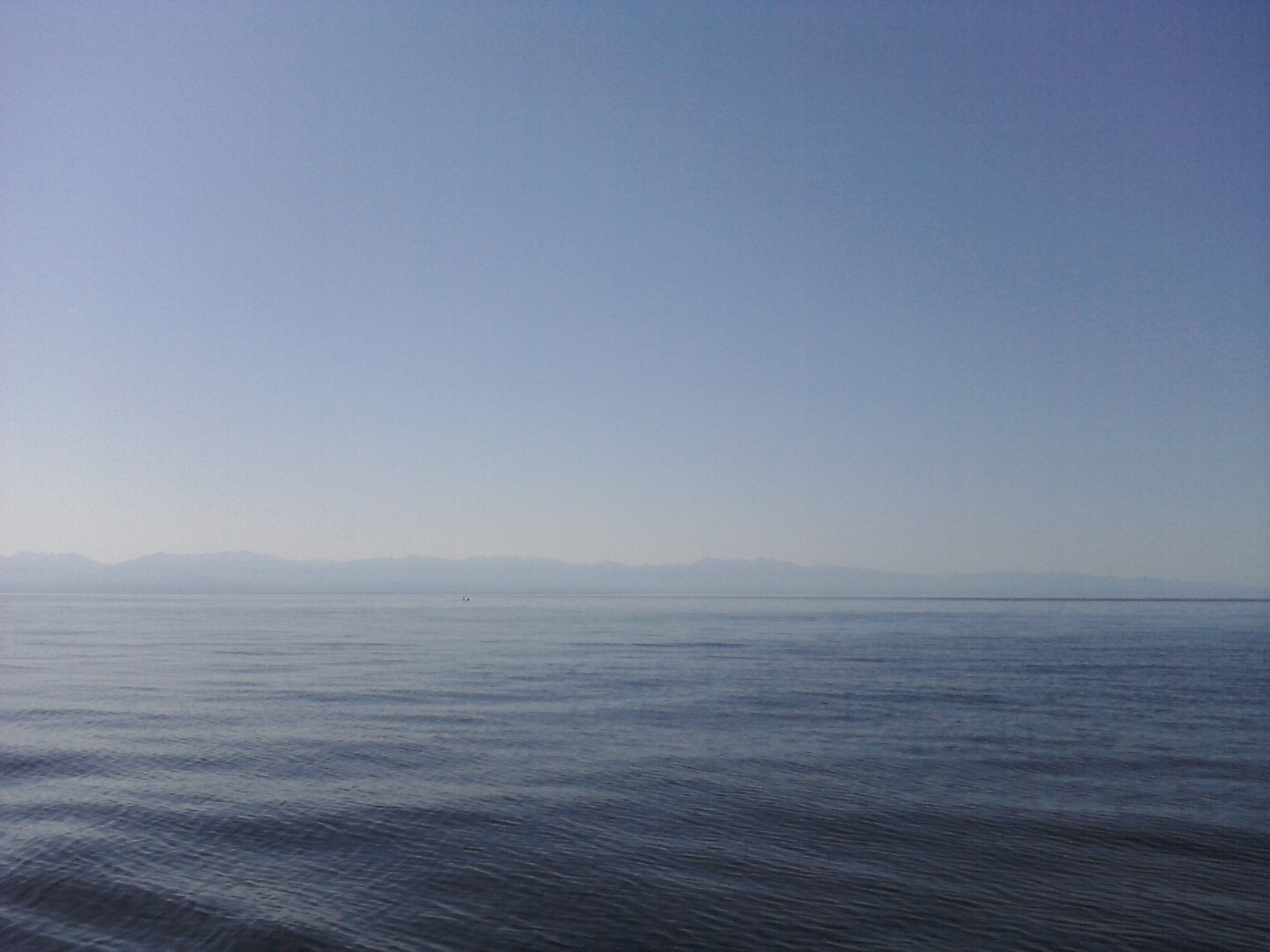
It’s a bright, sunny morning. The north wind freshens, sending diagonal ripples toward Old Hand’s stern as I gaze at reflected ovoid shapes meandering over the surface of  Port Madison.  The wavetops  reflect the cobalt sky, while in the  troughs,  dark green falls into the depths.

Johnathan Raban, in his book, The Sea and it’s Meanings, says that the fantastic imagery of Northwest Coast Indian art is greatly inspired by this sight- their stylized abstractions emerged from long hours paddling through the Salish Sea Dreamtime.  The ancient Northwest Coast artist first saw Thunderbird, Raven and Bear while in becalmed revery, gazing at the sea’s mirror.  The bounded yet fluid shapes that contain and release their ovoid imagery are interwoven, like sinuous kelp, with the sea itself. The mythic Hamatsa (cannibal dancer) of the Kwakiutal was descried on that insubstantial realm between surface and depth where images flicker and vanish.  This is the intermediate realm between wakefulness and dream.  Some of the masks came originally from the deep, while others descended, exact prototypes of masks we see today, from the sky.

Things are quiet in Port Madison. I spend a lot of time watching the Canadian Geese. The other day I witnessed a flock on Reah’s bulkhead repel an alien siege from another group who also desired the choice spot. Perhaps a rabble-rouser was after a female that was serenely perched on one leg under the cherry tree. The invading bunch first tried to look casual as they eased up the old boat ramp. But the locals charged down on them, their beaks lowered aggressively. This was, of course, accompanied by a god-awful din. Always something. They should have a reality TV show.

Then there’s the goats. They would eat my studio if I let them. When I show up they give me this interrogative look, as if I had the answer for their goatish angst. Maybe I am projecting- anthropomorphizing. Try pronouncing that, goats.

Today is clean the goat-shed day, a task to rival Hercules’ distasteful trial.

But I shouldn’t complain. I am ever grateful for the blessed gift of this lovely place, thankful I have found a home in this peaceful harbor.

Here’s a goose video I shot of a diving lesson, a big step in the life of any chick. Sorry for the quality. You can see the little guy on the big rock below the woodpile. The parents on the right call to him with encouraging honks.

Takes me back to my own first leap into the sea. But that is for my next McWhirr story.