Posted in Paintings in Progress

Particulars-an artwork in progress

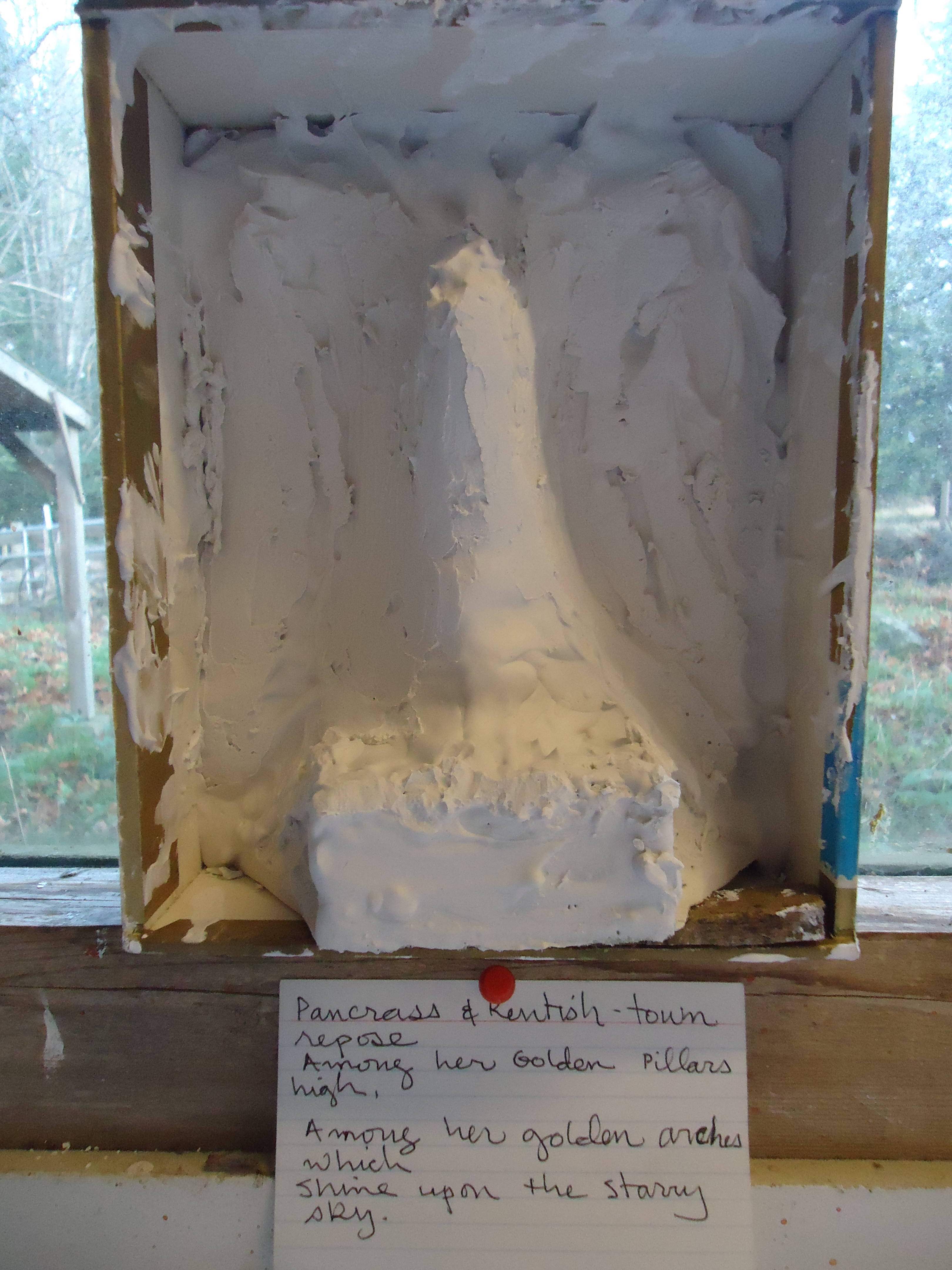
DSC02887 William Blake stressed the “particulars,” how the details of daily life are continuous with cosmic totality.  In Blake’s expansive vision the two perspectives interpenetrate and this all-inclusive vision animates and unifies his art in way that is unique in the history of art.  In Jerusalem, the local  village scene merges with vast space and opens on the mythic city:

  Pancrass & Kentish-town repose

Among her golden pillars high,

Among her golden arches which

Shine upon the starry sky.

So my Black Friday visit to a Port Angeles fabric store acquires new significance.  This particular Clallam anchorage is where the angels weave this narrative into the fabric of myth.  Or maybe it was just a place where I could score a good deal on the canvas I need for my February art show.

I am imagining some large canvases painted in the muted, earthen tones of the gray, English landscape overlaid with an architecture of arches and pillars of insubstantial, golden light.

jerusalem 1jerusalem painting 1

At the same time I continue the memory practice, learning Jerusalem “by heart” and using the mnemonic imagery of the memory stations as a starting point. These stations continue to evolve as I memorize the text and work the paintings.  In this way I hope to in infuse the paintings with some of Blake’s generous, all-encompassing spirit.

This process may sound cumbersome, but it works well in maintaining a broad perspective and helps avoid a myopic fixation on details.  This fixation is far from the non-dualistic attention to particulars Blake writes of.  I hope my art may be as expansive and generous as his.

If you look closely at the background, some ethereal light forms emerge; vague figures who begin to emerge from beyond a misty veil.  Or maybe the turpentine was just going to my head.

Posted in Paintings in Progress

The Memory Theatre-an artwork in progress

sculpture stationsculpture station
Second Memory Station

A dream:  I am building a stretcher (wood frame to stretch canvas over for painting) for my February art show.  After I nail it together, I see that I’ve used 2×4’s which are too heavy and ungainly for the size of the painting.  The center brace is too short and part of it is made of ground contact, pressure treated wood, a toxic and inappropriate material for a stretcher.

Now this is where it gets interesting.  A dream about my upcoming art show.  This project is continuous  with the practice I undertook to memorize dreams in order to gain a broader perspective on the work.  This is a view informed by the heart as well as mind.  A kind of feedback loop is created:  The intention to bring the dream to the waking world coincides with an awareness of waking life (art show) within the dream state.  This opens a dialogue between the flow of unconscious imagery and conscious intent.  It gives valuable clues on how to proceed.

I’m not sure what the symbols of treated 2×4’s and toxic ground contact, pressure treated wood tells me.  But I have an intuition that it relates to right proportion, appropriate measure-ways and means.

I’ve long intuited that lucid dreaming abides by the golden mean proportion.  It is not just control of dreams, but a way to avoid getting lost in allurements, terrors and distractions; mesmerized by the phantasms that present themselves as real.  It depends on the right proportion between waking and dream.  These contraries are held in a dynamic tension and generate a third element-a state which transcends contradiction. The point of all this is to gain clear awareness of profound emptiness.  This is the truth of the most fundamental Buddhist koan:

Form is emptiness, emptiness is form. – Heart Sutra

I began sculpting memory stations with plaster to use as a basis for drawings- studies for a series of large paintings.

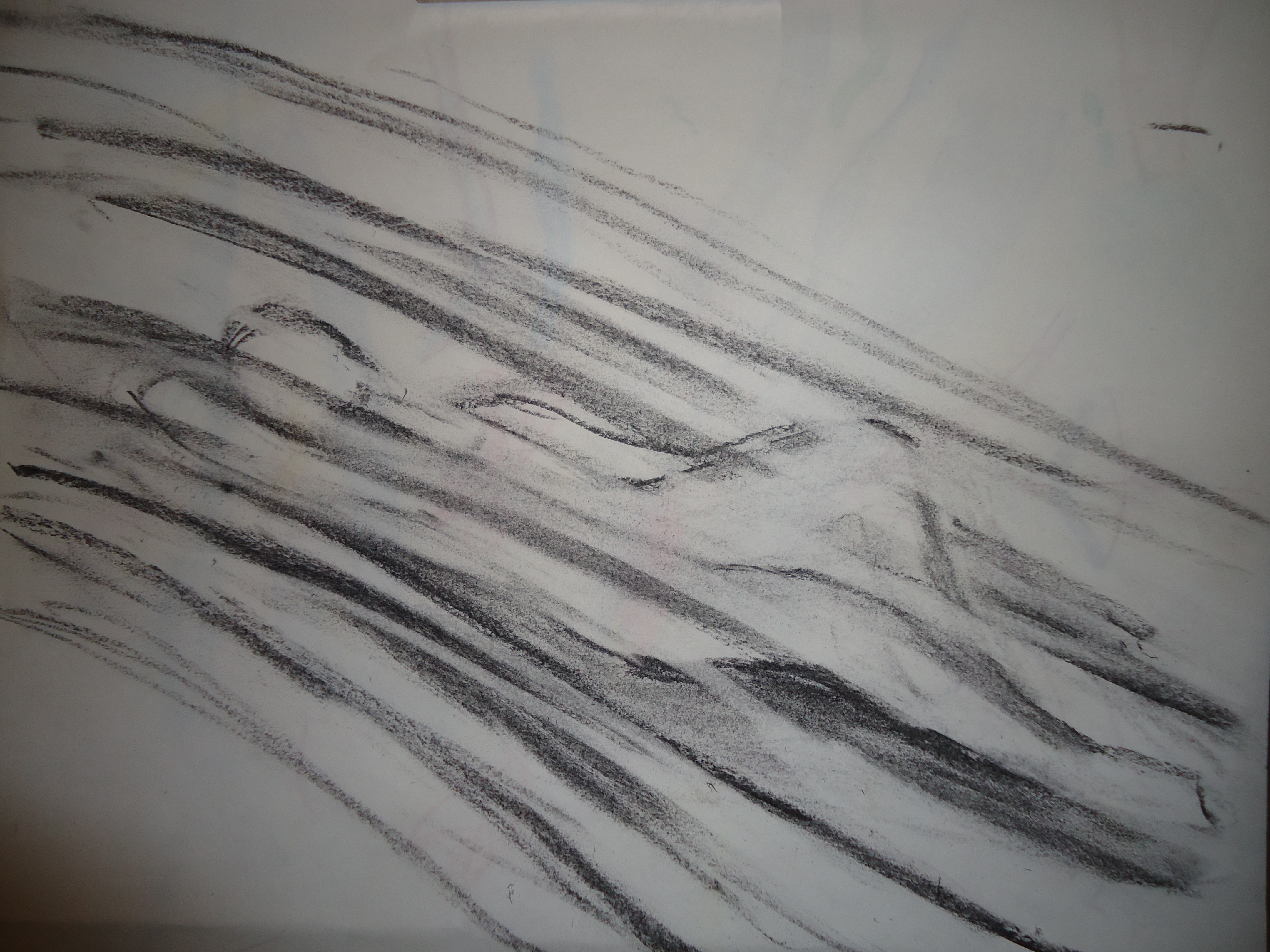
This one has taken a vaguely angelic form.angel drawingangel drawing

The challenge is to paint these ethereal beings without sappy cliché.

  Without contraries there is no Progression.       -William Blake

Posted in Paintings in Progress

The Memory Theatre-a Reprieve

DSC02850memory stations 10 tree
First memory station

In his wonderful book,  Little Book of Dreams,  Robert Bosnak says that the best way to enhance dream recollection is the classic memory practice.   This is important for many reasons.  Here’s one:

In a dream I was given a slip of paper on which was written the word HEARTNET.  The image was very clear and when I told Lily of the dream the next day, she suggested I google it.  It turned out to be a heart health website.

Taking this as a sign, I had a checkup and found my cholesterol levels dangerously high.  I became resolved to clean up my act and extend my life.  It gave  me a reprieve.

Tibetan Buddhist teachers say that the ability to consciously enter the dream state-lucid dreaming-is a good way to prepare for the bardo after death.

As I am not ready to face the bardo’s dangerous pathways, attending to the dream message allowed me more time to cultivate the qualities of compassion and wisdom that help to ease the transition.  This, it is said, increases the possibility of a favorable rebirth.


DSC01792blakes painting teacher
Blake’s painting teacher, from his visionary heads series

I was thinking of Blake’s vision of Jerusalem as a Golden city of peace, love and harmony that, at some timeless time, was “on England’s pleasant pastures seen.”  Did such a city exist in prehistory? 

Then I read this in Eva Wong’s commentary in the Hui-Ming Ching (Cultivating the Energy of life:)

  When we are in our mother’s womb, we were filled with the primordial energy of the Tao.  In the natal state, original nature and the energy of life are united.

At birth we come into contact with the world.  When air is inhaled through the nostrils, the primordial breath is contaminated and the connection with the Tao is broken.  Original nature and life energy separate, the former moving to the heart and the latter moving to the kidneys.

Posted in Paintings in Progress

The Memory Theatre-an artwork in process

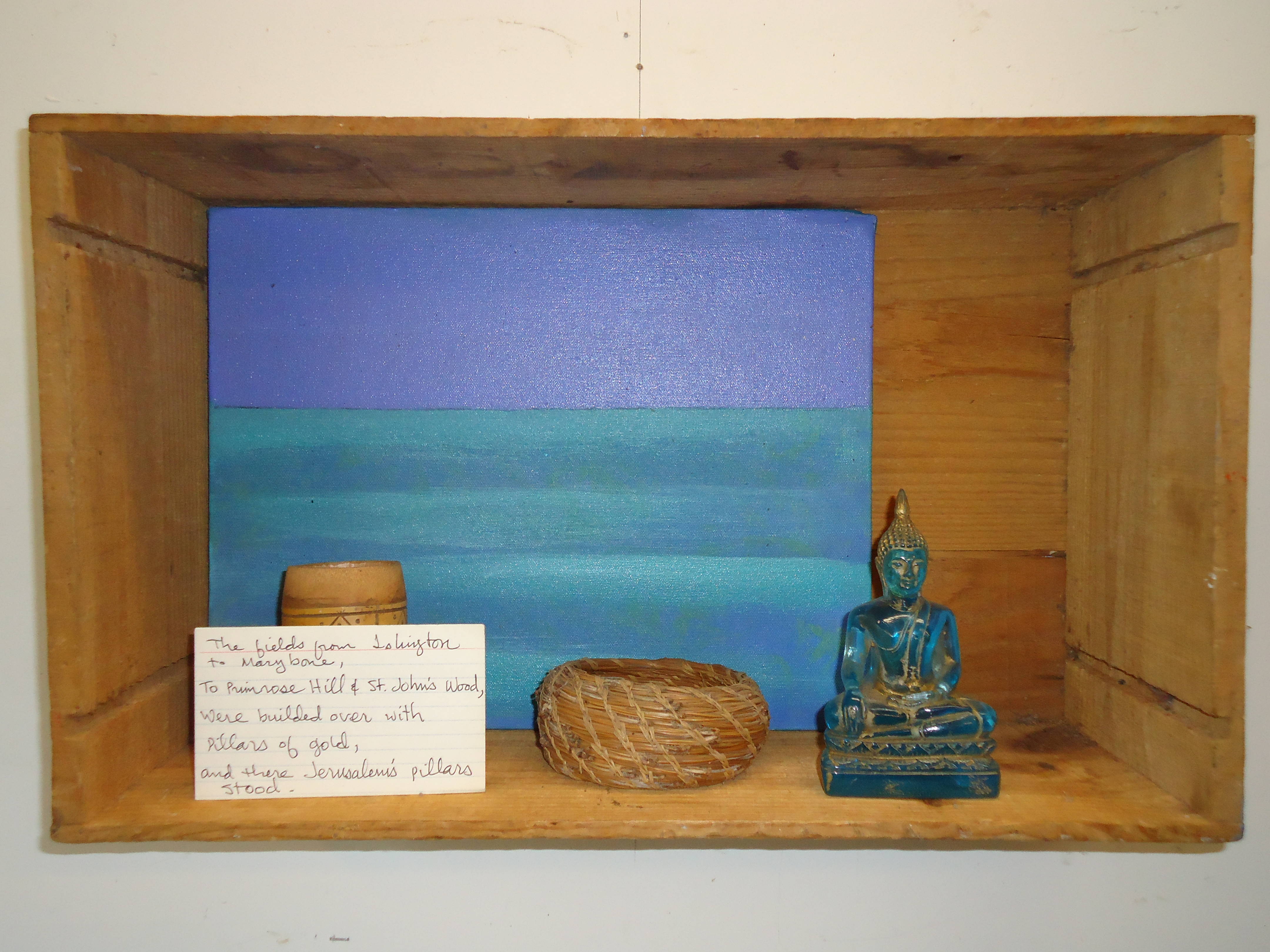
I’ve made some memory stations and begun the memory practice.  Maybe I’ll try to memorize Jerusalem (at least parts of it) by William Blake.  The organization of the space and creating the stations is not separate from the work of sketching out the composition on the canvases.  The placement and spacing are important. DSC02838memory stations 3

I imagine the paintings might take the form of a still life that opens onto a vast landscape. Blake had a vision that beheld the universe in a grain of sand, infinity in an hour and the celestial city built on the rolling green English countryside.  I want my art to share some of this all-encompassing perspective.

The fields from Islington to Marybone,

To Primrose Hill and Saint John’s Wood,

Were builded over with pillars of gold,

And there Jerusalem’s pillars stood.

I’ve found that memory practice leads to amazing experiences.  It is a way to attune to subtle influences and bring to conscious awareness the too-often suppressed messages from the unconscious.  In her brilliant book, the Art of Memory, Frances Yates quotes Cicero’s recollection of the poet Simonides, who was said to be inventor of the memory art:

…persons desiring to train this faculty (of memory) must select places and form mental images of the things they wish to remember and store those images in the places, so that the order of the places will preserve the order of the things, and the images of the things will denote the things themselves, and we shall employ the places and images respectively as a wax writing-tablet and the letters written on it.

DSC02844memory stations 9 white

Posted in Paintings in Progress

The Memory Theatre-Idea for my Febuary art exhibition

My next art show is coming up soon.  My idea is inspired by the Memory Theatre. This is an ancient mnemonic device used by actors and rhetoricians to commit long speeches to memory. The memory places are niches, or altars that contain imagery (the more outlandish the better) that facilitate recollection of the text. In ancient times, these features were incorporated into the design of theatres.

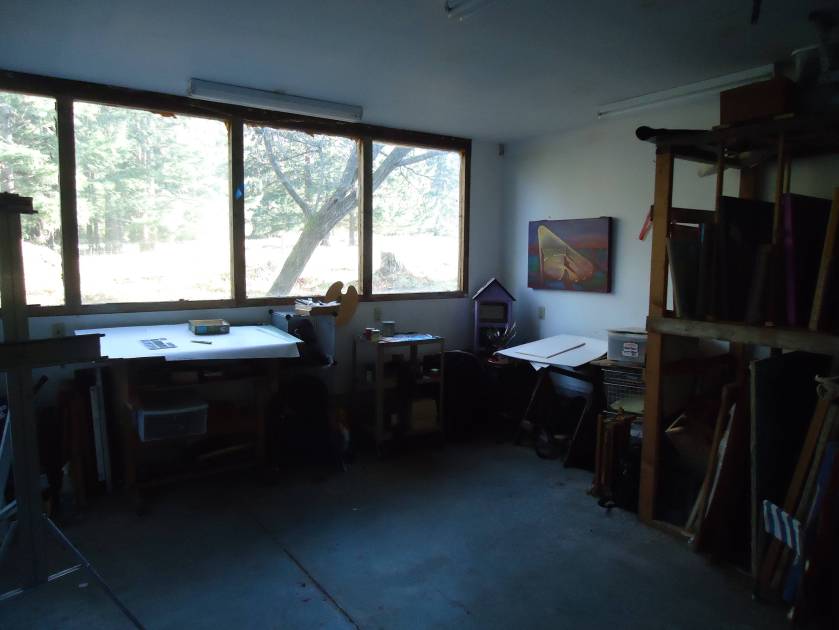
My idea is to make this part of the process of creating the work for my show. I’ll start with the basics: clean up my studio and create a series of 10 altars which I will decorate with whatever imagery will facilitate recollection of a long poem. At the same time I’ll prepare 10 canvases which will correspond with each of the memory stations. These paintings will comprise the exhibit.

I haven’t decided on a poem yet but maybe one of William Blake’s medium-length works will serve. This memory process will be concurrent with the creation of 10 paintings inspired by each of the memory stations.  The art show’s theme will be continuous with the theme of the poem.

The whole process from straightening out the studio to “completion” of the paintings will be documented in this blog with photos, text, video and recordings. Stay tuned.

Posted in Musings

Soul Hydrography- The Elwha Dam and Seattle Seawall


Sediment released by removal of the Elwha River dam flows into the Strait of Juan de Fuca.
port madisson images 004
Drawing by Craig Spencer

Soul Hydrography is the study of how waterways, rivers and currents reflect the spiritual state of humanity.   Our psychic energy flows with the drainage’s along which we establish our precarious settlements, into mythologies of the parched landlubber, and hies with the stream of time back to the infinite.  I have no actual experience in this field, unless an adolescent kookdom in Surf City counts for training.

We are pulled into the undertow of mythic floods or swept into a sea of trouble . The  primal chaos that threatens to engulf us is the same prima materia from which our civilization arose.

The removal of the Elwha River Dam and the rebuilding of the Seattle Seawall are two projects that reveal something of the secret history of the Northwest and the contradictory impulses we share-namely, the primal drive to hold or release, to build and destroy, or open and close.  Like the breath, these complementary movements alternate through  cycles of history.

The Elwha dam nearly decimated one of the world’s largest salmon runs, destroying the livelihood of the Clallum tribe as well as the settlers who lived along the river.   While it generated electric power for Port Angeles, it deprived the area of another form of energy not measured by kilowatt-hours.  It created a major blockage of the communities’ vital force-its chi.

The deteriorating Seattle seawall is symptomatic not only of infrastructure divestment, but is also an example of soul hydrography.  In a heartbeat, the waters can engulf the high temples of power so serenely reflected on the surface of Elliot Bay.

William Blake called the 5 senses “the chief inlets of the soul in this age” (A happy turn of phrase for our theme.)  Today, few consider that there might be other inlets, and forget  lessons from former ages.  Though decay of the materialist bulwark against the soul’s depths causes unease, we seem ever more walled off from the possibility of accord with   unconscious dictates.  These energies lie a thousand fathoms deep right off Seattle’s doorstep.

Emanuel Swedenborg’s  reading of Genesis accounts the Ark as a vessel bearing remnants of the Ancient church. The waters Noah navigated drowned the remaining populace-the Nephilim- in materialism and greed.  In Swedenborg’s esoteric reading of scripture, Nephilim denotes those whose inherent goodness and charity became immersed in selfish desires.  Noah safeguarded secrets that held the key to gnosis, a mode of perception that maintained the spiritual life of man and, therefore, humanity itself.   Though Swedenborg’s biblical interpretation addressed an inner history,  involving preservation of an Arcana entirely different from chronological narrative, there are correspondences with the ecological disaster we face today.  See Henry Corbin’s fascinating book,  Swedenborg and Esoteric Islam.

Happily, the Elwha dam is gone and the construction of a new seawall is in the works.