Posted in Euphrates Voyage, Saturnius McWhirr stories

Mesopotamia Voyage 3–Osman

“What is the greatest virtue a steam man may have to best fulfill his role?“ The Professor was already going strong before my foot touched the last wrung of the companionway ladder into the engine room.

“I don’t know.”

“A steam man’s greatest virtue is reason and moderation”

“I’m no wiz at math, but that sounds like two virtues to me.”

Budge, unhearing, went on:

“The three essential elements of the steam man’s art is fire, water and air. Only the most equitable balance between them ensures safe operation; and therefore an auspicious outcome to our common endeavor. And what is our common endeavor?”

“To not be blown to smitherines?”

“Yes, for one. And our number one priority.” He went to his blackboard and drew a pyramid.

“The harmonious disposition of the three elements, fire, water and air, is essential for a well-ordered steam engine. These three elements form an equilateral triangle with air at the apex. The dynamic between them produces the miraculous, fourth element, steam.” At the last word, he hit the blackboard so hard the chalk broke. “What would you say is an analogous model in other aspects of life?”

“You have me there Mister Budge.”

“A corresponding relationship exists in the three parts of the human soul: the calculating nature, the spirited nature, and the grasping nature—appetite. Just as the equitable disposition of air, Fire and Water creates the conditions to fuel our ship, so the harmonious accord of the three parts of soul; each doing their part in the appropriate measure and time, ensures the success of our collective enterprise. But it’s essential that all parts be ruled over by the faculty of reason. Disequilibrium among the parts—or elements—would spell disaster.” Here he erased the triangle with a dramatic flourish.

“Mister Spencer, report topside. We are approaching the station. Prepare to take on a passenger.”

I went into the wheelhouse as we neared the wharf. McWhirr said: “He’s a big shot named Osman Hamdi Bey, director of the Imperial Ottoman Museum. Word is, he’s been a royal pain in the arse in getting authorization for the Dig at Nippur—a real stickler for rules. His reputation for obstinacy is well known to the trustees back in Pennsylvania. There’s rumors about an article he wrote to help his buddy and patron, Midhat Pasha, whitewash the Bulgarian Massacre. He probably wants to check us out to make sure we don’t steal the loot.”

I could hear the revulsion in McWhirr’s voice. There’s nothing he abhors more than man’s inhumanity to man. The massacre was a horrible war crime and had liberals in England all worked up; calling for revocation of British support for the Ottoman Empire. But Osman’s spectacular finds in Syria—and securing them for the Ottoman Imperial Museum—had made him famous. It had also made him anathema to the covetous British Museum officials who were incensed that the treasures should be held in the “barbarous” hands of the Turks. So who is to say what was really behind the outrage at Osman’s alleged role as apologist for brutal treatment of the April Revolutionaries by the Ottoman army?

The landing was covered by an absurdly large pile of luggage attended by two Arab porters. Then a tall, lanky guy in a fez walked slowly up the gangplank with the dignified gate of man of affairs. For all his reputation, he wasn’t much to look at. But he was a real professor, not some bargain, boiler room philosopher like our engineer, Thaddeus Budge.

Osman’s effects were loaded by the porters who, as it turned out, were personal assistants accompanying him aboard for the trip to Nippur. They quickly spread their mats under a striped tarpaulin on the foredeck and set to making coffee over a charcoal stove.

“Welcome aboard, Mister Bey.”

“Thank you, but your kind greeting is redundant. Bey actually means “mister.” Nonetheless, it’s a pleasure to finally meet Saturnius McWhirr. I was pleased to hear that the most august, Pennsylvania Museum board has hired you to ensure the safe transport of our precious antiquities.”

“Your fame precedes you as well, sir. But where, if I may be so bold to ask, are we to stow all your gear? Or should we just chuck it all overboard now in the interests of expediency?”

Osman’s eyes glared from behind his prince Nez glasses. Thus began the strange, unlikely relationship of the two most remarkable men I’ve ever known.

Posted in Books I love

An account of the In-Between

How I came to follow the mystic path of Sufism demands an allusive prose that, I hope, remains faithful to the spirit of initiatory Gnosis at the heartfelt core of all faiths.

Some 20 years ago I come across the book, Alone with the Alone, creative imagination in the Sufism of Ibn Arabi by Henry Corbin.  At first, this convoluted explication of a particularly arcane branch of Islamic Sufism was way over my head.  Yet this book-and a powerful dream that was inspired by my first encounter with it-has since established a steady waypoint by which my spiritual life has been oriented.  It has opened vistas onto a world of  secret symbols whose meaning continue to elude, perplex and inspire me.

There is a realm, Corbin says, that lies between sense perception and the rarified sphere of pure spiritual essence.  This is where divine revelation takes place.  Those whose inner vision opens into the intermediate world (alam-al- mithal) are given the insight that liberates from the rigid strictures of dogma.  This perception–whose channel is the active imagination–requires we forsake the learned myopia of scientific materialists who accord “reality” only to those objects of sense, reason and measurable data.

In the dream, I was flying through black space, turning with outstretched arms and singing the Basmallah: Bism’allah er Rahman er Raheem [we begin in the name of the One who is all Mercy and Compassion.]  I’d learned this beautiful verse–which opens each sura of the Koran–some 20 years earlier at a gathering of the Dances of Universal Peace.  It had only returned to me again in this dream.
All was still dark when I felt myself land on solid, dream ground.  I heard a voice-over wryly proclaim: “it’s amazing what you can do with special effects” –I am heartened to know that spirits in the Sufi bardo maintain a sense of humor.
I was still turning and singing the Basmalah when I opened my eyes to find I was in the center of a large circle of men, women and children.  The men were bearded and wore turbans with long robes.  As it seemed presumptuous to occupy the center, I joined the others on the circumference of the circle.
A lively chant was taken up and I was led into a mad dance, side-steping 3 paces to thee right and shouting the word, “Kupt, Kupt, Kupt.”  We then took 3 steps toward the center singing: “Pisht, pisht, pisht.”  All were caught up in the ecstatic spirit of the dance.   It was an unaccompanied, non-melodic chant that filled the place with electric energy.  Children laughed as they were swept along in the frenzied tempo.  My dream body was being wrenched by my zealous neighbor whose left arm tightly held my neck.  Overcome, I retired outside of the circle and woke with a sudden “pop.”  My dream bubble had suddenly burst.
After long pondering the two, obscure words–those cyphers whose import I had only dimly glimpsed all those years ago–it is always to the original, immediate apprehension of their sense that I return.
In a Turkish\English dictionary I found the word Kupt, which means vault of Heaven, [shouting loud enough to bring down the heavens.]  The only definition for pisht I discovered was: an area marked on the ground for some sport or dance.
After long contemplation, I can only allude to the true sense of these words by images and feelings that relate to  our capacity for theopathy–to know God in a form that corresponds with our innermost being.  It is a timelss dance of ritual remembrance, an act of co-compassion between center and circumference, and a moving rite of worship that establishes a sympathetic bond between God and man.

I will return to this theme next post.  This brief account can hardly begin to plumb the depths of theophanic mystery.  I claim no special ability to navigate the intermediate world.  I believe all, if we really pay attention, have the ability for angelic perception; all have the capacity for revelatory experience.

Posted in Old Hand's northern voyage, videos

East Sound storm

Lily hurt her foot when we docked at East Sound for our dance.  Then yesterday, a storm blew up from Southeast, blowing a good 35 knots with gusts to 40.  Old Hand took a hammering at the public dock while Lily lay below getting seasick.  But the local EMT team were there in no time to get her off the boat, up to the nearby Oddfellows Hall where we had a wonderful event despite Lily’s injury.  It was a sweet circle praying for peace in this stormy world.

Posted in Old Hand's northern voyage

Septemptrionic Voyage

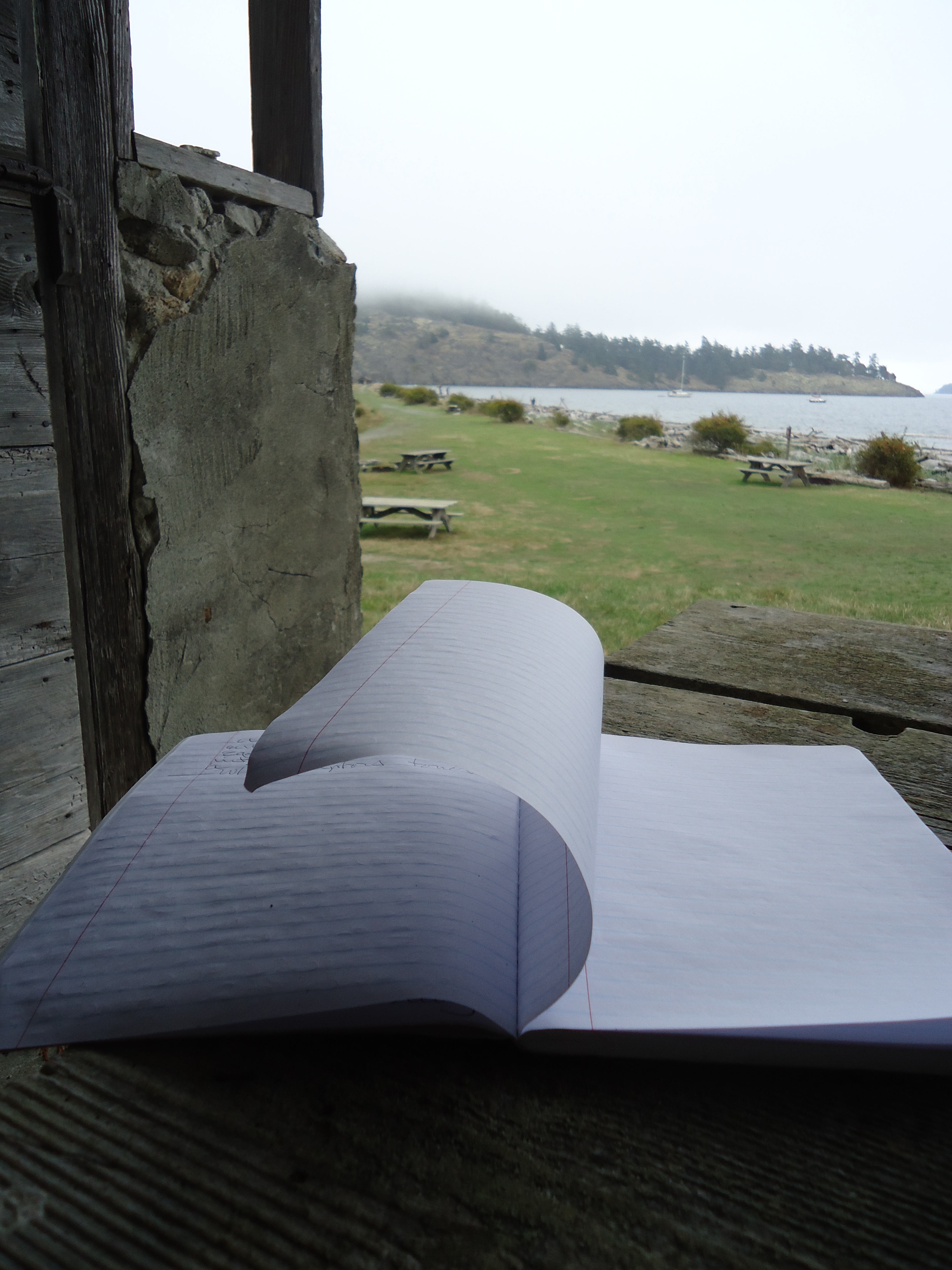
DSC02497

In the mid 70’s I had a studio in Eugene. Nearby was a pioneer cemetery where stood a tall, gray weathered tomb which housed an early patriarch of the Oregon Territory named Septembus Spencer.   While I won’t deny my memory may embellish the facts, this outlandish moniker has stayed with me all these years. Now I find that one of Willamette valley venerable line of Spencers had made his way further north to this stormy spit on Lopez Island’s east shore.

As though by a master sculptor’s hand, Equinoctial storms have carved cyphers into the rough stonework of the storehouse.  Apples still fall from the trees he planted on the grassy knoll.

Septembus comes from Septentrio, which is Latin for North.

On this gravel spit formed with perfect symmetry by alternating currents are seen middens of a tribal fish camp that had been used for over 3,000 years.

Though I bear no relation to the Eugene and Lopez Spencers, I find it strange to arrive at the most northern outpost of those Northwest settlers-that venerable line whose family tomb I saw in my earlier days. It is their most, so to speak, Septentrionic point.

I take heart in knowing that the same northern, wayfaring spirit calling us toward these enchanted Isles inspired the peregrinations of T. W. Spencer-that the same pole star he set his course by is the way point toward which Old Hand shapes her course.

DSC02499

I was taught by a Cowlitz elder that the cardinal directions are more than physical points on the compass, but spiritual states which must be embarked upon with full awareness of all their various qualities.

Black Elk once said the center of the world was Harney  (was this the same hawkish general who tried to incite war with England over a dead pig?) Peak in South Dakota.  Black Elk went on to add that the center is everywhere. It’s the same awareness that lead Jesus to sing to his round-dance on his crucifixion eve:

“The universe is inside the dancer.”

The tide flows into the lagoon at full flood like the rushing green flow of the Willamette River by which I sat staring so long that, when I rose, the solid banks seemed to move with the same fluid motion as the water.

The sacred land is everywhere-is already won. It is somewhere in Harney Channel (Harney again!) The Center is in the old Odd fellows Hall on Orcas Island where we hold our Dance of Universal Peace on this Sunday. The universe revolves around Old Hand’s keel as we voyage to the spiritual state of North; to honor the wisdom teachings of all faiths that ever points us toward the true polestar.

Posted in Paintings in Progress

All that is Golden- The Sun Standard

It’s hard to say why we are struck by certain images.

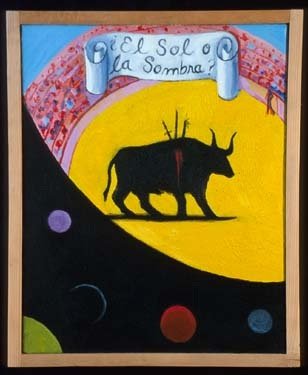
20 years ago I did a painting inspired by a dream of a bullfight. Bullfight ticket sellers ask their customers: “el sol o la sombra? Meaning: “do you want seats in the sun or the shade?”. As the sun passed, the shaded seats commanded a higher price. This fluid standard seemed a true valuation system because of it’s cosmic scope. It might be called the Sun standard.el sol o sombre

Gold and Sun are symbols that announce a new age ruled by the truest of values-that which emerge from the human heart.

In this Spanish interrogative I hear echoed the ancient Mithraic conflict between the Light of Glory and Ahrimanic Darkness. This is a drama which transcends religious history, learned judgments about dualism, and my own, personal revulsion at an act of cruelty.

The arena is a mandala-a microcosm.  The ritual killing it sanctifies has echoes throughout the cycles of history as an archetype-one that charges a brutal spectator sport with religious energy.  it is the reenactment of the primordial victory that ensures the perpetuation of the world.

In his book, Spiritual Body and Celestial Earth, Henry Corbin uses the striking  image of the progersso harmonium to describe the relationship between Shi’ite Islam and the earlier Mazdianism religion. The relation is not the  linear view of religious history by which  fundamentalists of all faiths are bound, but the fundamental tone, the timeless Truth to which all religions are ultimately traced.  It is ever present, running throughout time like a basso profundo under the higher registers of the octave.

To pass from one octave to another is not the same as to pass from one date in time to another, but is a progression to a height or pitch that is qualitatively different. All the elements are changed, yet the form of the melody is the same. Something in the nature of harmonic perception is needed to perceive a world of many dimensions.

So midway between the darkness of uncertainty and the light of inspiration, I revisit a related image, the altar. I set the stage with a yellow/orange ground. I want to hone my harmonic perception that I may realize my theme in a higher register, one that captures it’s elusive quality.day of dead altar

It now becomes  an altar for the Day of the Dead. On it I place my mother’s ashes, the tattered image of dad, and all loved ones who’ve left the arena of life. Here is the true value-the measure of all that is Golden.