Posted in Books I love, Paintings in Progress

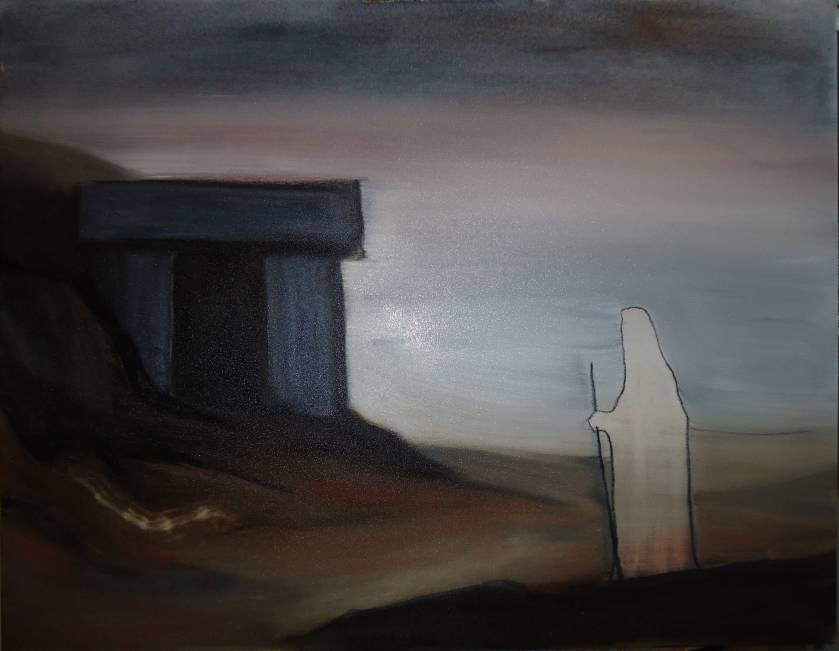
Camillo’s Memory Theatre-an artwork in progress

Francis Yates, in The Art of Memory, tells how Giulio Camillo reinvented memory art in accordance with the renewed interest in Neoplatonism.  Camillo’s conception was also inspired  by the recently rediscovered teachings of Hermetic philosophy which his friend, Marcilio Ficino had introduced into Renaissance Italy with his translation of the Corpus Hermeticism. 

Ficino inspired Camillo in the use of astral talismans to draw down celestial influences into memory images and infuse them with magic power.  This imaginative reinvention of memory art was meant to train the mind to receive celestial influences and  unify esoteric knowledge by holding an inner image that mirrored the celestial harmony.

The Corpus Hermeticum taught the essential divinity of man and that all phenomena have their origin in the realm of ideas (archetypes.)  Camillo’s theatre enabled the “viewer” to recall these first causes, and the essential relationship between man (microcosm,) and the world (macrocosm.)

The first level of manifestation was mediated by the 7 Governors.  These astral beings made up the 7 measures by which the interior man descends into creation, acquires a body whose parts fall subject to the dominion of the zodiac, before he reascends through the heavenly spheres.  It is through the Hermetic religious experience he regains his innate divinity.  The 7 governors have associations with the known planets, 7 days of creation, angelic hierarchy and the lower sephiroth.

Yates says that the greatness of Renaissance art  was largely due to perfect proportion that was in accord with celestial harmony.  Seen in this light, the grace and majesty of Botticelli’s The Birth of Venus is a result of her status as talisman.

Posted in Old Hand's northern voyage, videos

Port Headlock

I’ve been anchored in Port Hadlock for 5 days.  Actually, after being pinned down here so long I’ve come to think of it as Port Headlock.  As soon as I start to haul in rode, a sound rises from the far north, a deep rush of sound that gives me pause, and my hand is stayed from weighing anchor.

Since the Equinox, the weather has taken a nasty turn, with savage gusts from the Austral quarter of this turbid globe cast into the swirling cosmos.  After long, night-watches, I see the gale steam the weather-glass a frenzied, vaporous scene of genesis. The glass is the vessel which holds the primordial spark and the damp, hylic goo of the Prima Materia in a seething, Hylic confluence.  The torn north hangs rain-slanted like a black curtain fallen over the final act of a Doric sea tragedy.

Like I said, it was a nasty storm with gusts to 70.  But now I pace the deck and see over the port beam, young men learning the old shipwright’s trade at the Northwest School of Wooden Boat Building.  A vessel went by that’s based on the old longboat design of Vancouver’s rowing/sailing launch and skipered by a young, pretty lass who calls from the bow with all the assurance of an old salt.  Does my heart good to see the old tradition of working sail carried on by such eager hands.

Posted in Paintings in Progress

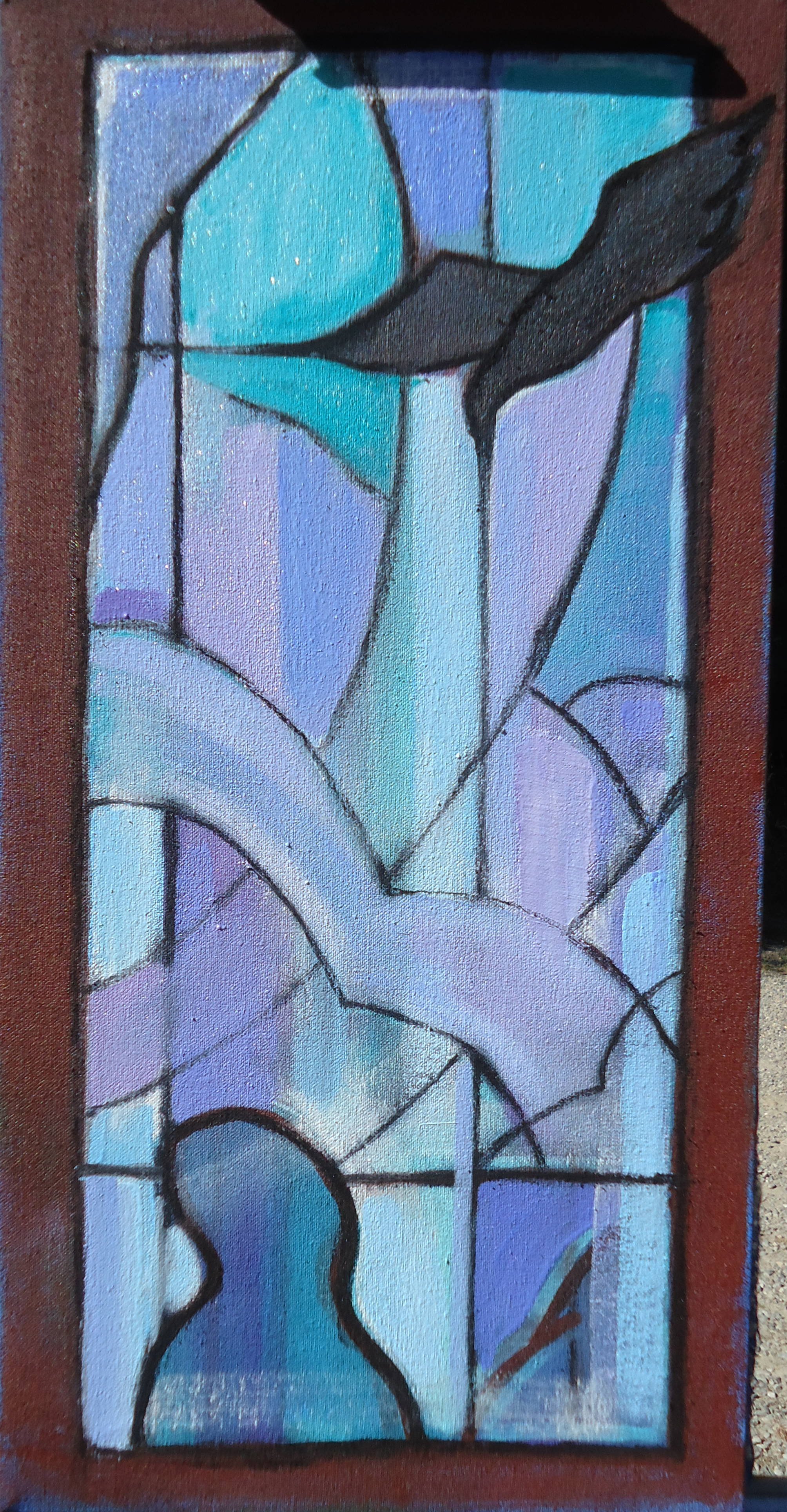
Raven Window-The Albedo Phase

DSC02382raven window 3The canvas is theTemenos, where I had earlier faced the black work of the Nigredo- where the inessential was burnt away leaving the skeletal composition etched in blackest black..

Stained glass framed the scene for my latest confrontation with doubt and the obstinate reality of the Prima Materia.

Now is the phase to which corresponds the Alchemical process of the Albedo-the whitening.

The Hermetic philosopher, Artephius said it is:

“That which is uplifted by the air…pure, subtle, brilliant, clear as the dew, diaphanous as unflawed crystal.”

The diaphanous in between I invoke, where light reflects both ways.

Julius Evola, says in the Hermetic Tradition says the Albedo:

“ …reintegrates the personality with the non-corporeal state.”

It moves me outward from this dark interior of crowded thoughts, into something vast-where the spectral colors of the work’s final phase finds its completion in harmony.

It is Raven’s call.