
Tag: esoteric

Ziggurat-an artwork in progress
My commitment to chronicle the art making process requires I relate all, from the most difficult stretches, to my modest successes. The muse is fickle and I am negotiating a dry spell. Here is a belated post to let you know I’m still hanging in there
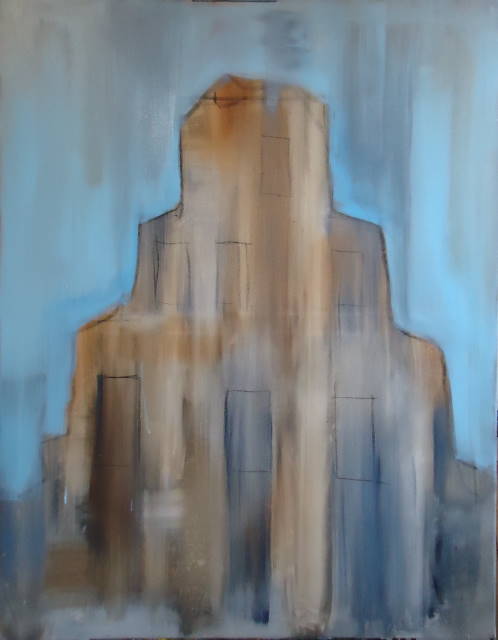 So far, only one image came through on the lucid dream channel. Here it is.
I had been working the raw umber, paynes gray and burnt sienna into a web of interwoven strokes. That night, in a dream, I saw an ancient ziggurat carved in natural sandstone and honey-combed with caves. As I looked at its golden, weathered form rising into the vivid, blue sky, I realized it was a dream. It was a fleeting glimpse of profound emptiness–the ultimate ground of reality. In that insubstantial image I apprehended the Heart Sutra’s most essential teaching: Form is Emptiness/Emptiness is no other than Form.
I don’t claim this as a great accomplishment, but I do like that the process of painting inspired dream imagery and the dream, in turn, redirected the painting.
The image was also inspired by a program about early Christianity I’d seen that night. The film showed the mountain, hermit caves where the Nag Hamadi collection of early Gnostic writings were found.
The Gnostics taught that soul is imprisoned in matter; that Gnostic experience is a return to the pure light of Divinity through overcoming demonic forces (Archons) whose job it is to hold humanity in bondage to the dense spheres of matter.
While I may not share this belief in the malign aspect of the natural world, I do believe these teachings form a part of our spiritual heritage. They have left psychic imprints upon the collective unconscious. It is not so much a matter of belief as that of experience–Gnossis.
These imprints permeate William Blake’s work. Benjamin Walker talks about the fall of Sophia (Wisdom) in his book, Gnosticism:
Various reasons are put forward for the fall of Sophia from the upper spheres and her plunge into the world of matter…(in one version) the tragedy occurred when she mistook the false light she saw below for the ‘light of lights’ for which she aspired…
In some texts she represents…the stricken city of Jerusalem.

Vala-an Artwork in Progress
 Sometimes painting is a real struggle. But I press on, slap the obdurate material into shape, as if my worn brush might push the paint into actual space–into the 3rd dimension.
Art often requires tactics that subvert one’s own assumptions in order to create the one image that is to the point, heartfelt, and true.
This one is a mess. The possibility of failure is always present. It is a perpetual letting go– of tricks, habits and even those pretty passages that no longer serve the whole.
This exhibit started with an idea about altars or memory stations. It is an attempt to combine my art with an interest in Blake in a way that helps me understand this eccentric genius and gives my own work greater depth.
The painting shows a stone wall with a niche in which is placed an image inspired by one of Blake’s Persian looking Angels. Carved into the stone wall is a willow tree that arches over the niche and breaks into space. The sun, etched into the wall, spreads beams of light over the canvas. 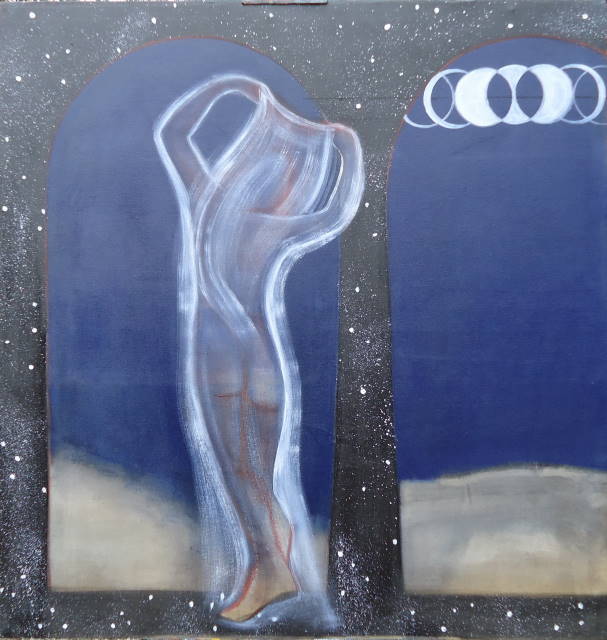
The next painting is of Vala, Jerusalem’s shadow, whose veil obscures the celestial light, and seduces Albion away from Jerusalem’s pure spiritual beauty.
She is a complex figure. Kathleen Raine has likened her to Psyche.
Know me now, Albion: Look upon me. I alone am beauty. The imaginative human form is but the breathing of Vala. I breathe him forth into the Heaven from my secret Cave, born of the Woman to obey the Woman, O Albion the mighty. For the Divine appearance is Brotherhood, but I am love.

Baked Soul-an Artwork in Progress
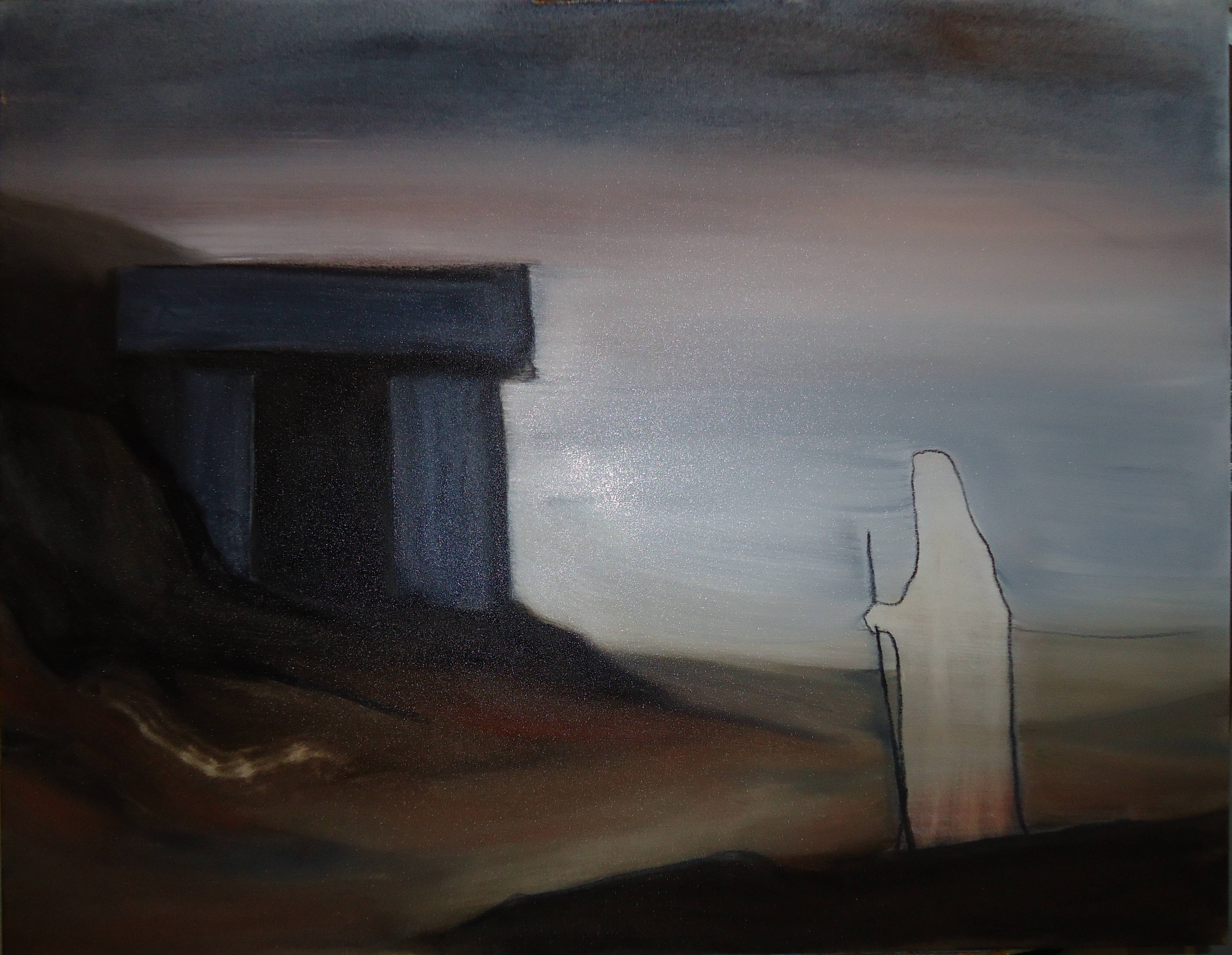
I recently dreamed that I went back to my old studio in Seattle. Its proximity to the neighboring building cut off most of the natural light. The new tenant had hung a mirror on the neighboring wall that reflected sunlight into the studio, creating a greater sense of spaciousness.
This dream seems to reflect the dilemma I face with each new artwork.
Every painting presents an opportunity to break into new territory, beyond habitual modes, toward a more fully realized statement of my particular vision. Each stark white field stands before me like a challenge to move beyond easy solutions; invites the spontaneous gesture that preserves the initial inspiration. It is the free spirit exemplified by Blake’s Songs of Innocence. But the luminous energy of spontaneous creativity is immediately followed by the discriminating mind as shadow accompanies light. The state of Experience is Blake’s necessary counterpart to that of Innocence.

Often, my own “strengths” are an obstacle. I want my work to break boundaries, open spaces where imagination has room to expand.
I begin with laying out broad swathes of muted color to set the stage-to invite images into the memory stations, or conjure a player from behind the Gothic pillars of a Blakean stage-set.
A shift in perspective is also necessary to understand Blake.
Blake recognized that God and Angels reside in the mind. Unlike Christian dogmatists, he saw Christ’s resurrection not as a single event of historical time unique to a single individual, but as expression of the universal Christ-spirit within “…Heathen, Turk or Jew.” This interiorization of the mysteries is a step in the evolution of consciousness, a withdrawing of childish projections, and the realization of the Divine Human.
Materialist science sees the phenomenal world perceived by the 5 senses as the only measure of reality. Blake’s work reflects the Neoplatonic doctrine that acknowledges the primacy of the spiritual world and sees nature as the “vegetable glass” reflecting spiritual truths. Post-Cartesian science that recognizes only natural phenomenon as sole measure of truth is the fundamental error which precipitated Jerusalem’s’s fall. Los, embodiment of the poetic genius and agent in the soul’s recovery, takes a walk through London streets:
(Los)…saw every Minute Particular of Albion degraded and murder’d
But saw not by whom; they were hidden in the minute particulars
Of which they possess’d themselves: and there they take up
The articulations of a man’s soul, and laughing throw it down
Into the frame, then knock it out upon the plank, & souls are bak’d
In bricks to build the pyramids of Heber & Terah.
-from Jerusalem
Camillo’s Memory Theatre-an artwork in progress
Francis Yates, in The Art of Memory, tells how Giulio Camillo reinvented memory art in accordance with the renewed interest in Neoplatonism. Camillo’s conception was also inspired by the recently rediscovered teachings of Hermetic philosophy which his friend, Marcilio Ficino had introduced into Renaissance Italy with his translation of the Corpus Hermeticism. 
Ficino inspired Camillo in the use of astral talismans to draw down celestial influences into memory images and infuse them with magic power. This imaginative reinvention of memory art was meant to train the mind to receive celestial influences and unify esoteric knowledge by holding an inner image that mirrored the celestial harmony.
The Corpus Hermeticum taught the essential divinity of man and that all phenomena have their origin in the realm of ideas (archetypes.) Camillo’s theatre enabled the “viewer” to recall these first causes, and the essential relationship between man (microcosm,) and the world (macrocosm.)
The first level of manifestation was mediated by the 7 Governors. These astral beings made up the 7 measures by which the interior man descends into creation, acquires a body whose parts fall subject to the dominion of the zodiac, before he reascends through the heavenly spheres. It is through the Hermetic religious experience he regains his innate divinity. The 7 governors have associations with the known planets, 7 days of creation, angelic hierarchy and the lower sephiroth.
Yates says that the greatness of Renaissance art was largely due to perfect proportion that was in accord with celestial harmony. Seen in this light, the grace and majesty of Botticelli’s The Birth of Venus is a result of her status as talisman.
A walk through the Memory Stations-an artwork in progress
The best way to approach an art exhibit is to work on all the pieces at once. I’m prepping 7 canvases, working on the memory stations and doing the memory practice. Here is a video to give an idea of how it works.

Higgily-Piggily Mindscape-an artwork in progress
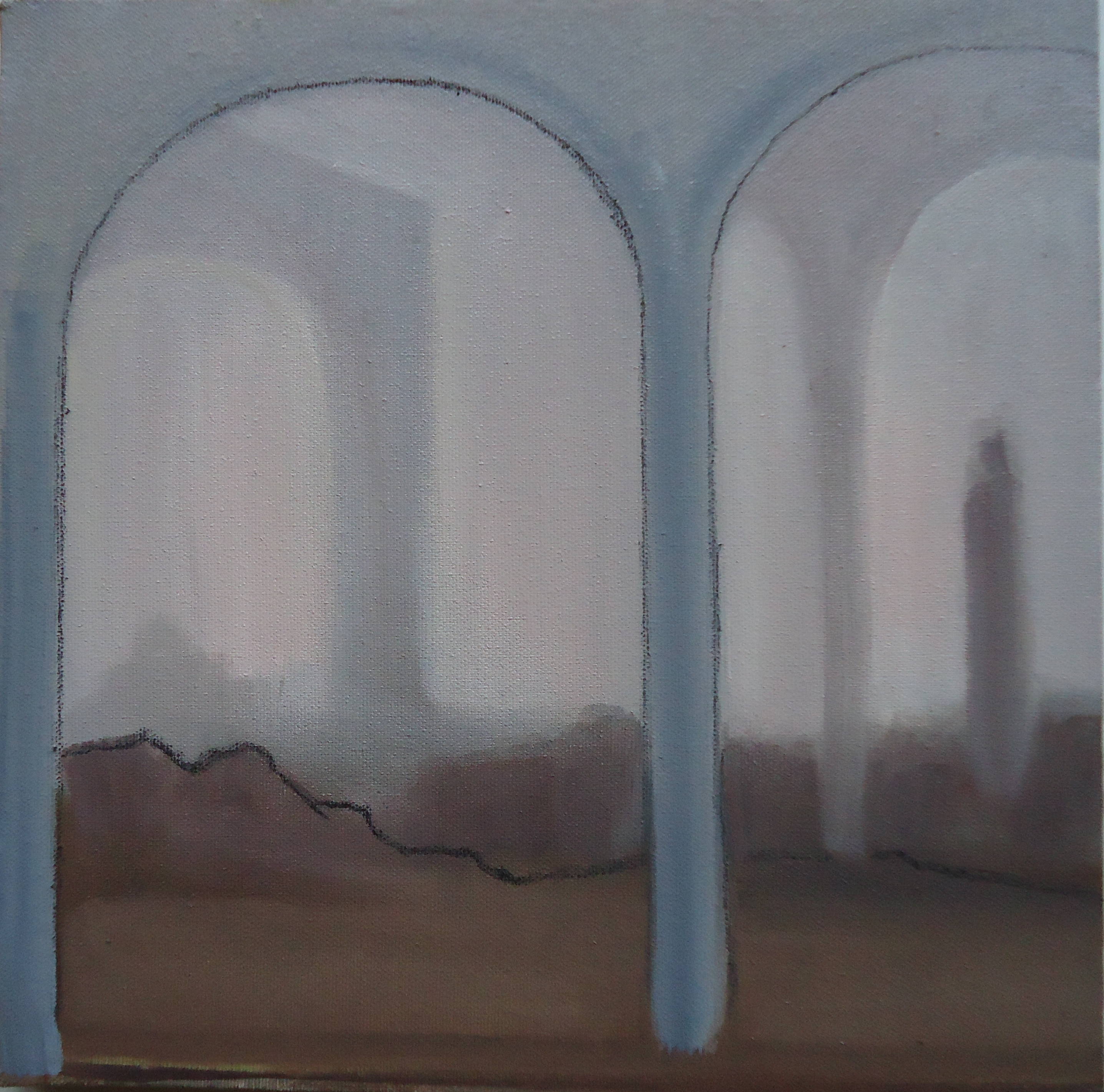 Here is a small study for a larger piece. I’m wanting to keep it lean, avoid accumulation of extraneous detail and focus on atmosphere, light and a general feeling of spaciousness. This one seems to suggest loss.
Shadowy forms step forward from the mists with a single swipe of the paint rag. They appear in my dreams silhouetted against ancient fires, as if to demand I attend to their their melancholy plight wandering the in-between.
The memory practice is working. I went from recalling no dreams at all, to writing 5 pages this morning. These seem to have associations with the art project, “real” life, and offer encounters with Asiatic shamans in crazy hats who get on my case for some vague act of forgetfulness.
The intent to work with the spontaneous flow of dream imagery-the attempt to bring unconscious content into the light of day-involves a confrontation with subject/object paradox. Who is doing the observing? Who is observed? Looking inward brings up thorny issues about perception and reality that artists have been struggling with since Cezanne, and which mystics have explored for centuries.
How needing of compassion are the ignorant and the deluded, bound in this confining dungeon of egotistical attachment and the subject-object dichotomy…
The Tibetan Book of the Dead

Blake saw his brethren bound in this dungeon, and sang of fallen Albion held in thrall to the satanic, scientific-materialism that set man apart from nature, charity and the Heaven within himself.

Particulars-an artwork in progress
 William Blake stressed the “particulars,” how the details of daily life are continuous with cosmic totality. In Blake’s expansive vision the two perspectives interpenetrate and this all-inclusive vision animates and unifies his art in way that is unique in the history of art. In Jerusalem, the local village scene merges with vast space and opens on the mythic city:
Pancrass & Kentish-town repose
Among her golden pillars high,
Among her golden arches which
Shine upon the starry sky.
So my Black Friday visit to a Port Angeles fabric store acquires new significance. This particular Clallam anchorage is where the angels weave this narrative into the fabric of myth. Or maybe it was just a place where I could score a good deal on the canvas I need for my February art show.
I am imagining some large canvases painted in the muted, earthen tones of the gray, English landscape overlaid with an architecture of arches and pillars of insubstantial, golden light.

At the same time I continue the memory practice, learning Jerusalem “by heart” and using the mnemonic imagery of the memory stations as a starting point. These stations continue to evolve as I memorize the text and work the paintings. In this way I hope to in infuse the paintings with some of Blake’s generous, all-encompassing spirit.
This process may sound cumbersome, but it works well in maintaining a broad perspective and helps avoid a myopic fixation on details. This fixation is far from the non-dualistic attention to particulars Blake writes of. I hope my art may be as expansive and generous as his.
If you look closely at the background, some ethereal light forms emerge; vague figures who begin to emerge from beyond a misty veil. Or maybe the turpentine was just going to my head.

The Memory Theatre-an artwork in progress
A dream: I am building a stretcher (wood frame to stretch canvas over for painting) for my February art show. After I nail it together, I see that I’ve used 2×4’s which are too heavy and ungainly for the size of the painting. The center brace is too short and part of it is made of ground contact, pressure treated wood, a toxic and inappropriate material for a stretcher.
Now this is where it gets interesting. A dream about my upcoming art show. This project is continuous with the practice I undertook to memorize dreams in order to gain a broader perspective on the work. This is a view informed by the heart as well as mind. A kind of feedback loop is created: The intention to bring the dream to the waking world coincides with an awareness of waking life (art show) within the dream state. This opens a dialogue between the flow of unconscious imagery and conscious intent. It gives valuable clues on how to proceed.
I’m not sure what the symbols of treated 2×4’s and toxic ground contact, pressure treated wood tells me. But I have an intuition that it relates to right proportion, appropriate measure-ways and means.
I’ve long intuited that lucid dreaming abides by the golden mean proportion. It is not just control of dreams, but a way to avoid getting lost in allurements, terrors and distractions; mesmerized by the phantasms that present themselves as real. It depends on the right proportion between waking and dream. These contraries are held in a dynamic tension and generate a third element-a state which transcends contradiction. The point of all this is to gain clear awareness of profound emptiness. This is the truth of the most fundamental Buddhist koan:
Form is emptiness, emptiness is form. – Heart Sutra
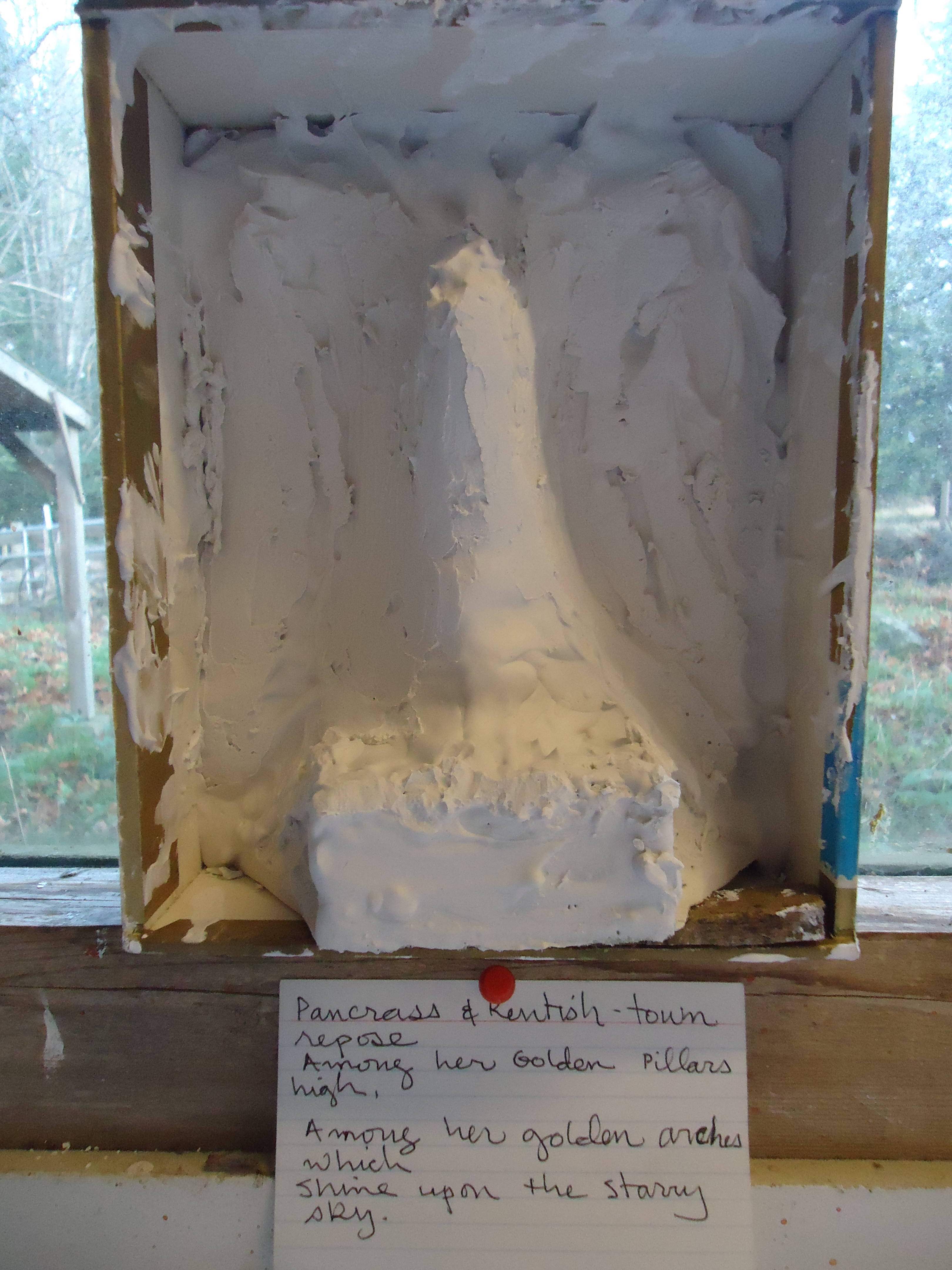
I began sculpting memory stations with plaster to use as a basis for drawings- studies for a series of large paintings.
This one has taken a vaguely angelic form.
The challenge is to paint these ethereal beings without sappy cliché.
Without contraries there is no Progression. -William Blake

The Memory Theatre-a Reprieve

In his wonderful book, Little Book of Dreams, Robert Bosnak says that the best way to enhance dream recollection is the classic memory practice. This is important for many reasons. Here’s one:
In a dream I was given a slip of paper on which was written the word HEARTNET. The image was very clear and when I told Lily of the dream the next day, she suggested I google it. It turned out to be a heart health website.
Taking this as a sign, I had a checkup and found my cholesterol levels dangerously high. I became resolved to clean up my act and extend my life. It gave me a reprieve.
Tibetan Buddhist teachers say that the ability to consciously enter the dream state-lucid dreaming-is a good way to prepare for the bardo after death.
As I am not ready to face the bardo’s dangerous pathways, attending to the dream message allowed me more time to cultivate the qualities of compassion and wisdom that help to ease the transition. This, it is said, increases the possibility of a favorable rebirth.

I was thinking of Blake’s vision of Jerusalem as a Golden city of peace, love and harmony that, at some timeless time, was “on England’s pleasant pastures seen.” Did such a city exist in prehistory?
Then I read this in Eva Wong’s commentary in the Hui-Ming Ching (Cultivating the Energy of life:)
When we are in our mother’s womb, we were filled with the primordial energy of the Tao. In the natal state, original nature and the energy of life are united.
At birth we come into contact with the world. When air is inhaled through the nostrils, the primordial breath is contaminated and the connection with the Tao is broken. Original nature and life energy separate, the former moving to the heart and the latter moving to the kidneys.
 A View from the Wheelhouse