I finally got the art show up. I came down with a nasty cold as the time for hanging approached, and all the work of logistics, promotion, and “finishing” the paintings became a real grind.
But we had a nice opening last night. Many friends came showing their appreciation and support. Thanks to all.
In my next post I hope to give a more complete account about the experience of creating these works over the past 3 months.
Lets just say for now that I came to realize I bit off far more than I could chew, though I did this deliberately–as a sort of audacious challenge to myself.
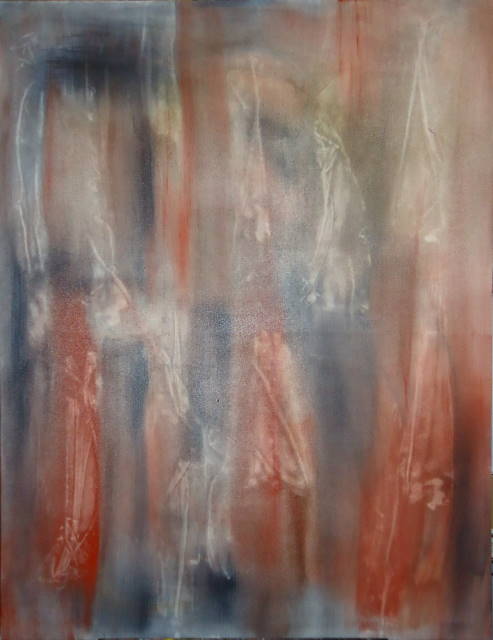
Jerusalem-painting by Craig Spencer
There always looms the possibility that the painting was better left at an earlier stage, or that the work may not bear the test of time. At times I wondered if a painting might be veering perilously close to maudlin tripe, or the whole concept totally misguided.
But I really don’t worry about it. It’s best to have the courage to make a clear statement. I think age and experience has taught me to trust the process and to carry through despite such doubts about relevance, skill level or (in this case) my understanding of Blake’s gorgeously bombastic, prophetic poem.
These blog posts have been an integral part of this exhibit’s creation. Thanks to all who have been following and commenting.
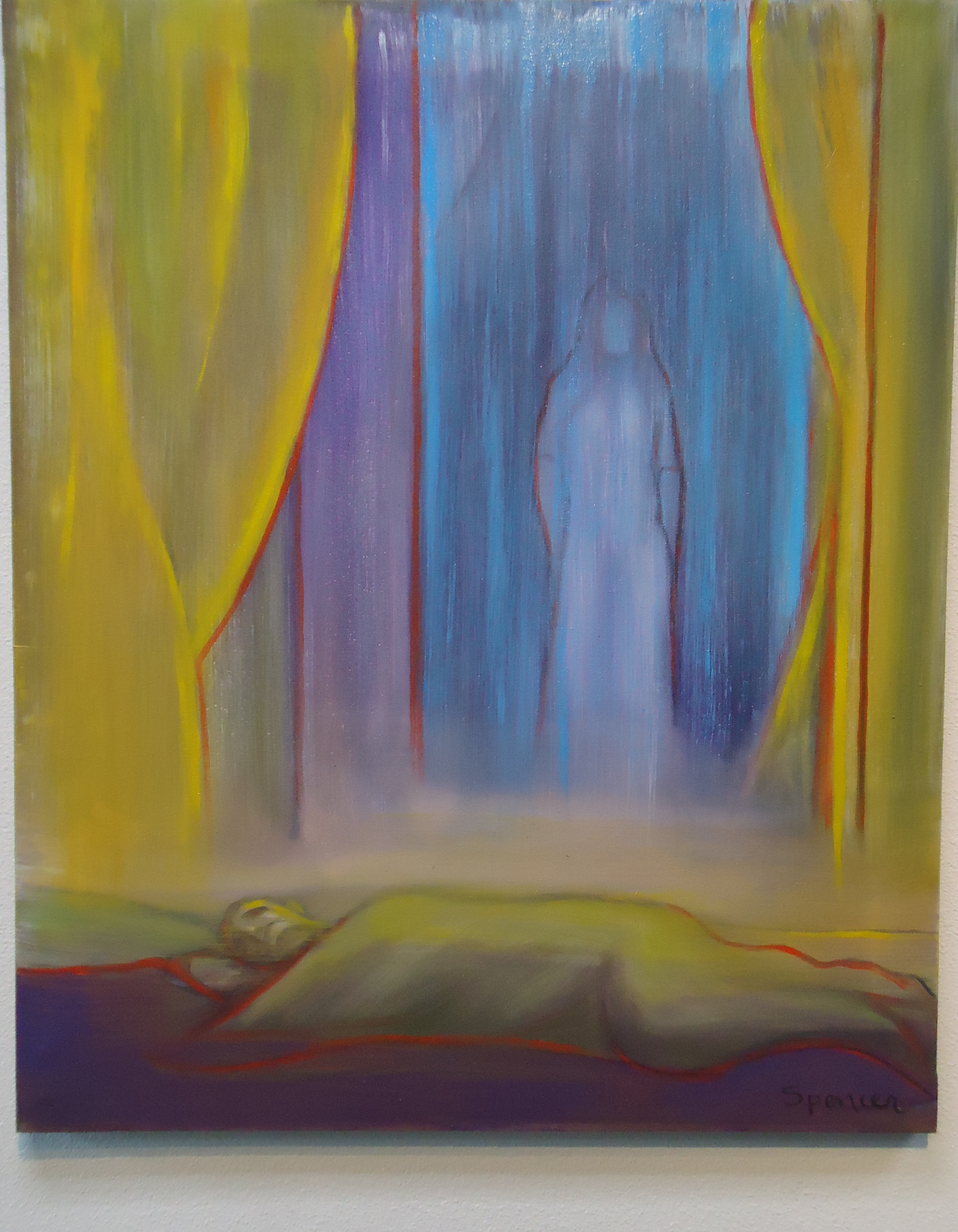
Vala, Temple 3, Building Golgonooza-paintings by Craig SpencerAlbion Asleep-painting by Craig Spencer
My art show goes up in a week and now the most difficult part has arrived–the Artist’s Statement. But in this odious task, which I’ve always dreaded, I may have a small advantage. I’ve actually been working on it since I began this series, some three months ago. I only need glean the relevant bits from my blog posts and tidy them up. Right.
Blake saw Albion (universal Man) held in deadly sleep, in thrall to satanic, scientific-materialism that separated him from Jerusalem, his emanation, and the Heaven within himself.
The Gnostics taught that soul is imprisoned in matter; that Gnostic experience is a return to Divinity through overcoming the demonic forces (Archons) who hold humanity in bondage to dense spheres of matter. These teachings informed much of Blake’s work.
His work also reflects the Neoplatonic doctrine that acknowledges the primacy of the spiritual world and sees nature as the “vegetable glass” reflecting spiritual truths. Post-Cartesian science that recognizes only natural phenomenon perceived by the senses as sole measure of truth is the fundamental error which precipitated Jerusalem’s’s fall.
diagram by Foster Damon
Jerusalem tells of Los’s struggles with Urizen (reasoning power) to re-establish harmony among the four Zoas (universal, four-fold man,) and the building of Golganooza, Los’s great city of art and science.
…and fourfold the great City of Golganooza: fourfold to the north ,
And toward the south fourfold & fourfold toward the east & west,
Each within the other toward the four points: that toward
Eden, and that toward the World of Generation.
The Zoa’s correspond with the four Buddha families who inhabit the vast edifice of spiritual architecture in the Tibetan Book ofthe Dead.
…at the northern gate of one’s skull is Vajra, Dark green, snake headed, and holding a bell.
O you, the four female gatekeepers…
Perform the rites which obstruct the doors leading to rebirth from the intermediate state!
Like the Buddhist masters, Blake saw that salvation lay in the recognition that God, Angels and Demons reside in the mind. Christ’s resurrection was not a single event of time, unique to a single individual, but as expression of the universal Christ-spirit within. This interiorization of the mysteries is part of the evolution of consciousness and the realization of the Divine Human. For Blake, Jesus is imagination, and lamented “Abstract thought warring against imagination.” The tragic effects of Urizen’s reign were evident in the squalor and slavery of the London cityscape where was enacted the cosmic drama of spiritual redemption.
Los is the fiery, artistic genius whose task is to restore Jerusalem and re-establish harmony among conflicting aspects of Albion; an inner kingdom that has been usurped by the soul-denying power of Urizen. The soul divided into warring entities is a sign that Albion has fallen into a sleep that closes the doors of spiritual perception. Caretaker of archetypal images, and fluent in the language of correspondences, Los forges celestial links in his fiery furnace, and illuminates the inner, demonic specters that would banish Jerusalem forever.
My commitment to chronicle the art making process requires I relate all, from the most difficult stretches, to my modest successes. The muse is fickle and I am negotiating a dry spell. Here is a belated post to let you know I’m still hanging in there
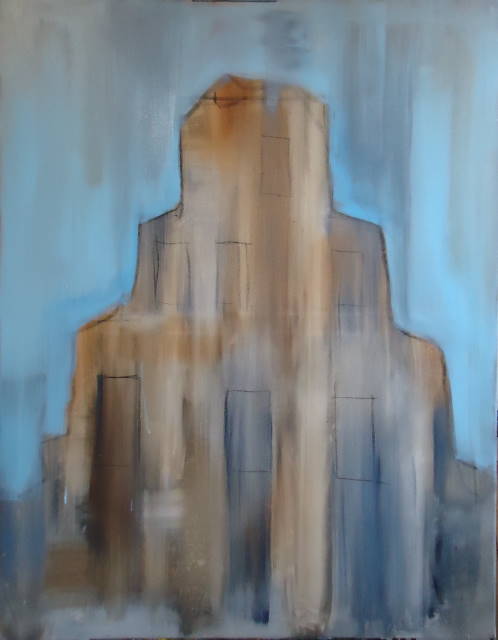
So far, only one image came through on the lucid dream channel. Here it is.
I had been working the raw umber, paynes gray and burnt sienna into a web of interwoven strokes. That night, in a dream, I saw an ancient ziggurat carved in natural sandstone and honey-combed with caves. As I looked at its golden, weathered form rising into the vivid, blue sky, I realized it was a dream. It was a fleeting glimpse of profound emptiness–the ultimate ground of reality. In that insubstantial image I apprehended the Heart Sutra’s most essential teaching: Form is Emptiness/Emptiness is no other than Form.
I don’t claim this as a great accomplishment, but I do like that the process of painting inspired dream imagery and the dream, in turn, redirected the painting.
The image was also inspired by a program about early Christianity I’d seen that night. The film showed the mountain, hermit caves where the Nag Hamadi collection of early Gnostic writings were found.
The Gnostics taught that soul is imprisoned in matter; that Gnostic experience is a return to the pure light of Divinity through overcoming demonic forces (Archons) whose job it is to hold humanity in bondage to the dense spheres of matter.
While I may not share this belief in the malign aspect of the natural world, I do believe these teachings form a part of our spiritual heritage. They have left psychic imprints upon the collective unconscious. It is not so much a matter of belief as that of experience–Gnossis.
These imprints permeate William Blake’s work. Benjamin Walker talks about the fall of Sophia (Wisdom) in his book, Gnosticism:
Various reasons are put forward for the fall of Sophia from the upper spheres and her plunge into the world of matter…(in one version) the tragedy occurred when she mistook the false light she saw below for the ‘light of lights’ for which she aspired…
In some texts she represents…the stricken city of Jerusalem.
The paintings have each taken on planetary aspects and this one seems to be heading toward Mars. I’ve been trying to preserve a loose, fluid handling, but it always becomes a struggle.
It’s like meditation. When sitting, my mind wanders into monkey territory and I need to refocus-come back to the breath, mantra or visualization. And this is Okay. I’ve heard it said that meditation was about shedding light into the darker corners of confusion and afflictive emotions; confronting obstacles, not avoiding them. Something similar is being played out on canvas.
Ghostly figures emerge from pools of raw umber, terra rosa and paynes gray as if they wanted to give me tips on technique. Maybe they want to tell me it’s all good-just chill and take up a new canvas when things get too thick.
And since these posts are a big part of this process, I’ve decided they should also be more spontaneous-straight from the heart. Just whip it out without worrying it too much.
At the same time, I’ve continued to grapple with Jerusalem. I read of Los’s (poetic genius) struggles with Urizen (reasoning power) to re-establish harmony among the 4 Zoas (similar to Jung’s 4 functions) in the imaginative project of building Jerusalem. There are are verses that, while memorizing them, beguile me with their stunning imagery and painterly use of upper case letters. Some have all the pithy weight of a zen koan.
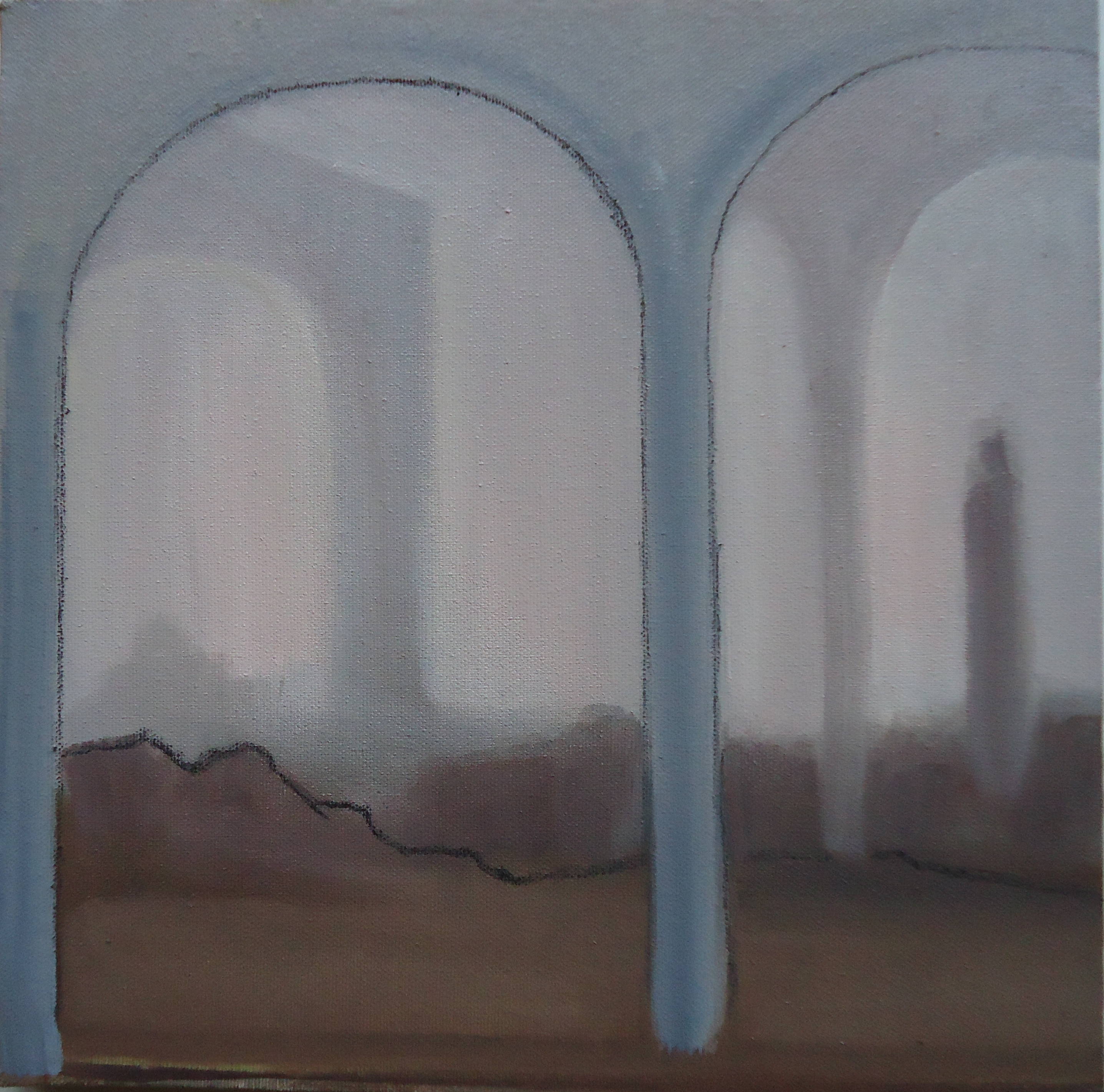
Here is a small study for a larger piece. I’m wanting to keep it lean, avoid accumulation of extraneous detail and focus on atmosphere, light and a general feeling of spaciousness. This one seems to suggest loss.
Shadowy forms step forward from the mists with a single swipe of the paint rag. They appear in my dreams silhouetted against ancient fires, as if to demand I attend to their their melancholy plight wandering the in-between.
The memory practice is working. I went from recalling no dreams at all, to writing 5 pages this morning. These seem to have associations with the art project, “real” life, and offer encounters with Asiatic shamans in crazy hats who get on my case for some vague act of forgetfulness.
The intent to work with the spontaneous flow of dream imagery-the attempt to bring unconscious content into the light of day-involves a confrontation with subject/object paradox. Who is doing the observing? Who is observed? Looking inward brings up thorny issues about perception and reality that artists have been struggling with since Cezanne, and which mystics have explored for centuries.
How needing of compassion are the ignorant and the deluded, bound in this confining dungeon of egotistical attachment and the subject-object dichotomy…
The Tibetan Book of the Dead
Blake saw his brethren bound in this dungeon, and sang of fallen Albion held in thrall to the satanic, scientific-materialism that set man apart from nature, charity and the Heaven within himself.
George Lakoff has retired as Distinguished Professor of Cognitive Science and Linguistics at the University of California at Berkeley. His newest book "The Neural Mind" is now available.



 I finally got the art show up. I came down with a nasty cold as the time for hanging approached, and all the work of logistics, promotion, and “finishing” the paintings became a real grind.







 A View from the Wheelhouse