
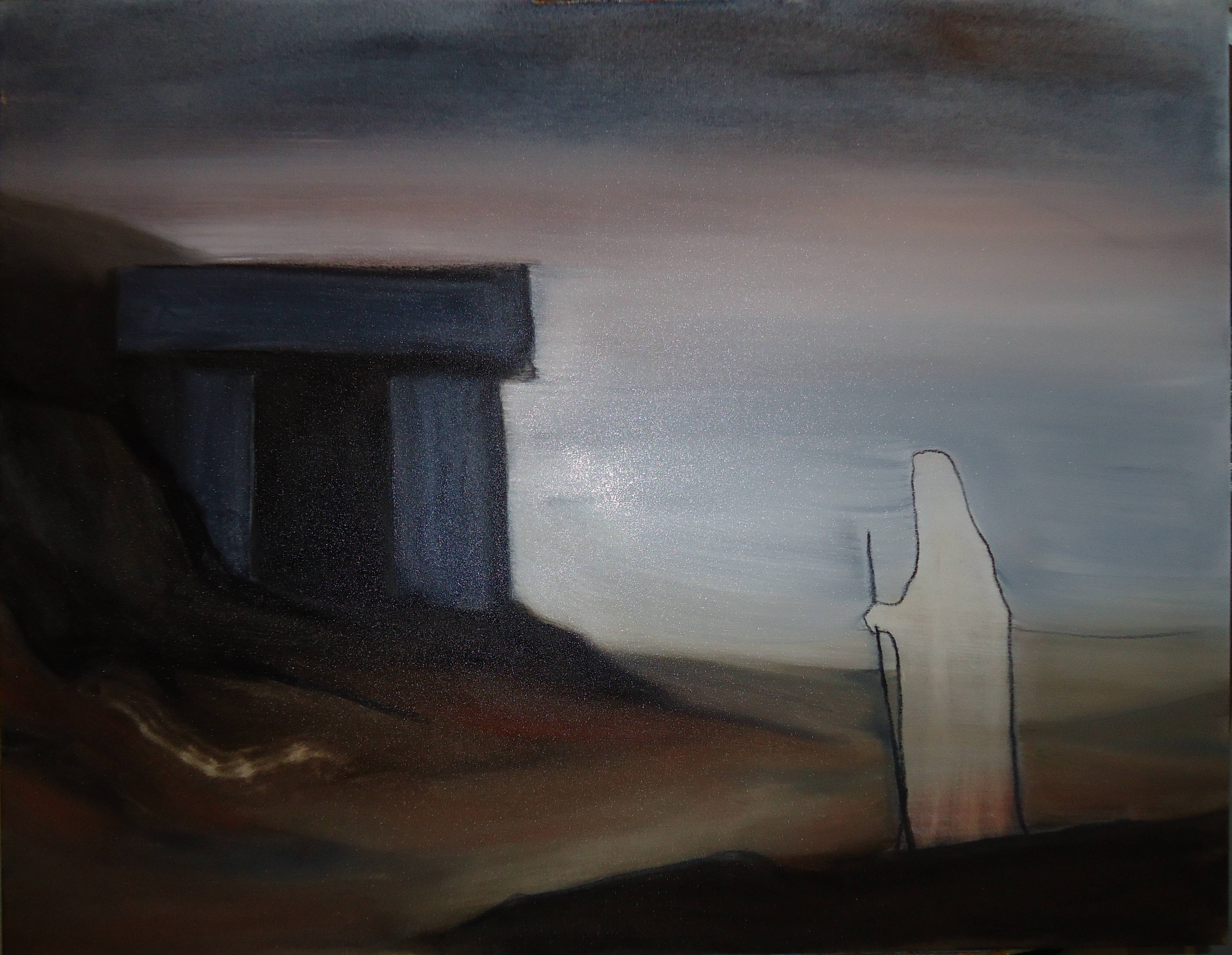
I recently dreamed that I went back to my old studio in Seattle. Its proximity to the neighboring building cut off most of the natural light. The new tenant had hung a mirror on the neighboring wall that reflected sunlight into the studio, creating a greater sense of spaciousness.
This dream seems to reflect the dilemma I face with each new artwork.
Every painting presents an opportunity to break into new territory, beyond habitual modes, toward a more fully realized statement of my particular vision. Each stark white field stands before me like a challenge to move beyond easy solutions; invites the spontaneous gesture that preserves the initial inspiration. It is the free spirit exemplified by Blake’s Songs of Innocence. But the luminous energy of spontaneous creativity is immediately followed by the discriminating mind as shadow accompanies light. The state of Experience is Blake’s necessary counterpart to that of Innocence.

Often, my own “strengths” are an obstacle. I want my work to break boundaries, open spaces where imagination has room to expand.
I begin with laying out broad swathes of muted color to set the stage-to invite images into the memory stations, or conjure a player from behind the Gothic pillars of a Blakean stage-set.
A shift in perspective is also necessary to understand Blake.
Blake recognized that God and Angels reside in the mind. Unlike Christian dogmatists, he saw Christ’s resurrection not as a single event of historical time unique to a single individual, but as expression of the universal Christ-spirit within “…Heathen, Turk or Jew.” This interiorization of the mysteries is a step in the evolution of consciousness, a withdrawing of childish projections, and the realization of the Divine Human.
Materialist science sees the phenomenal world perceived by the 5 senses as the only measure of reality. Blake’s work reflects the Neoplatonic doctrine that acknowledges the primacy of the spiritual world and sees nature as the “vegetable glass” reflecting spiritual truths. Post-Cartesian science that recognizes only natural phenomenon as sole measure of truth is the fundamental error which precipitated Jerusalem’s’s fall. Los, embodiment of the poetic genius and agent in the soul’s recovery, takes a walk through London streets:
(Los)…saw every Minute Particular of Albion degraded and murder’d
But saw not by whom; they were hidden in the minute particulars
Of which they possess’d themselves: and there they take up
The articulations of a man’s soul, and laughing throw it down
Into the frame, then knock it out upon the plank, & souls are bak’d
In bricks to build the pyramids of Heber & Terah.
-from Jerusalem


 A View from the Wheelhouse