Posted in Uncategorized

Old Hand’s Indonesian Voyage–part 3

We piled in the skiff and I rowed toward a dilapidated pierhead while McWhirr continued his narration.
“My grandfather also told a darker tale. He said the streets of old Batavia were paved with sorrow, the walls built with the grief of mothers who toiled over an illusory harvest, it’s ramparts manned by desiccated souls who invested all their goods in the virtual fun-house of Mammon.“

We ascended the quay to the cobbled road.  McWhirr’s words had conjured a fantastic image of despair, though, in my green youth, I could scarce fathom the depths of his narration.
McWhirr hailed a bicak.  How this small guy was going to haul us and our seabags in the little tricycle was beyond me. His name was Rubio.  He was a grinning, eager pilot who pedaled like a fiend and navigated Jakarta like some Vasco de Gama of the alleyways.
Rubio brought us to the crumbling, neo-classical facade and we passed through the weathered teak door into the club.  While McWhirr ordered a couple pints I looked around.  A Strawberry Alarm clock tribute band blasted onstage.
Soon McWhirr came with the drinks and said: “Here’s to the Queen.”

I picked up a battered book lying on the table and read:
–And it came to pass that a great swarm of splog descended upon the land and the
soundcloud was darkened with idle slander and empty promises of sensual delights.  Worshippers of the true faith were subjected to the false blandishments of priests and the perfidious purveyors of illusory commerce.  And the once mighty creatives of the realm looked upon their followers and found naught of artistic merit and grew heavy in spirit, seeing therein ought but Jezebelian allurements by comely maids in unseemly attitudes of licentious repose–

“I’m glad I wore my sea-boots,” said McWhirr.
“Listen to this, Captain:”
–And lo, the verminous swarm of splog grew apace, and the goodly scions of the realm gnashed their teeth in anguish, for their earnest, artistic efforts were devoured by the black vultures of Satan. The fat herds of the righteous became but reeking carrion for the voracious appetites of the infidels–
“What fools would steal such windy bombast anyway?” asked McWhirr.
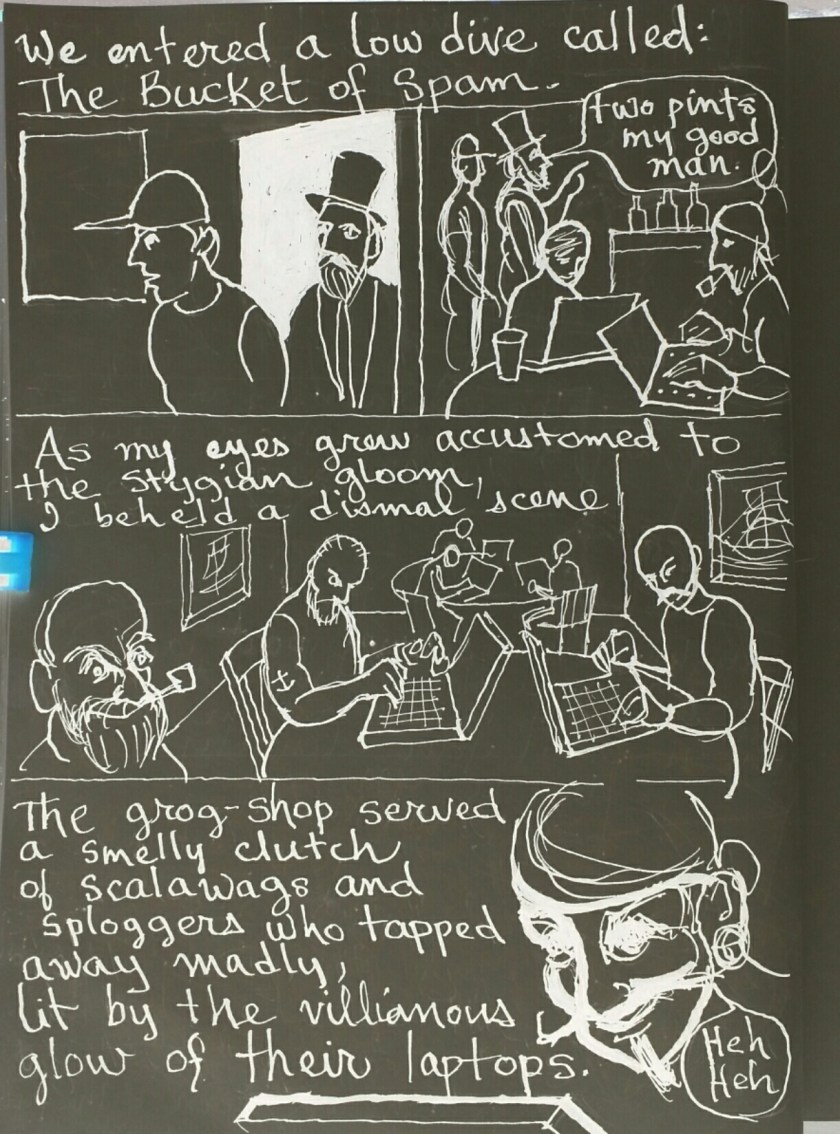
The joint appeared to serve a clientele of wharf-rats and scurvy rum-bots from dilapidated bum-boats.  One smelly clutch of waisters clicked madly at their laptops, their rummy faces aglow in the in the villainous blue light.
“Get this, a real Byron he thinks he is,” said a muscled hulk in a pink tutu.

“Ya really read that BS? “
Asked his mate in a voice  that sounded hollow and grating-like 50 fathoms of hause-fouled chain.
I’d heard of the splog pirates, but thought them mere paranoid tales by rummy tars around the fo’c’sle stove. And now here they were, as big as life, waylaying the earnest efforts of my myself and my literary colleagues like the nefarious ship wreckers luring unwary vessels with false
lights on the storm-wracked coast of Cornwall.

I continued reading:

-The once proud sites of the righteous became barren wastes of vacuous splogs and brazen images of bouncing titties–

“Maybe there is something to it after all,” says McWhirr.

“Aye, Captain. And look what we have now in this rank grog-shop of the internet-a foul lot of brazen cut-throats  who’d just as soon steal your traffic as say how-do-ye-do.”

One such galoot, a skanky brigand with a striped shirt and cutlass, approached the bar next to McWhirr with the slithery movement of a wolf eel saying:

“Eh mates, stand us a pint.”

I hastened to intervene.

“My good sir, may I introduce Saturnius Machirr?”

At this, the miscreant grew pale as an albino beluga and withdrew with an obsequeous bow.

“Most honored to meet you.”
Posted in Uncategorized

A Tale of Two Houses–a secret history of Port Madison

farnham house croppedfarnam house cropped
Farnham

The rains have let up. I scan Port Madison’s northeast shore through binoculars to see the Farnham house, built above the old mill-site, where much of Bainbridge Island’s forests were milled in the mid-19th century. The house looks the same as when Judge John Farnham leaned on his hoe under his prize apple trees.

farnham up close

He  first signed on the General Park Hill at the age of 12 and spent 3 years shipping cotton between South Carolina and Liverpool before trading in contraband silk between Shanghai and Hong Kong. He rounded the Horn in the rush of ’49 and headed north to Port Madison when  loggers, ship builders and land speculators were rapidly displacing the indigenous Suquamish people.  He commanded side-wheel steamers, worked as shipwright and, in an odd –if not downright ironic–turn of fortune, served as keeper of the Seattle Pest House.

old maan hose cropped
Old Man House

This was when the Old Man House still stood; where creation was annually sung into being in the Winter Dances. It was the lofty, cedar temenos of the Suquamish tribe that was demolished by Albion’s brass-plated cannon of imperious might in 1870.

This is was the home of Princess Angeline.

After reading Jerusalem, I’ve come to see Blake’s Gothic, sweeping poetry entwined with the shadowy firs of Port Madison.  A rummy wastrel turned Urizenic guardian of self-righteous law, Farnham  became the very image of man’s fallen spiritual state, laboring eternally in the Satanic mills, separated from his Sophianic emanation and closed to the Divine Vision.

angeline cropped
Princess Angeline

And I hear fair Angeline as the banished Jerusalem, still weeping over the bay for her lost and tender children.

Farnham’s end was tragic. He had begun exhibiting signs of odd behavior and was forcibly dismissed from office. He held out against the deputy sheriffs in the Port Madison courthouse (then the County seat) with a shot-gun for 3 days before being led away quietly–a man forsaken by his adamant God of Reason.

Ballasted with river rock, he boarded the Seattle ferry, planning to jump into the deep soundings off Elliot Bay. But the emergency crew fished him out and he died shortly after.

Urizen

I honor John Farnham, respect his adventuresome spirit and outrageous character; whose salty yarn and prize apples are the true golden relics of another age.

Posted in Paintings in Progress

Raven Visitation 2

DSC02373raven window 2

Carrying on with the Raven Visitation. As Raven is the messenger who dwells between worlds, the stained glass window motif fits the theme. It frames the shifty threshold where spirit travels between waking and dream.

Stained-glass demands a faithfulness to process which brings you back, again and again, to the logical form of it’s making. It is fitting that the material for scribing of boundaries in stained-glass windows is Saturn’s element, lead.

It is also fitting that the base material of the painter is charcoal, end product of the calcification process in Alchemy. Composition is a fiery process where all superfluous passages are burnt away, leaving only the original inspiration, the point of it all. It is a reminder of the point of all this shifting between worlds, and the spirit I need to maintain through the fiery calcification process: that my heart’s work may benefit all beings. It is Raven’s wake-up call.

Posted in Paintings in Progress

Our Lady of the Kedge

vickers painting may 23 2013

There are infinite possibilities in art. When faced with an empty canvas an artist can be stymied by so many alternatives. It requires a narrowing of focus to hone in on intention, that particular thing you are called upon to express.

One needs set the right environment, speak prayers of supplication to the muse, and open to what nature has to reveal in the exuberant flow of her endless manifestations.

The challenge is to maintain balance, and walk the fine line between conscious intent and receptivity to what arises spontaneously when paint hits canvas and colors bleed in confounding ways.

I take a break from the mental gyrations of painting to work in the garden.DSC02047

Thatcher Farm is big, with more rows of fertile earth than I can plant. I take an 8 by 16′ bed and divide it according to the square foot gardening technique. I lay it out with sticks and line, and plant seeds so many per square depending on the plant’s requirement for space. I impose an ordered framework, prepare the ground and trust that Mother Gaia can take it from there.

It’s like the layout for my next painting. But here the grid is based on the mystic proportion, the Golden Mean.

It is a major precept of spiritual and artistic disciplines to work like nature. The ancients discovered that the Golden mean is the proportion that comes closest to the original unity from which the diversity of life forms arose. It is this unity to which, in spiritual practice, we aspire to return. The proportion is expressed in plants, shells and seasonal cycles.

I lay out a grid of charcoal lines and, with color studies, narrow the colors to a triad of blue/green, red/violet and yellow/orange.

vickers painting 3

The sculpture on the Vickers memorial abides by the golden proportion, and its mystic rule sets the measure for creative expansion into the space around her. She is a portion of that spaciousness which is the ultimate nature of reality and she bestows it generously upon the graves of Port Madison’s founders lying at her stone feet.  Like a beacon, she radiates light far over the bay.

I recall what my Eastern European sculpture teacher told me: sculpture is, ultimately, about light and space. He talked about how Michelangelo distorted David’s head so it would catch light and project it upward. Maybe it had to do with chakra’s. But I did learn from him that the ultimate end of the sculptor’s work is emptiness.

It is the quality of spaciousness and light she projects that is the theme of my painting, and her expansive energy inspires a harmonious distribution of color and form on the canvas. For, in the end, it comes down to this: to call upon the muse of art (and gardening) to favor us with her bounty and use the brute material of the tangible world to evoke the intangible spirit.

Posted in Saturnius McWhirr stories

The McWhirr stories-An Afterword?

Cormorants are huddled like a conclave of robed mystics brooding over lost fish. The wind blows from all directions in Port Madison.

I write windy dialogue that transpires between two contrary characters.  I suppose the I of the story refers to myself, but even this first-person identity gets pretty tenuous at times.  I am obtuse foil to McWhirr’s exacting command, and he is confounded by my poetic flights.  This tension, this ever tipping dynamic, propels the leaky vessel of my prose.

In the voyage of this yarn to it’s “conclusion”, fact and fiction are interwoven to create a tapestry of associative episodes in order to express some ineffable truth about man’s impulse toward adventure.

But to what degree can I actually claim these adventures mine? Where was the line crossed between inspiration and plagiarism? All my powers of expression are called upon to render a fictional account of  vaguely recalled events in the transient world of sensations and ideas.

craig at helm 014
Me sneezing

I’ve come close to foundering in a fog of  fantasy, relevant only to myself or to those souls fortunate enough (or unlucky enough) to be conversant with sailing lore, and experienced in the sea’s fickle ways.

Where has McWhirr gone? While his vanishing act seems a natural outcome of the narrative flow, it has left me without bearings-without a meaningful waypoint.  He’s left me becalmed at slack water, transfixed by sunlight on the Strait of Juan de Fuca, with only an obscure missive from Virgil’s heroic verse:  From me learn courage and patience, from others the meaning of fortune.  Then again, maybe this is all the bearing I need.

Though the dream of finding a copy of the Aeneid happened some 20 years ago, it’s true import remains enigmatic.  But I feel it has to do with carrying on a lineage, the bearing of the household gods to establish a new homeland or  mode of awareness.  It’s also about a mutual need, a pact made with the dead to honor them.  My dad’s ghost comes and goes in the story, and recalls me to some forgotten bond.  He says I should heed McWhirr.

The View from the Wheelhouse is a fluid one, and successful navigation depends on an ability to tolerate a constantly shifting perspective. The conclusion of this tale is as elusive as a Micronesian landfall.

So I trust this isn’t the last we’ve heard from McWhirr. The wily old coot’s vanishing act may be prologue to his reinstatement on a more believable level of fictional existence.

Wars are started by mistaking the thing in itself for the metaphor, and the inability to see through the symbol, as through a veil, to the symbolized. Scientists have recently discovered that the north wind doesn’t really have a beard and puffy cheeks. We’ve evolved beyond such nonsense.  But this knowledge is of little use to the sailor driven on a rocky lee shore by a fierce northerly gale.  For myself and everyone, I pray to the household gods.

Posted in Saturnius McWhirr stories

Ahab meets Aeneas

File:Moby dick434.jpg

The sound of waves whooshed over the sandlot playground where, high overhead on the screen,  elongated tars sang from the Pequod’s rigging. Dad had piled the crew into the wagon to see the awesome spectacle of Moby Dick unfold on a 50’s drive-in movie screen.  Gaunt against the dusky tropical light, Ahab glowered over the taffrail, the very image of the leaden god that circumscribes our meager efforts on earth.  Is that when I first heard the  lydian call of the Siren’s sea?

“Ready about! We’ll never make our offing if you don’t wake up!”

McWhirr stands on the foredeck, grasping a weather shroud against the roll.

“ Ready about!”

The wind freshens, and Old Hand pounds into seas steepened by the brute contention of wind and tide, hell-bent on clearing the boulders awash off Skiff Point.

Why must we hurl headlong into the tide-race at Neptune’s mercy, when we might be lounging, beer poised, before the latest remake of the same old sea story, remote from the possability of drowning? At the question, the mind can only wander, and flow with the kelp’s sinuous curves into deeper soundings past the headland to the west…oriens

Dad, from his wheelchair on the  Laguna Beach hills, held lookout for whale-spouts on the gold-burnished horizon.  A watch he may yet hold, in his heart. His stout heart, relic of the an ancient clan, has either been occulted into the rarefied vaults of the holy ones or lost in a cluttered closet on Dawson Street.

Then, in a dream, I found a a copy of the Aeneid among carved wooden heads on a laural-shaded altar. A sign? A waypoint that marks the passage of another life?

“We are becalmed, mate.”studio etc 010

McWhirr’s foghorn bass, seems far away.

The boom swings overhead. A clatter of gear from below rouses me in time to see an abomination of a container ship off Jefferson Head turn southeast around the Sierra Foxtrot buoy.  I turn the helm alee, past sodden fishermen bent over gunwales, looking bereft of hope for even an enemic cod.

“3 fathoms. Let go here, mister Spencer!”

“Aye sir!”

I drop anchor and Old Hand slowly turns toward the flood. The east turns blue/violet, then slate-gray above the  Cascade range.

“Have I ever told you that dream about Aeneas?”

“Who’s he when he’s at home?”

Let it go. That was another life. Another has signed on as swab this voyage. I was but a nipper who saw the hollow face of Saturn in the light projected on an L.A. drive-in movie screen. Just as now, he’s rough-hewn on the rocky peak yonder.  He limps his sluggish round while the laurel tree’s shadow circles over the household gods, ever counter to the golden sun.

Posted in Musings

Chop wood,carry on

Noreen
Classic tug, Noreen, built in 1906
DSC01975
Oh my back! Monk’s shop to left

Its been very lovely in Port Madison this Spring.  I’ve been regrouping after putting up the art show, taking stock and redirecting energy toward simpler things like chopping wood.  We are talking serious wood chopping.

The building is a workshop built by  Ed Monk.  I’ve been privileged to Moor Old Hand at this historic site, built by one of the Northwest’s finest boat designers.  I feel his presence in the stoutly built out- buildings and docks,  and gladdened by the thought that, he too, hauled gear and materials up and down the steep path to the water.  His can-do spirit inspires my humble efforts, and I take extra care in the stacking of split maple and cedar.  This stacking is itself, an art.

old hand interior January '12 007
Interior of Old Hand

At first, I was unimpressed by Monk’s designs.  But as I worked on his boat-houses I came to see his ubiquitous, wooden power cruisers in a new light.

I find rusty, bent shipwright tools near Monk’s shop, and use an old, weathered workbench he made.  After the long preparation for the exhibit, this physical connection with  common objects that surrounded his life has inspired in me an appreciation for the simple aesthetic of usefulness.

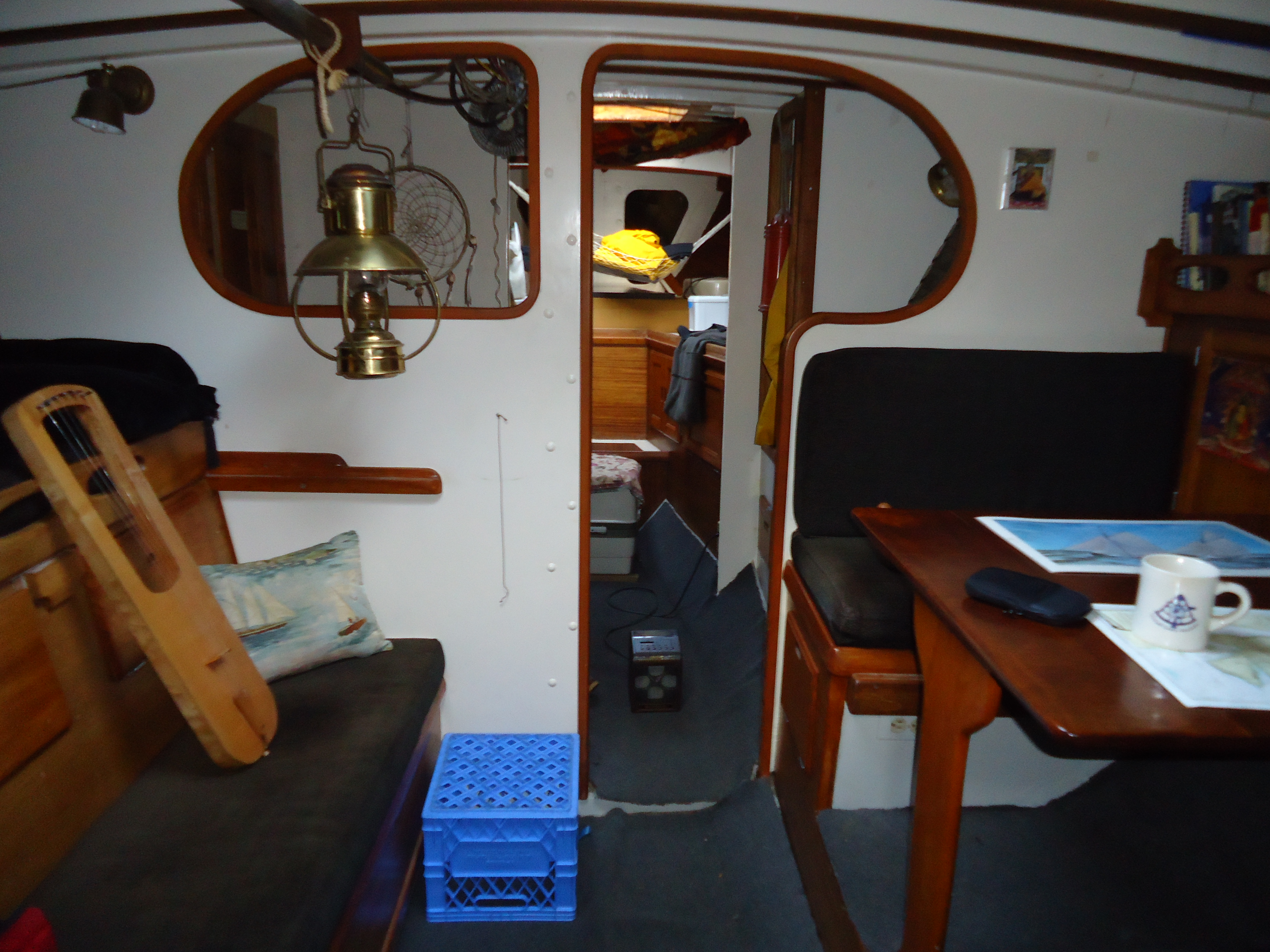
My boat, Old Hand is not a Monk, but was built of such stuff.  Her portly hull design is a scaled-down version of the hefty Norwegian lifeboats designed by Colin Archer.  After 10 years of owning her I’ve   greater appreciation for her ponderous lines and stout workmanshipShaw Island 2009 961.                                         So I am readying for another season of sailing.  I look at tide tables and plot course South toward Old Hand’s first port of call:  Gig Harbor.

So stay tuned for posts chronicling these adventures on the Salish Sea told in art, music and videos.

Posted in Paintings in Progress

An Artwork in Progress-The Post Deluvian Perspective

Image

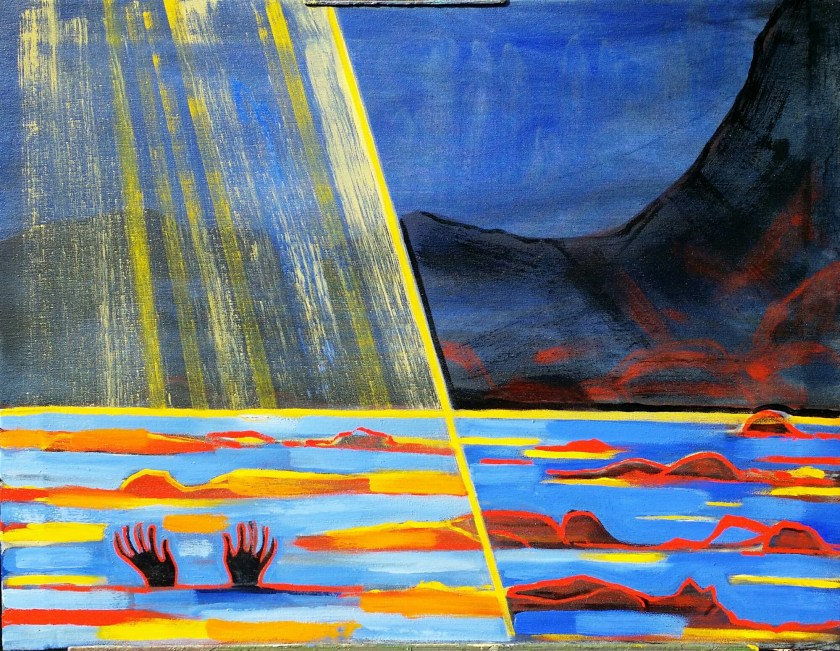
Here is another go at an old unresolved work.  As this blog is about the art process, I include it despite its cloying sappiness.  It was inspired by a story from the same manuscript in which Gawain’s story is told. It is called The Pearl.  By a stream, the poet falls asleep and dreams of a maid who leads him to wondrous visions of salvation.  Nearly 20 years ago I decided to memorize it and can recall some of it still.pearl image from jung

From the memory practice unfolded a long period of work with lucid dreams, of bringing conscious intent to bear on the spontaneous flow of dream imagery by doing walking meditation and mantra within the dream itself.  The dream mantra invokes the aid of compassionate deities as we wander alone through the hazardous pathways of the dream bardo.  According to Tibetan Buddhists, This prepares us for the bardo after death.

opposites 002
These illustrations are from Carl Jung’s Psychology and Alchemy

In the poet’s dream, the unconscious is pushed into conscious awareness  like oceanic tides flooding upriver.    This inundation has been long expressed in flood myths.  Its flow forms an imaginal landscape and the sudden release of its energy forces a breakthrough of vivid imagery.  This can form a tsunami if not channeled  through the creative process.  It demands integration with our logical mind.  It becomes necessary to  reconcile the irreconcilable, to balance  contrary states into a healthy, creative relationship.  This is the artistic process.

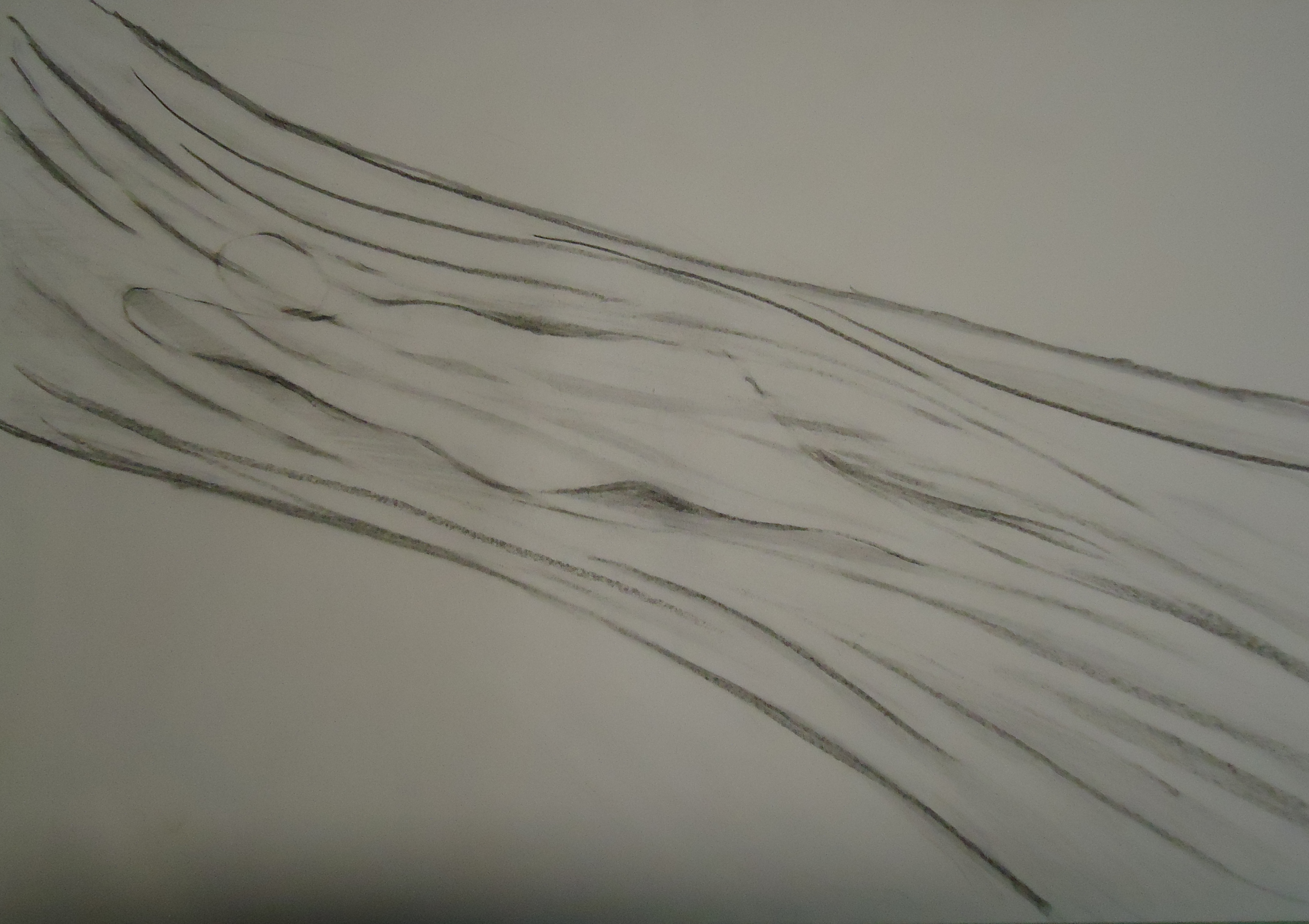
stream drawing 002
This drawing is for a new version.

This harmony is represented in Alchemical imagery as the mystic marriage.  Sufi’s have a phrase, ishq’ allah mabudlilah, which means something like: Love, lover and beloved are One.   This sacred phrase speaks of how we are continuous with all we behold, and that knowledge of this truth transforms us through  knowing it.  It is the Gnostic vision.  The subject/object dichotomy is illumined by a larger, more inclusive totality that embraces paradox.

The Golden Mean  expresses this truth and is the proportion closest to the original unity from which multiplicity arises.