Posted in Books I love

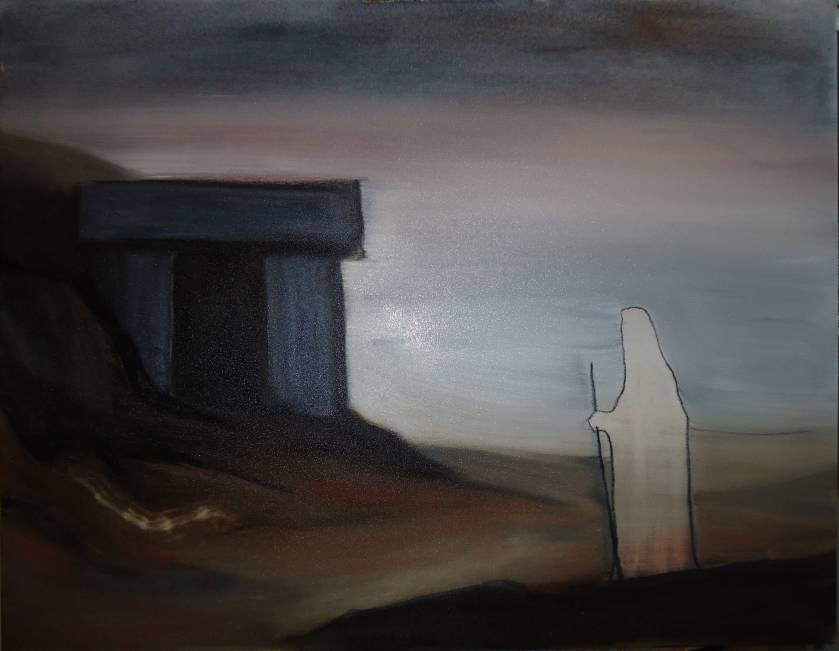
An account of the In-Between

How I came to follow the mystic path of Sufism demands an allusive prose that, I hope, remains faithful to the spirit of initiatory Gnosis at the heartfelt core of all faiths.

Some 20 years ago I come across the book, Alone with the Alone, creative imagination in the Sufism of Ibn Arabi by Henry Corbin.  At first, this convoluted explication of a particularly arcane branch of Islamic Sufism was way over my head.  Yet this book-and a powerful dream that was inspired by my first encounter with it-has since established a steady waypoint by which my spiritual life has been oriented.  It has opened vistas onto a world of  secret symbols whose meaning continue to elude, perplex and inspire me.

There is a realm, Corbin says, that lies between sense perception and the rarified sphere of pure spiritual essence.  This is where divine revelation takes place.  Those whose inner vision opens into the intermediate world (alam-al- mithal) are given the insight that liberates from the rigid strictures of dogma.  This perception–whose channel is the active imagination–requires we forsake the learned myopia of scientific materialists who accord “reality” only to those objects of sense, reason and measurable data.

In the dream, I was flying through black space, turning with outstretched arms and singing the Basmallah: Bism’allah er Rahman er Raheem [we begin in the name of the One who is all Mercy and Compassion.]  I’d learned this beautiful verse–which opens each sura of the Koran–some 20 years earlier at a gathering of the Dances of Universal Peace.  It had only returned to me again in this dream.
All was still dark when I felt myself land on solid, dream ground.  I heard a voice-over wryly proclaim: “it’s amazing what you can do with special effects” –I am heartened to know that spirits in the Sufi bardo maintain a sense of humor.
I was still turning and singing the Basmalah when I opened my eyes to find I was in the center of a large circle of men, women and children.  The men were bearded and wore turbans with long robes.  As it seemed presumptuous to occupy the center, I joined the others on the circumference of the circle.
A lively chant was taken up and I was led into a mad dance, side-steping 3 paces to thee right and shouting the word, “Kupt, Kupt, Kupt.”  We then took 3 steps toward the center singing: “Pisht, pisht, pisht.”  All were caught up in the ecstatic spirit of the dance.   It was an unaccompanied, non-melodic chant that filled the place with electric energy.  Children laughed as they were swept along in the frenzied tempo.  My dream body was being wrenched by my zealous neighbor whose left arm tightly held my neck.  Overcome, I retired outside of the circle and woke with a sudden “pop.”  My dream bubble had suddenly burst.
After long pondering the two, obscure words–those cyphers whose import I had only dimly glimpsed all those years ago–it is always to the original, immediate apprehension of their sense that I return.
In a Turkish\English dictionary I found the word Kupt, which means vault of Heaven, [shouting loud enough to bring down the heavens.]  The only definition for pisht I discovered was: an area marked on the ground for some sport or dance.
After long contemplation, I can only allude to the true sense of these words by images and feelings that relate to  our capacity for theopathy–to know God in a form that corresponds with our innermost being.  It is a timelss dance of ritual remembrance, an act of co-compassion between center and circumference, and a moving rite of worship that establishes a sympathetic bond between God and man.

I will return to this theme next post.  This brief account can hardly begin to plumb the depths of theophanic mystery.  I claim no special ability to navigate the intermediate world.  I believe all, if we really pay attention, have the ability for angelic perception; all have the capacity for revelatory experience.

Posted in Books I love, Paintings in Progress

Camillo’s Memory Theatre-an artwork in progress

Francis Yates, in The Art of Memory, tells how Giulio Camillo reinvented memory art in accordance with the renewed interest in Neoplatonism.  Camillo’s conception was also inspired  by the recently rediscovered teachings of Hermetic philosophy which his friend, Marcilio Ficino had introduced into Renaissance Italy with his translation of the Corpus Hermeticism. 

Ficino inspired Camillo in the use of astral talismans to draw down celestial influences into memory images and infuse them with magic power.  This imaginative reinvention of memory art was meant to train the mind to receive celestial influences and  unify esoteric knowledge by holding an inner image that mirrored the celestial harmony.

The Corpus Hermeticum taught the essential divinity of man and that all phenomena have their origin in the realm of ideas (archetypes.)  Camillo’s theatre enabled the “viewer” to recall these first causes, and the essential relationship between man (microcosm,) and the world (macrocosm.)

The first level of manifestation was mediated by the 7 Governors.  These astral beings made up the 7 measures by which the interior man descends into creation, acquires a body whose parts fall subject to the dominion of the zodiac, before he reascends through the heavenly spheres.  It is through the Hermetic religious experience he regains his innate divinity.  The 7 governors have associations with the known planets, 7 days of creation, angelic hierarchy and the lower sephiroth.

Yates says that the greatness of Renaissance art  was largely due to perfect proportion that was in accord with celestial harmony.  Seen in this light, the grace and majesty of Botticelli’s The Birth of Venus is a result of her status as talisman.

Posted in Books I love

Books I love-Journey to Ixtlan by Carlos Castaneda

You must give up your personal history.

This terse comment by Carlos Castaneda’s teacher Don Juan, in Journey to Ixtlan, contains the key to this spiritual travelogue in which he renounces his anthropological career to enter the sorcerer’s path.

The drawings done of Castaneda, partially erased by himself, speak more eloquently than revelations of his mendacity or alleged misogyny.

For the sorcerer, reality, or the world we know is only a description.

For novelists (it is absurd to argue which category this work belongs) the world is the reality in which they are immersed at the moment of creation.

My feelings were clear bodily sensations; they did not need words.

Yet he describes, at great length, terrifying encounters in  the intermediate realm. When Castaneda is shaken by these experiences, Don Juan commands him:

Write! Write or you’ll die!

It is an imperative Castaneda takes to heart.   Abandonment of personal history might contradict Don Juan’s statement about writing as survival but, rather than a bid for immortality, Castaneda’s account may be the final act of self erasure.  It resulted, ultimately, in irrelevance.  As he progressed to the rank of Nagual (teacher of sorcery), the fiction stylist was displaced by his persona-his double.  As he was subsumed into the anemic New-Age genre, he became infatuated by his own image (or its absence) and got mired in convoluted explications of sorcery.   Most fatal, he lost his sense of humor.

Unfortunately this seems to be the lot of many successful artists who find endless justification for their surrender to the allurements of the marketplace.

But Journey to Ixtlan is Castaneda in his prime. Take the hilarious scene where Don Juan and his sidekick Don Genaro-as antidote to Castaneda’s attachment to his worldly vehicle-make his car disappear:

“Where’s my car?”

Don Genaro began turning over small rocks and looking underneath them…

“Don Genaro is a very thorough man,” Don Juan said with a serious expression. “He’s as thorough and meticulous as you are. You said yourself that you never leave a stone unturned. He’s doing the same.”

Genaro, puffing and sweating, tries to lift a boulder.

 We could not budge the rock. Don Juan suggested we go to the house and find a thick piece of wood to use as a lever…

Resigned to this insanity, Castaneda lends a hand; with a tremendous effort, they lift the boulder.

 …Don Genaro examined the dirt underneath the rock with the most maddening patience and thoroughness.

“No. It isn’t here,” he announced.

Other passages are suffused with a beauty as stark and dramatic as the desert landscape through which they travel. In the chapter, Becoming a Hunter, the sophisticated anthropologist, Castaneda, admits to the reader his feelings of superiority over an Indian.  Reading his mind, Don Juan says:

“We are not equals.  I am a hunter and a warrior and you are a pimp.”

Don Juan then meets Castaneda’s angry protest at these harsh words with a masterful act of “not doing.”

…when it was pitch black around us he seemed to have merged into the blackness of the stones. His state of motionlessness was so total it was if he did not exist any longer.

It was midnight before I realized that he could and would stay motionless there in that wilderness, in those rocks, perhaps forever if he had to. His world of precise acts and feelings and decisions was indeed superior.

I quietly touched his arm and tears flooded me.

Castaneda has been maligned for having done his field-work exclusively in the UCLA library.  But, for me, this only makes his work more impressive.  No other writer so cannily expressed the manic spirit of the psychedelic era. I am forever astounded by the man who could transmute the dusty anthropological tomes of the UCLA library into supreme works of imagination.